

Choosing between an airport taxi and a shuttle bus feels straightforward until you’re standing at arrivals with heavy bags, a delayed flight, and no idea which option actually saves you money. Many travelers automatically assume shuttles are cheaper, but that assumption frequently leads to frustration, added travel time, and unexpected costs. Whether you’re flying into Dublin, Heathrow, Gatwick, Madrid Barajas, or Barcelona El Prat, the right choice depends on a set of very specific factors. This guide breaks them down clearly, with real prices, practical scenarios, and the kind of direct advice that makes your next airport transfer genuinely stress-free.
Table of Contents
- How airport taxis and shuttles work
- Price comparison: taxis vs shuttles in the UK, Ireland, and Spain
- Comparing convenience: door-to-door, speed, and real-life scenarios
- When a shuttle makes sense (and when it doesn’t)
- Our take: what airport taxi vs shuttle guides rarely tell you
- Discover airport transfers tailored to your travel style
- Frequently asked questions
Key Takeaways
| Point | Details |
|---|---|
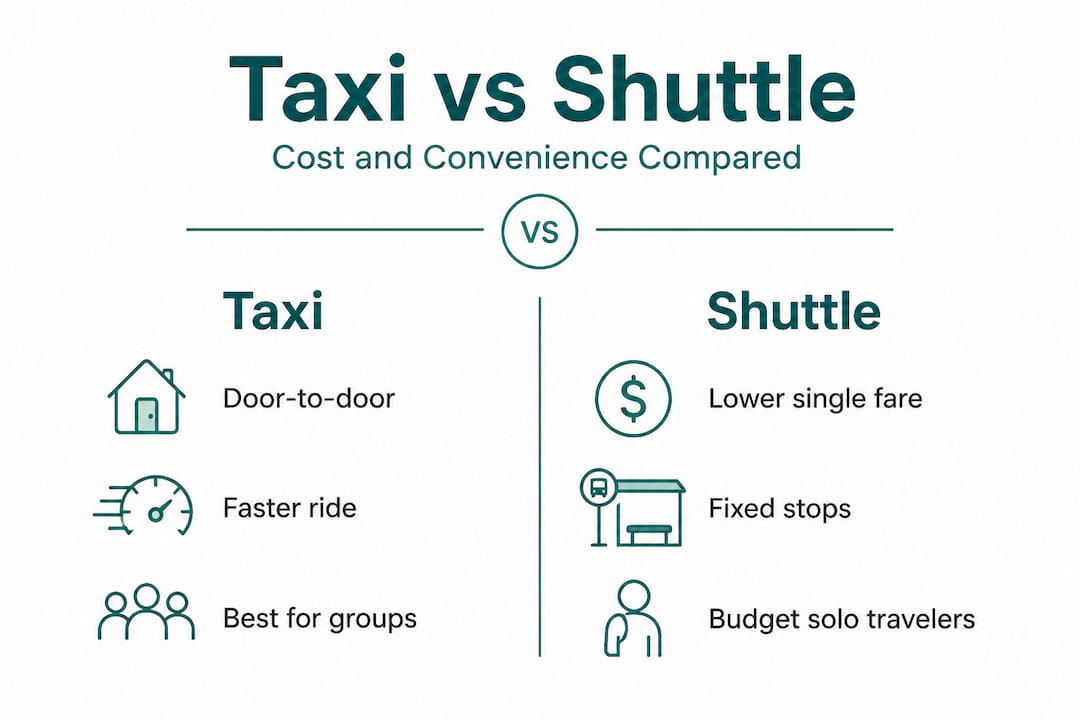
| Taxis best for groups | Splitting a taxi often beats shuttle tickets for three or more travelers. |
| Shuttles work for solo trips | Single travelers on a budget should consider shuttles if schedules align. |
| Convenience matters | Taxis save time and reduce stress, especially with luggage or late flights. |
| Check real-time costs | Always compare taxi and shuttle fares for your specific airport and time. |
How airport taxis and shuttles work
First, let’s clarify what each service really offers and how they typically operate, so you know exactly what to expect.
An airport taxi is a private, on-demand vehicle that takes you directly from the airport to your destination, with no stops along the way. You book a specific vehicle for your party. Nobody else shares that ride. The driver is dedicated to you, your schedule, and your luggage.
An airport shuttle operates on a shared basis. It follows a defined route or schedule, picks up multiple passengers from the airport, and drops them at various locations. This can mean waiting at the airport while other passengers are collected, then riding through several stops before reaching your hotel or home.
Here’s a quick breakdown of how each service operates at major airports across Ireland, the UK, and Spain:
- Booking process: Taxis can be pre-booked or hailed on arrival; shuttles almost always require advance reservation
- Route flexibility: Taxis go anywhere; shuttles are restricted to set routes or zones
- Timing: Taxis depart when you’re ready; shuttles depart on a fixed schedule
- Luggage capacity: Taxis accommodate your actual luggage; shuttles may have limited storage
- Availability at night: Taxis are generally available 24/7; shuttle services often reduce or stop after midnight
- Group accommodation: Taxis or minibus group transport comfortably handle families and groups together
One of the most practical benefits of private transfers is maximizing comfort and saving time, particularly when you’re navigating an unfamiliar airport after a long-haul flight. Knowing your driver is already waiting, with your name on a sign, is a fundamentally different experience than searching for a shuttle bay.
Taxis are consistently better for luggage, groups, or late hours, and that advantage becomes more significant as your travel circumstances become more demanding.
Pro Tip: If you’re arriving at Dublin Airport for the first time, review the Dublin Airport meeting points guide before you land. Knowing exactly where your driver will meet you saves valuable time and eliminates confusion at arrivals.
Reviewing airport pick-up tips before you travel is one of the simplest ways to reduce arrival stress, regardless of which transfer option you ultimately select.
Price comparison: taxis vs shuttles in the UK, Ireland, and Spain
With the basics covered, let’s see how much you’ll actually pay in common travel scenarios.
Pricing is where the shuttle assumption most often breaks down. Yes, a shuttle ticket is typically cheaper for a single traveler. But once you add a second, third, or fourth person to the equation, the math shifts considerably.

| Route | Shared shuttle (per person) | Private taxi (per vehicle) | Taxi breakeven point |
|---|---|---|---|
| Heathrow to central London | £15 to £40 | £50 to £130 | 2 to 3 passengers |
| Gatwick to central London | £15 to £35 | £55 to £110 | 2 to 3 passengers |
| Dublin Airport to city center | €12 to €25 | €30 to €55 | 2 to 3 passengers |
| Madrid Barajas to city center | €10 to €20 | €30 to €50 | 2 to 3 passengers |
| Barcelona El Prat to city center | €10 to €20 | €35 to €55 | 2 to 3 passengers |
Taxis from Heathrow or Gatwick to central London range from £50 to £130 per vehicle, while shared shuttles cost £15 to £40 per person. For a party of three, a single taxi at £65 is already competitive with three shuttle seats at £30 each, totaling £90. And that taxi cost also covers a faster, more direct journey.
Key factors that influence final price:
- Group size: The larger your group, the more favorable the per-person taxi cost
- Baggage surcharges: Some shuttle services add fees for extra bags or oversized luggage
- Late-night rates: Many shared shuttles stop running after midnight; taxis available around the clock may carry a small premium
- Destination type: Remote addresses, rural hotels, or locations off the shuttle route always favor taxis
- Advance booking discounts: Pre-booked private transfers often cost less than last-minute airport rank taxis
Callout: At Heathrow, a single taxi for a group of three or more almost always beats the combined per-person shuttle cost, and you arrive in less time.
For larger parties traveling together, minibus group transport offers an even more cost-effective solution, combining the door-to-door convenience of a private transfer with the capacity to move six to sixteen passengers at once.
Comparing convenience: door-to-door, speed, and real-life scenarios
Beyond price, let’s break down what it’s like to actually ride each option, from journey time to night arrivals.
Convenience is often the deciding factor. And convenience means different things to different travelers. For a solo business executive on a familiar route, a well-timed shuttle during peak hours is perfectly manageable. For a family of four landing at 1:30 a.m. after a delayed transatlantic flight, that scenario is a very different story.
Convenience factors at a glance:
- Door-to-door service eliminates the need to navigate local transit or find your hotel on an unfamiliar map
- Direct routing means no detours through other neighborhoods or hotel drops
- Fixed pickup time means you control your schedule, not the shuttle company’s schedule
- Driver assistance with luggage is standard for professional taxi and chauffeur services
- No waiting for fellow passengers to clear customs or collect bags before departing
Taxis typically complete the Heathrow to London journey in 45 to 90 minutes, while shuttles can take 60 to 120 minutes due to multiple stops. That difference of 30 to 60 minutes matters enormously when you have a business meeting, a connecting rail journey, or simply exhausted children who need to reach the hotel.
Consider a real scenario: a couple arrives at Barcelona El Prat at 11:45 p.m. Their hotel is in the Gothic Quarter. The last shuttle departed at 11:00 p.m. A taxi takes them directly there in 25 minutes. Without a pre-booked transfer, they face an uncertain queue at the rank, potential surge pricing, and no guarantee of availability.
“For business travelers on tight schedules, the time saved by a direct taxi transfer is often worth more than the price difference.”
For families traveling with strollers, car seats, or multiple suitcases, the advantages multiply. Shuttles rarely accommodate special luggage configurations without extra fees or advance arrangement. A reliable airport taxi matched to your group’s size handles all of this as standard.
Pro Tip: For families with significant luggage or business travelers with strict arrival deadlines, the convenience of a private taxi consistently outweighs any marginal savings from a shuttle. Factor in your total travel experience, not just the ticket price. For deeper insight, explore luxury airport travel insights and understand what a premium transfer actually delivers.
When a shuttle makes sense (and when it doesn’t)
But shuttles can sometimes beat taxis under the right conditions. Let’s lay out when and why.
Shuttles are not without merit. Under the right circumstances, they represent a practical and cost-conscious choice. The key is knowing precisely when those circumstances apply to your trip.
Ideal conditions for choosing a shuttle:
- You are traveling solo or as a pair with light luggage
- Your destination hotel is directly on the shuttle’s standard route
- You are arriving during daytime hours when multiple services run frequently
- Your schedule is flexible and you don’t mind waiting for other passengers to board
- You have researched the shuttle timetable and confirmed it aligns with your flight landing time
Situations where shuttles fall short:
- Off-peak arrivals, especially late night or very early morning when schedules are severely limited
- Remote accommodations not on the standard shuttle route
- Urgent or time-sensitive situations where a missed shuttle means a long wait for the next one
- Traveling with children, elderly passengers, or anyone with mobility requirements
- Arriving with heavy, bulky, or specialized luggage that doesn’t fit standard compartments
Express trains serve only fixed stations, while shuttles and taxis offer door-to-door convenience. The distinction matters because even a shuttle’s flexibility is constrained by its route. If your destination is not on that route, you face an additional transfer, adding cost and complexity.
Pro Tip: Before booking a shuttle, verify the last scheduled departure time for your arrival day. A surprising number of travelers discover mid-journey that the shuttle they counted on stopped running hours before their flight landed. For routes across Ireland, the UK, and Spain, always have a contingency plan. The guide to airport taxi services abroad offers useful context for planning transfers in unfamiliar cities.
Final decision framework:
- Choose a shuttle if your priority is minimizing cost, you are traveling solo during the day, and your hotel is on a major shuttle route
- Choose a taxi or private transfer if you value direct routing, predictable timing, luggage convenience, or are traveling with more than two people
Our take: what airport taxi vs shuttle guides rarely tell you
Most standard comparisons frame this decision as purely financial. The taxi is more expensive per person, so the shuttle wins. But that logic ignores a critical variable: the unpredictability of actual travel.
Real journeys rarely go exactly to plan. Flights are delayed. Luggage takes longer than expected. Airports are larger and more confusing than anticipated. And when you land after six hours in the air, sometimes with young children or following a demanding business trip, the mental and physical cost of navigating a shared shuttle adds up in ways that never appear in a price comparison table.
The value of a private transfer grows as the situation becomes less predictable. A taxi booked in advance with a professional driver waiting at arrivals is not just a convenience. It is a form of reliability that removes uncertainty from the equation entirely. For travelers who are unfamiliar with Irish, British, or Spanish airports and road layouts, that reliability is genuinely valuable.
There is also a tendency to underestimate travel fatigue. Jet lag, early morning departures, and the cumulative stress of modern air travel affect decision-making and physical endurance. Choosing a slightly cheaper shuttle that requires more walking, waiting, and sharing a vehicle with strangers is a real cost that never appears in a comparison table.
Budget travel advice often champions the cheapest option without acknowledging the personal definition of value. For some travelers, saving €15 per person is the priority. For others, arriving at their destination promptly, without stress, and with all luggage intact is worth a premium. Neither position is wrong. The mistake is applying one traveler’s priorities to every situation.
The luxury airport taxi options available through professional services are worth considering not just for VIP travelers, but for anyone whose time, comfort, and peace of mind have genuine value. That is a far broader audience than most guides acknowledge.
Discover airport transfers tailored to your travel style
Ready to put this knowledge to use? Here’s how you can secure the best airport transfer for you.
Whether you are traveling solo, as a couple, with a group, or on executive business, the right transfer makes a measurable difference to your entire journey. At APTS, premium airport transfers are available across Ireland, the UK, and Spain, with professional drivers, punctual service, and vehicles matched to your group size and comfort expectations.

Explore options to book your airport transfer and arrive with complete confidence. For larger groups, group shuttle options provide cost-effective private transport for six to sixteen passengers. If you want to understand exactly what sets a premium service apart, the luxury taxi features guide details every element of the executive transfer experience. Book online in minutes and remove the uncertainty from your next airport arrival.
Frequently asked questions
Are airport taxis or shuttles cheaper for groups?
For groups of three or more, a single taxi often costs less per person than purchasing separate shuttle tickets, particularly on routes between city centers and major airports like Heathrow, Dublin, or Barajas.
Which is faster: airport taxi or shuttle?
Taxis are reliably faster. Taxis complete the Heathrow to London route in 45 to 90 minutes, while shared shuttles can take 60 to 120 minutes due to multiple stops and route detours.
When does taking a shuttle make sense over a taxi?
A shuttle is most cost-effective for solo travelers arriving during the day with light luggage, when the destination is directly on the shuttle’s standard route at £15 to £40 per person and the schedule aligns with the flight.
Are taxis better for late-night or early morning flights?
Yes. Taxis are significantly more reliable for late-night and early arrivals, when shuttle services are limited, infrequent, or entirely unavailable at airports across Ireland, the UK, and Spain.
Recommended
- Why book airport transfer? Maximize comfort and save time
- Your guide to reliable airport taxi services abroad
- Your essential UK airport taxi guide: easy, reliable rides
- Top luxury taxi features that deliver real comfort and value
Article checked by Declan Rodden.