

Most travellers assume that booking an airport transfer is a straightforward decision. It rarely occurs to anyone that the choice of vehicle, the number of passengers, and the provider’s environmental credentials can collectively determine whether your sustainable airport transfers goal is meaningful or mostly wishful thinking. The gap between genuinely green transport and a vehicle with a leaf logo on its website is wider than most people realise. This guide cuts through the noise, explaining what actually reduces emissions, how to spot credible green claims, and how to make choices that hold up to scrutiny.
Table of Contents
- Key takeaways
- Understanding the environmental impact of airport transfers
- Certifications and standards for green transfers
- Choosing truly eco-friendly airport transfers
- Comparing sustainable transfer options
- Practical steps to reduce your transfer emissions
- My perspective on sustainable airport travel
- Travel greener with Apts
- FAQ
Key takeaways
| Point | Details |
|---|---|
| Vehicle type and occupancy matter most | Eco-friendly transfers depend primarily on whether the vehicle is electric and whether the journey is shared. |
| Airport green certs are not transfer certs | Airport sustainability accreditation covers on-site operations, not the emissions of the taxi picking you up. |
| Modal shift delivers the biggest savings | Choosing rail, coach, or shared shuttle over a solo private car reduces per-passenger emissions significantly. |
| Greenwashing is common | Many eco claims lack verified CO2e per passenger-kilometre data. Always ask for specifics. |
| Carbon offsetting is a last resort | Offsetting should supplement genuine emission reductions, not substitute for choosing a lower-emission vehicle or mode. |
Understanding the environmental impact of airport transfers
Not all airport journeys produce the same carbon footprint. A solo diesel taxi from Dublin Airport to the city centre produces a fundamentally different environmental outcome than a shared electric shuttle carrying six passengers along the same route. The difference comes down to two variables: the vehicle’s power source and the number of people sharing the journey.
Transport researchers summarise this under three categories of emissions. Scope 1 covers direct exhaust from the vehicle engine. Scope 2 covers the upstream emissions from generating the electricity that powers an electric vehicle. Scope 3 covers indirect impacts such as vehicle manufacturing, fuel supply chains, and infrastructure. For travellers making day-to-day transfer decisions, Scope 1 is the most directly influenced by your booking choice.
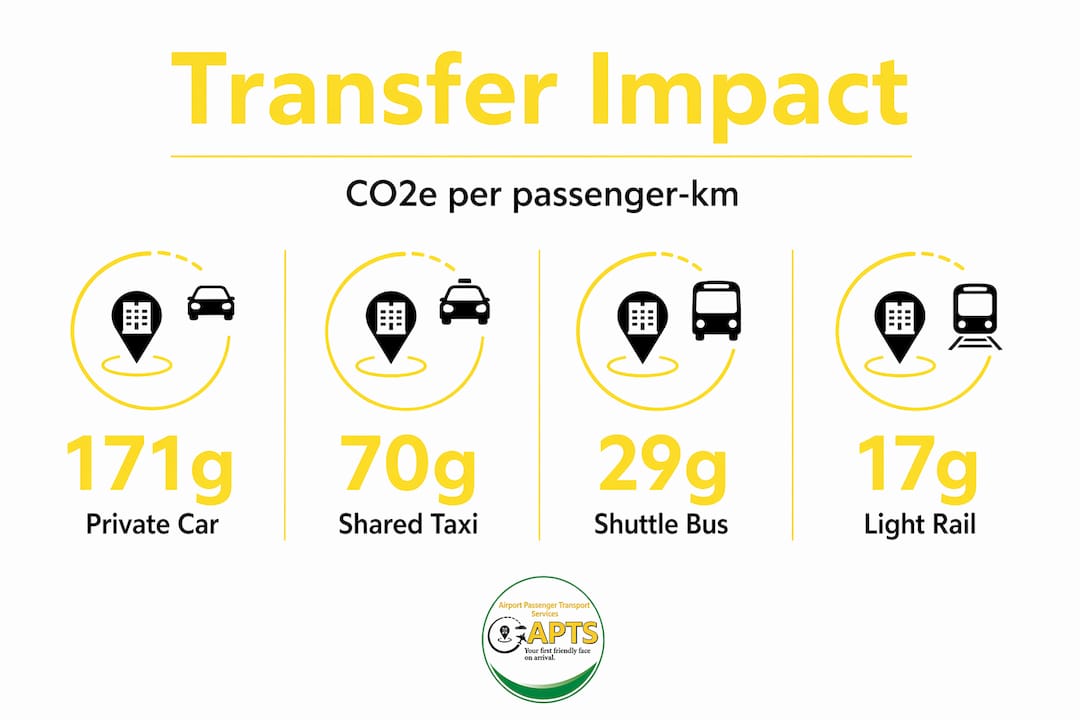
The modal shift research from UCLA is clear on the mechanics: moving away from solo car use to higher-occupancy or ground transport alternatives is the single biggest lever for reducing transport emissions. A private petrol car carrying one person produces roughly 171g CO2 per passenger-kilometre. A full airport coach drops that figure to around 27g. An electric vehicle shared between four passengers can achieve similar or better results depending on the electricity grid’s carbon intensity.
| Transfer mode | Approx. CO2e per passenger-km | Notes |
|---|---|---|
| Solo private petrol car | ~171g | Worst case for per-passenger emissions |
| Private electric car (solo) | ~50–70g | Depends on grid carbon intensity |
| Shared ride (petrol, 4 occupants) | ~43g | Significant reduction through occupancy |
| Shared electric vehicle (4 occupants) | ~15–20g | Best private vehicle outcome |
| Airport coach or shuttle | ~27g | Cost-effective and consistently low |
| Rail connection | ~14–41g | Highly variable; electrified rail is best |
These figures illustrate why occupancy is often more impactful than vehicle technology alone. A shared petrol taxi outperforms a solo electric vehicle on a per-passenger basis in many scenarios.
Certifications and standards for green transfers
When a transfer provider or airport claims sustainability credentials, it helps to understand which frameworks carry genuine weight and which are marketing labels with no independent verification.
The Airport Carbon Accreditation (ACA) programme is the most recognised standard in the aviation ground sector. Accredited airports collectively reduced Scope 1 and 2 emissions by 542,559 tonnes CO2e in the year to May 2025, with 21 airports reaching Level 5 net zero for emissions under their direct control. This is a meaningful achievement. However, it relates to airport operations, not to the private vehicles operating outside the terminal.
IATA’s IEnvA programme takes a broader approach. IEnvA independently assesses airlines, airports, and other aviation stakeholders for environmental performance through external audits. The programme’s independence is what distinguishes it from self-declared green claims, and it provides a credible basis for evaluating whether a service provider’s sustainability statements are backed by third-party verification.
A practical example of airport-level sustainability in action is King County International Airport in the United States. It achieved Level 3 Airport Carbon Accreditation partly through fleet electrification and sustainable ground vehicle deployment, demonstrating that airport certification can translate into tangible transfer-level improvements when tied to concrete vehicle actions.
Here is what to look for when assessing a transfer provider’s credentials:
- Independent third-party verification: Ask whether any sustainability claims have been externally audited or assessed.
- Specific vehicle data: Request the fleet composition, including what percentage of vehicles are electric or hybrid.
- CO2e per passenger-kilometre figures: Legitimate providers can supply or estimate this. Vague language like “we care about the environment” is not a metric.
- Carbon management policy: Does the company have a documented approach to measuring and reducing its operational emissions?
- Low-emission zone compliance: Providers operating in cities with emission zone charges should have a clear policy on compliant vehicles.
Pro Tip: When booking, search for the provider’s name alongside terms like “carbon disclosure” or “fleet electrification” to find any public sustainability reporting before you commit.
Choosing truly eco-friendly airport transfers
The most impactful decision you make is before you open any booking app. Eco-friendly airport rides are defined by vehicle type and trip occupancy above all else. A provider’s branding, pricing, or airport partner status tells you little about actual emissions.
Electric vehicles represent the clearest upgrade in vehicle technology. On a grid with moderate renewable capacity, an electric vehicle produces roughly 60 to 70 per cent fewer direct emissions than an equivalent petrol car. However, the vehicle’s emission performance is only as good as the grid supplying its charge. In Ireland, where wind energy contributes an increasingly large share of the electricity mix, electric airport vehicles perform well on this measure.
Greenwashing is prevalent in the green transportation options market. Watch for these specific warning signs:
- Claims of being “carbon neutral” without reference to any offsetting scheme or certification
- Promotional language about green values with no mention of fleet specifications
- Carbon offset claims without naming the offset programme or its verification standard
- Descriptions of “eco-friendly vehicles” that turn out to be Euro 6 diesel, which is cleaner than older engines but not genuinely low-emission
Low-emission zone compliance is a separate but related consideration. In cities that apply road pricing or emission zone charges, a reputable provider integrates these charges into fixed quotes from the outset. This matters for sustainability because a vehicle that is switched at the last minute to avoid a charge may not meet the emission standards of the original booking. Transparent, fixed pricing tied to compliant vehicles is a hallmark of a trustworthy provider.
Questions to ask any transfer provider before booking:
- What percentage of your fleet is fully electric or plug-in hybrid?
- Do you measure your CO2e per passenger-kilometre?
- How do you handle low-emission zone compliance in cities you serve?
- Do you offer shared or pooled transfer options to reduce per-passenger emissions?
- Is your carbon offsetting verified by a recognised programme such as Gold Standard or Verra?
Pro Tip: Pooled or shared transfers are often the single fastest win for reducing your transfer footprint. If you are travelling solo and your route allows it, ask specifically whether a shared service is available before assuming a private booking is your only option.
Comparing sustainable transfer options
Understanding how the main transfer types compare gives you the context to choose well, rather than defaulting to the most convenient option.
| Transfer type | Environmental impact | Convenience | Typical cost | Availability |
|---|---|---|---|---|
| Private electric taxi | Low (solo) to very low (shared) | High | Medium to high | Growing in urban areas |
| Shared electric shuttle | Very low | Medium | Low to medium | Limited but expanding |
| Airport coach / bus | Low per passenger | Medium | Low | Widely available at major airports |
| Electrified rail link | Very low | High (where available) | Low to medium | Limited to specific airports |
| Private petrol taxi (solo) | High | High | Medium | Widely available |
Rail connections deliver the largest carbon savings per passenger where they exist. Dublin Airport currently does not have a direct rail link, making coach and shared taxi services the most practical lower-emission alternatives for most travellers. Checking the airport to hotel transfer options available at your destination helps you plan the lowest-impact combination before you travel.
For those who require private transfers, whether for accessibility, luggage volume, or schedule constraints, the priority is electric vehicle selection and, where possible, combining journeys with other passengers travelling the same route. Comparing taxi versus shuttle options at the planning stage can reveal shared services that are both greener and more cost-effective than a solo private booking.
Practical steps to reduce your transfer emissions
Reducing your airport transfer carbon footprint does not require drastic changes to how you travel. It requires consistent attention to a handful of decisions at the booking stage.
- Plan ahead: Last-minute bookings restrict your access to electric or shared vehicle options, which are often pre-allocated.
- Prioritise shared or pooled services whenever your schedule allows. The per-passenger emission reduction is immediate and significant.
- Specify electric or hybrid vehicles explicitly when booking. Many platforms allow vehicle type filtering, and providers who offer electric fleets will highlight it when asked.
- Confirm low-emission zone compliance before finalising any booking in a city with road pricing or urban clean air zones.
- Use carbon offsetting as a supplement, not a primary strategy. If your only available transfer is a petrol vehicle, verified offsetting is better than nothing. However, IATA’s net zero roadmap treats offsetting as a residual tool, not a solution in itself.
- Consider the full journey: If rail is available for part of your route, combining it with a short electric taxi leg at either end often outperforms any single private transfer over the whole distance.
- Avoid unnecessary extras: Choosing a correctly-sized vehicle rather than upgrading to a larger model for comfort reduces fuel consumption, particularly on longer airport routes.
My perspective on sustainable airport travel
I have worked with ground transport long enough to know that most travellers overestimate how green their transfer choices actually are. The leap from “I booked an eco-friendly airport transfer” to “that booking meaningfully reduced my emissions” is far less automatic than the marketing suggests.
What I have learned is that the gap between airport sustainability reporting and actual transfer sustainability is real and often substantial. An airport can hold impressive ACA accreditation while the majority of vehicles collecting passengers outside its doors are ageing diesel saloons. The airport certification distinction matters: airport scores reflect on-site operations, not the vehicle in front of you.
My honest advice is to spend two minutes asking your provider a direct question about their fleet before you book. The quality of the answer tells you everything. A provider serious about affordablesustainable transport will have a clear answer. One relying on vague green language will not. The combination of modal shift and electric vehicle use is where the real gains lie, and providers who understand that are worth seeking out.
— Declan
Travel greener with Apts

Apts provides professional taxi, executive taxi, and chauffeur services to and from airports throughout Ireland and Spain. For travellers who prioritise both comfort and responsible travel, the Apts fleet includes premium vehicles selected for quality and environmental compliance. Whether you need a reliable transfer from Dublin Airport or a chauffeur service in Spain, Apts combines punctuality with attentiveness to the standards that matter most to discerning clients. Explore executive taxi options for your next trip, or review the luxury transfer features available when comfort and sustainability go together.
FAQ
What makes an airport transfer genuinely sustainable?
A genuinely sustainable airport transfer uses an electric or low-emission vehicle and, where possible, carries multiple passengers to reduce per-passenger CO2e. Providers should be able to supply specific fleet and emissions data rather than general green marketing.
Are airport carbon certifications relevant to my transfer choice?
Airport Carbon Accreditation covers direct airport operations, not the vehicles collecting passengers. Airport sustainability is a useful signal of an airport’s commitment, but you should assess your transfer’s vehicle type and occupancy independently.
Is a shared shuttle better than a private electric taxi?
In most cases, a shared electric shuttle produces the lowest per-passenger emissions. A private electric taxi is the better choice when no shared service is available, particularly if the journey is long or involves several passengers travelling together.
What is carbon offsetting and should I use it for airport transfers?
Carbon offsetting means funding verified projects that reduce CO2 elsewhere to compensate for your own emissions. It is a valid supplement when greener transfer options are unavailable, but it should not replace the priority of choosing low-emission vehicles and high-occupancy transfers in the first place.
How do I spot greenwashing in airport transfer services?
Look for specific data rather than general claims. Credible providers state fleet composition, CO2e per passenger-kilometre, and named offset programmes. Vague language about “caring for the environment” without figures or third-party verification is the most common sign of greenwashing in the best eco airport services market.
Recommended
- Top airport pick-up tips for stress-free travel in 2026
- Your essential UK airport taxi guide: easy, reliable rides
- How to schedule airport transfers for stress-free travel
Article checked by Declan Rodden.