

Arriving at an unfamiliar airport after a long flight is rarely straightforward. The airport to hotel transfer process is the one part of your journey where poor planning costs real time and real money. Signage is confusing, queues are unpredictable, and the gap between landing and reaching your hotel room can stretch from 30 minutes to well over two hours depending entirely on the choices you make. Whether you are travelling for business into Dublin, London, or Madrid, or arriving for a holiday with your family, this guide covers every step you need to take from booking to arrival.
Table of Contents
- Prepare for your airport to hotel transfer
- Choose and understand your airport transfer options
- Execute your airport to hotel transfer smoothly
- Troubleshoot common airport to hotel transfer issues
- Expected benefits and outcomes of an organised transfer process
- The overlooked details that personalise your airport to hotel transfer experience
- Streamline your airport to hotel transfer with trusted services
- Frequently asked questions
Key Takeaways
| Point | Details |
|---|---|
| Book in advance | Reserve your airport to hotel transfer 24-48 hours before arrival providing all key flight and passenger details. |
| Choose suitable transfer | Select from private cars, shuttles, taxis, or public transport based on your budget, group size, and convenience. |
| Communicate flight changes | Immediately inform your transfer provider if your flight changes to avoid complications and extra fees. |
| Know arrival procedures | Locate your driver at designated meeting points and use allotted waiting times to navigate customs and baggage claim. |
| Reliable transfers save time | Professional pre-booked transfers reduce waiting, avoid queues, and enhance your overall travel experience. |
Prepare for your airport to hotel transfer
Preparation is where smooth transfers are won or lost. Most travellers focus on the flight and treat the ground journey as something to sort out later. That approach creates avoidable stress, particularly in busy airports where demand for taxis spikes at peak hours.
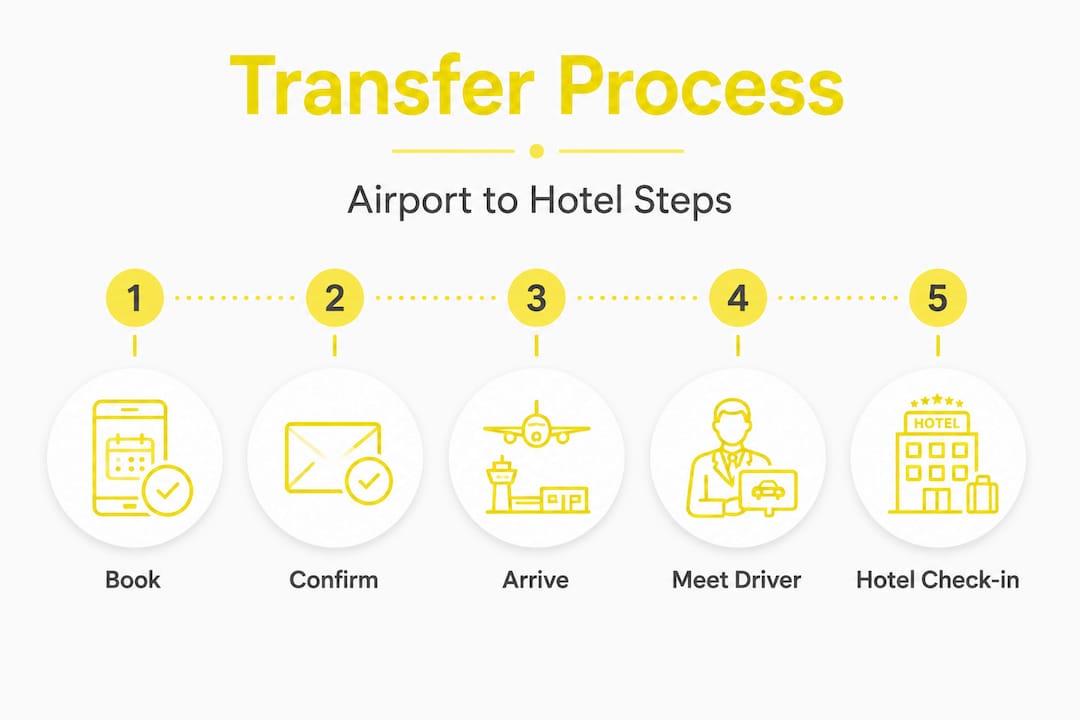
Booking airport transfers should be done 24 to 48 hours in advance at a minimum. You will need to provide specific details to ensure your driver is ready and informed when you land. According to current transfer booking guidance, the required details include:
- Flight number so the service can track your actual landing time
- Arrival time based on your confirmed schedule
- Passenger count including children travelling with you
- Full hotel address including postcode or area code
- Mobile contact number for direct communication with your driver
- Luggage details such as number of bags or any oversized items
Receiving written confirmation by email matters more than most travellers realise. That confirmation contains your pickup point, driver contact details, and any special instructions specific to your terminal. Save it offline before you fly.
Pro Tip: If your flight time changes after booking, notify your transfer service immediately. Most providers accommodate changes without fees if given sufficient notice, but last-minute alerts can result in charges or a missed pickup.
The transfer type you select during this preparation stage will shape everything that follows. The table below summarises the most common options and who they suit best.
| Transfer type | Best suited for | Key advantage |
|---|---|---|
| Private transfer | Business travellers, families | Door-to-door, fixed price, flight tracking |
| Hotel shuttle | Budget leisure travellers | Low cost, simple booking |
| Airport taxi | Solo travellers needing flexibility | Immediate availability |
| Public transport | Solo budget travellers | Lowest cost |
With preparation in place, understanding transfer options helps you choose the best fit.
Choose and understand your airport transfer options
Not all hotel transfer options are equal, and the right choice depends on more than just price. International travellers can choose between hotel shuttles, pre-booked private transfers, taxis, public transport, and ride-sharing, with the decision shaped by convenience, flexibility, and budget.
Here is what each option actually looks like in practice:
- Private transfers offer a dedicated vehicle, a professional driver who meets you in the arrivals hall, and full assistance with luggage. The price is fixed at the time of booking. This is the standard for business travel and the best airport transfer method for families with children or significant luggage.
- Hotel shuttles run on fixed schedules between the airport and a specific property. They are cost-effective but inflexible. If your baggage is delayed or your connection runs late, you may miss your slot entirely.
- Taxis are available without pre-booking at taxi ranks outside most terminals. The convenience is real, but so is the unpredictability. Surge pricing, long queues during peak hours, and variable driver knowledge of your destination all factor in.
- Public transport is the lowest-cost option and works well for solo travellers with light luggage arriving at airports with strong rail or bus links, such as Dublin, London Heathrow, or Madrid Barajas. For the family airport transport process, it is rarely practical.
Pro Tip: When comparing airport taxi vs shuttle, calculate the total journey time, not just the ticket price. A shuttle that saves £15 but adds 45 minutes of waiting and multiple stops often costs more in real terms.
The advantages of private taxi services become particularly clear for holiday airport transport where groups are larger and arrival timing is unpredictable. A pre-booked driver who tracks your flight removes the need to worry about any of it.
Having chosen your transfer type, know how to execute a smooth pick-up on arrival.
Execute your airport to hotel transfer smoothly
Landing is only the start. The steps you take between leaving the aircraft and sitting in your transfer vehicle determine how quickly and calmly the rest unfolds.
Follow this sequence on arrival:
- Exit the aircraft and follow signs to passport control. At larger airports such as Heathrow or Dublin, this walk alone can take 15 minutes. Factor that into your expectations.
- Complete passport control and proceed to baggage reclaim. Do not rush this. Confirm your belt number from the display screens.
- Collect all luggage and check it against your booking details. If a bag is missing, report it immediately to the airline desk before leaving the secure zone.
- Proceed to the arrivals hall. Your driver will be positioned here, holding a sign with your name clearly displayed for easy identification.
- Look for your driver at designated meeting points. Most major airports have dedicated meet-and-greet zones. Check your confirmation email for the precise location.
- Contact your driver directly if you cannot locate them. Their mobile number will be on your confirmation. A quick call resolves most situations within minutes.
Meet and greet airport assistance removes the guesswork from this process entirely. Rather than scanning a crowded arrivals hall with heavy bags in hand, you have a named point of contact who has tracked your flight and adjusted their position accordingly.
Pre-booked private transfers include 60 minutes of complimentary waiting time from aircraft landing, covering the time needed to clear customs and reach the arrivals hall.
That buffer is particularly valuable at airports like Heathrow where customs queues and baggage reclaim can extend well beyond the time shown on your boarding pass.
Once on board, it is useful to understand how to troubleshoot common transfer issues.

Troubleshoot common airport to hotel transfer issues
Even well-prepared travellers encounter problems. Flights are delayed, bags take longer than expected, and drivers occasionally park further from the terminal than anticipated. Knowing what to do in these moments keeps the transfer on track.
Key steps when things go wrong:
- Notify your transfer service immediately when your flight is significantly delayed or rerouted. Most services require 24 hours notice to make adjustments without fees, but even short-notice communication is better than silence.
- Keep your confirmation email accessible offline. Screenshots work well when airport Wi-Fi is slow or unavailable. Your driver’s mobile number is the most important detail.
- Ask your driver to reposition if baggage reclaim is taking longer than expected. A brief call allows them to move from a short-stay car park to a more convenient waiting area without penalty.
- Know the location of taxi ranks and local airport shuttle services as a contingency. If a pre-booked transfer fails completely, having a backup route in mind prevents panic.
- Avoid peak arrival windows where possible. Mornings and early evenings see the highest traffic at most international airports. If your schedule allows flexibility, slightly off-peak arrivals make for a noticeably calmer transfer experience.
Effective communication with your airport transfer driver is the single greatest factor in resolving issues quickly. Most problems that cause frustration are simply the result of delayed information on one side of the arrangement.
Understanding how to overcome hiccups completes your transfer knowledge with confidence.
Expected benefits and outcomes of an organised transfer process
When the airport to hotel transfer process is handled correctly, the difference to your overall travel experience is tangible. This is not simply a matter of convenience; it directly affects how you arrive and how you begin your time at your destination.
The practical benefits of organising your transfer in advance include:
- Eliminated uncertainty on arrival. A confirmed driver, a fixed pickup point, and a named contact remove the variables that cause stress.
- Flight tracking as standard. Most professional transfer services monitor your flight in real time. If you land 40 minutes early or 30 minutes late, your driver already knows.
- Fixed pricing with no surprises. Unlike metered taxis, pre-booked transfers from airport to accommodation carry an agreed price that does not change based on traffic or time of day.
- Door-to-door service. Your driver handles the route. You handle nothing beyond collecting your bags and following your driver to the vehicle.
- Reduced physical effort. Luggage assistance, vehicle loading, and a direct route to your hotel conserve the energy you need for the day ahead.
At Dublin Airport specifically, private transfers save travellers 30 to 60 minutes compared to standard taxi queues, with fixed rates and flight tracking included as part of the booking. That time saving alone justifies the benefits of booking an airport transfer well in advance.
With the benefits clear, let us consider a unique perspective on commonly overlooked transfer details.
The overlooked details that personalise your airport to hotel transfer experience
Most articles about transfers from airport to accommodation focus on the obvious steps: book in advance, provide your flight details, wait in arrivals. All of that is correct. But there is a layer of detail beneath those basics that separates a genuinely professional transfer from a merely functional one.
The name sign held by your driver is a good example. It looks like a small courtesy. In practice, it removes a moment of genuine confusion for a tired traveller who is scanning an unfamiliar arrivals hall. That one detail signals organisation, attentiveness, and accountability before a single word is exchanged.
Driver positioning matters in ways that most passengers never consider. At Heathrow, for instance, peak arrival times between 06:00 and 09:00 create dense arrivals that affect roughly 40% of standard bookings, with hidden fees emerging from extended parking and repeated terminal access attempts. Experienced chauffeurs use short-stay car parks and planned terminal positioning to avoid exactly this. You would never know it was happening unless something went wrong.
Keeping your driver’s contact number saved as soon as your confirmation arrives is another detail with real value. When you land in an unfamiliar city, you do not want to be searching through emails. One stored number means one call resolves any uncertainty.
The airport pickup procedures that distinguish a premium transfer from a standard taxi ride are rarely dramatic. They are consistent, small, and cumulative. Clear communication throughout the transfer process ensures that every adjustment, whether a delayed bag or a changed terminal, is handled without inconveniencing you.
Streamline your airport to hotel transfer with trusted services
Planning your airport transfer is the one preparation that pays back immediately on arrival. A reliable, professional service removes every variable that makes airport arrivals stressful.

Our team at APTS provides executive taxi, private transfer, and chauffeur services to and from airports across Ireland, the UK, and Spain. Every booking includes flight tracking, meet-and-greet, fixed pricing, and direct driver communication. Whether you are travelling alone on business, managing a family holiday airport transport process, or coordinating a group arrival, we tailor the service to your exact needs. Explore our private airport transfers for full details on what is included, review why booking in advance makes such a measurable difference, and when you are ready, book your transfer today.
Frequently asked questions
What information do I need to provide when booking an airport transfer?
You should provide your flight number, arrival time, passenger count, hotel address, luggage details, and a mobile contact number. Most services confirm via email with full pickup instructions once these details are submitted.
How long do private transfer drivers wait after my flight lands?
Drivers typically allow 60 minutes of complimentary waiting time for international arrivals, covering the time needed to clear customs and baggage reclaim before meeting in the arrivals hall.
What should I do if my flight is delayed or changed?
Notify your transfer service immediately. Most providers accommodate flight changes without fees when given sufficient notice, so keep your confirmation and driver contact details accessible throughout the journey.
Are airport hotel shuttles reliable for late-night arrivals?
Hotel shuttles run on fixed schedules and frequently stop operating late at night. For arrivals outside standard hours, private transfers or taxis offer more consistent and flexible options.
Recommended
- How to schedule airport transfers for stress-free travel
- How to communicate with airport taxis for smooth transfers
- Why book airport transfer? Maximize comfort and save time
Article checked by Declan Rodden.