

Airport transport myths are widespread, misleading beliefs that cost travellers real money and unnecessary stress. The Global Business Travel Association (GBTA) identifies ground transport as one of the most misunderstood cost categories in travel planning. Rideshare apps, airport shuttles, taxis, and trains each carry a set of assumptions that rarely hold up under scrutiny. This guide cuts through the most common airport transportation misunderstandings, using current evidence to help you make smarter, more confident choices every time you travel.
Which airport transport myths are most widespread?
The most damaging airport transport myths centre on cost, reliability, and convenience. They persist because travellers rarely compare options systematically. They rely on habit, word of mouth, or a single good or bad experience.
Myth 1: Rideshare is always the cheapest option

Rideshare apps surge prices 1.5 to 3 times the standard rate during peak hours, holidays, and bad weather. That means a fare that looks affordable at 2:00PM can triple by 11:00PM on a Friday. Professional car services can save frequent travellers around 23% annually compared to rideshare once surge pricing, wait times, and lost productivity are factored in.
Myth 2: Airport shuttles are free or always on demand
Many airport shuttles run on fixed, limited schedules and are not available on demand. A 15-minute journey can stretch to 60 minutes because of multiple stops and capacity limits. Travellers who assume they can simply turn up and board often find themselves waiting far longer than expected.
Myth 3: Taxis are always the simplest, most transparent choice
Taxis carry their own complications. Airport surcharges, toll fees, and regulatory levies all add to the base meter fare. The final bill frequently surprises travellers who assumed the metered rate was the total cost.
Myth 4: Public transport always saves money
Public transport is cheapest when it runs directly and frequently. After late-night arrivals or with heavy luggage, reduced or unavailable services force travellers into backup rides that cost more than a pre-booked transfer would have. The ticket price is never the full picture.
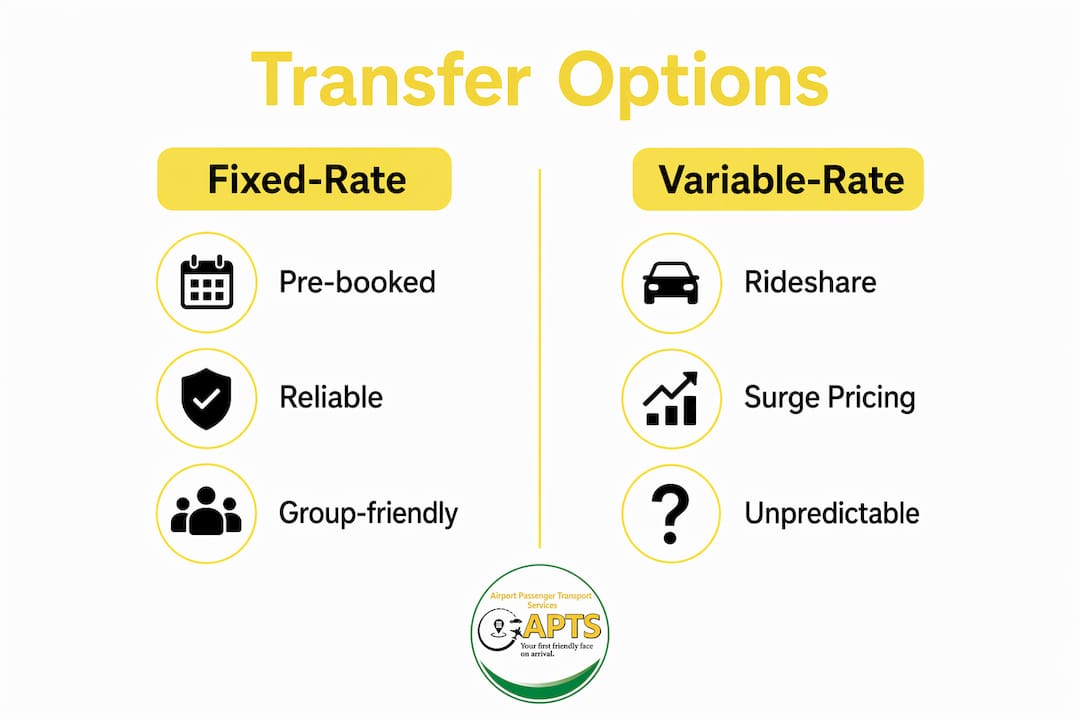
Pro Tip: Book your airport transfer at least 48 hours in advance during peak travel periods. Fixed-rate pre-booking removes surge pricing risk entirely.
How do airport transfer options compare on cost, time, and convenience?
No single transport mode wins every scenario. The fastest and cheapest option depends on time of day, luggage volume, group size, and your final destination. Understanding this is the foundation of smart airport transfer planning.
Choosing by travel scenario
A train suits a solo traveller arriving during the day with a single carry-on bag and a city-centre destination. It is fast, predictable, and affordable in that specific context. The calculation changes completely for a family of four arriving at midnight with checked luggage heading to a suburban hotel.
For groups of two to four passengers, pre-booked private transfers consistently deliver better value than multiple rideshares or individual train tickets plus last-mile transport. The cost per person drops, and the convenience rises sharply.
Fixed pricing versus surge pricing
Fixed-rate transfers quote a set price at the time of booking. That price does not change regardless of traffic, weather, or demand. Rideshare apps, by contrast, apply dynamic pricing algorithms that can push fares 2 to 3 times higher during holidays or peak demand. Pre-booked transfers also guarantee pickup at unconventional hours such as 3:00AM, when rideshare availability is unreliable.
| Transport mode | Best for | Pricing model | Key limitation |
|---|---|---|---|
| Pre-booked private transfer | Groups, late arrivals, heavy luggage | Fixed rate | Requires advance booking |
| Rideshare app | Solo, off-peak, light luggage | Dynamic, surge-prone | Unpredictable cost and wait |
| Airport shuttle | Budget solo travel, flexible timing | Fixed but shared | Multiple stops, schedule-dependent |
| Train | Solo, daytime, city-centre destination | Fixed ticket | Poor for late nights or heavy bags |
| Metered taxi | Short trips, immediate need | Metered plus surcharges | Surcharges and tolls add up |
Pro Tip: Check the full fare breakdown for airport taxis before you travel. Surcharges and tolls are rarely displayed at the point of hailing.
What are the truths behind shuttle and rideshare misconceptions?
The airport transport market was valued at $15.55 billion in 2024, with shared shuttle services projected to hold a 28.4% market share. That growth reflects a real shift in traveller preference toward predictable pricing and professional service. Yet misconceptions about both shuttles and rideshare apps remain deeply embedded.
The reality of shuttle booking and reliability
Professional shuttle companies with real-time flight tracking technology adjust pickup times automatically when flights are delayed. This removes one of the most common sources of transfer stress. Rideshare drivers, by contrast, have no obligation to track your flight and frequently cancel bookings for low-value fares or inconvenient destinations.
Key truths about shuttle services:
- Shuttles during peak periods require booking 48 to 72 hours in advance to guarantee a seat.
- Last-minute rideshare requests at airports regularly result in longer waits or outright cancellations, particularly during bad weather or high-demand periods.
- Professional shuttle drivers are assigned to bookings and do not cancel based on fare size or destination.
- Shared shuttles cost less per person but add journey time through multiple stops. Private shuttles cost more upfront but deliver door-to-door speed.
The rideshare pickup zone problem
Rideshare pickups at major airports are rarely at the terminal door. Designated pickup zones can be a significant walk from arrivals, which matters considerably with heavy bags or when travelling with children or elderly passengers. This friction is rarely factored into the “quick and easy” assumption that surrounds rideshare apps.
Group travel also flips the perceived price advantage of rideshare. Four or more passengers travelling together in a private transfer often pay less per person than the same group would across multiple rideshare vehicles, once luggage logistics and last-mile connections are included.
How can travellers apply this knowledge to improve their choices?
Knowing the myths is only useful if it changes how you plan. These steps translate myth-busting into practical decisions.
-
Book in advance and lock in a fixed rate. Pre-booked transfers guarantee availability and remove surge pricing risk. For late-night or early-morning flights, this is not optional. It is the only reliable approach. Apts offers stress-free airport transfers with fixed pricing across Ireland and Spain.
-
Calculate the true cost, not just the headline fare. Add surcharges, tolls, last-mile connections, and potential wait time costs before comparing options. Public transport rarely wins once all factors are included for groups or late arrivals.
-
Split costs across your group. A private transfer for four passengers often costs less per person than four individual rideshare fares. Use the taxi versus rideshare comparison to run the numbers before you travel.
-
Match your transport to your arrival time. Trains and buses are strong choices for daytime arrivals with light luggage. For arrivals after 10:00PM, a pre-booked private transfer is almost always the better decision on cost, reliability, and comfort.
-
Account for luggage and passenger needs. Heavy bags, pushchairs, or passengers with mobility requirements change the calculation entirely. A pre-booked vehicle sized for your group removes all of that uncertainty.
Pro Tip: Some travellers request rideshare pickups just outside the airport’s geofenced zone to reduce surge pricing by 30 to 50%. This works occasionally but adds effort and luggage management challenges. Pre-booking a fixed-rate transfer is a more reliable solution.
Key takeaways
Airport transport myths consistently lead travellers toward higher costs and greater stress. Pre-booked fixed-rate transfers deliver the most predictable outcome across cost, timing, and convenience for groups and late-night arrivals.
| Point | Details |
|---|---|
| Rideshare is not always cheapest | Surge pricing can push fares 2 to 3 times higher during peak periods, erasing any cost advantage. |
| Shuttles require advance booking | Pre-book 48 to 72 hours ahead during peak periods to guarantee availability and avoid long waits. |
| Group travel favours private transfers | Four or more passengers often pay less per person with a private transfer than with multiple rideshares. |
| Public transport has real limits | Late-night reduced services and luggage handling make public transport impractical for many arrivals. |
| Fixed pricing removes uncertainty | Pre-booked transfers lock in a fare at booking, protecting against dynamic pricing and last-minute cancellations. |
Declan’s take: why these myths keep costing travellers
I have watched the same pattern repeat itself countless times. A traveller opens a rideshare app at the airport, sees a price that looks reasonable, and books without checking whether it is a surge fare. They then wait 20 minutes in a pickup zone that is a 10-minute walk from arrivals, only to have the driver cancel. By that point, the pre-booked transfer they dismissed as “too expensive” would have been waiting at the kerb.
The truth about airport transportation misunderstandings is that they are not random. They are driven by a single flawed assumption: that the cheapest-looking option at the moment of booking is the cheapest option overall. It almost never is. Total journey cost includes time, stress, reliability, and what happens when things go wrong.
What I find most telling is that experienced travellers, the ones who fly frequently for business, almost universally pre-book. They have learned through experience what the data confirms. Predictability is worth paying for. A fixed fare, a named driver, and a guaranteed vehicle waiting regardless of your flight’s arrival time is not a luxury. For anyone travelling with luggage, in a group, or arriving late, it is simply the rational choice.
The myths persist because occasional travellers compare the best-case rideshare fare against the standard transfer price. They never compare the worst-case rideshare experience against a pre-booked transfer that performed exactly as promised. Start making that comparison, and the decision becomes straightforward.
— Declan
Reliable airport transfers, without the guesswork
Choosing the right airport transfer should not require second-guessing every option at the departure gate. Apts provides professional taxi, executive taxi, and chauffeur services to and from airports across Ireland and Spain, with fixed pricing confirmed at the time of booking.

Whether you are a business traveller who needs punctual, professional transport, a family requiring space and reliability, or a frequent flyer who simply wants the transfer handled correctly, Apts has a service to match. Explore the taxi service selection guide to find the right option for your journey, or review the business travel taxi guide if you travel regularly for work. For families, the family taxi guide covers everything you need to travel with confidence.
FAQ
Are rideshare apps cheaper than pre-booked airport transfers?
Not reliably. Rideshare apps apply surge pricing of 2 to 3 times the standard rate during peak periods, holidays, and bad weather, making pre-booked fixed-rate transfers the more cost-effective choice for groups and late arrivals.
How far in advance should I book an airport shuttle?
Book at least 48 to 72 hours ahead during peak travel periods. Many shuttles run on fixed schedules with limited capacity, and last-minute availability is not guaranteed.
Is public transport always the cheapest airport transfer option?
Public transport is cheapest when it runs directly and frequently. After late-night arrivals or with heavy luggage, reduced services and last-mile connections add cost and stress that often exceed the price of a pre-booked transfer.
Do private airport transfers cost more for groups?
Not per person. Four or more passengers travelling together in a private transfer frequently pay less per person than the same group would across multiple rideshare vehicles, once luggage and last-mile logistics are included.
What makes pre-booked transfers more reliable than rideshare?
Professional transfer companies assign a named driver to your booking, track your flight in real time, and do not cancel based on fare size or destination. Rideshare drivers can and do cancel bookings, particularly during high-demand periods or for low-value fares.
Recommended
- Role of airport transport provider: what travellers need to know
- Why airport transfer matters for stress-free travel
- List of airport ground transport: your 2026 guide
- Airport taxi pricing explained: a traveller’s guide
Article checked by Declan Rodden.