

Getting to the airport should be the least stressful part of any trip. Yet choosing from the range of transport options available, each with different costs, journey times, and levels of comfort, is a decision many travellers get wrong. The best transport options to airports depend on several factors: whether you are travelling alone or as a group, how much luggage you are carrying, and how much reliability matters to you. TSA recommends arriving two hours before domestic flights and three hours before international departures. Your transport choice directly affects whether you hit that window comfortably.
Table of Contents
- Key takeaways
- 1. Key criteria for choosing the best transport options to airports
- 2. Taxi and private car transfers
- 3. Train and rail connections to airports
- 4. Coach and shared shuttle services
- 5. Airport transport comparisons: side-by-side overview
- 6. How to decide the best transfer for your specific needs
- My perspective on choosing airport transport
- Travel with confidence: Apts airport transfers
- FAQ
Key takeaways
| Point | Details |
|---|---|
| Cost vs. convenience | The cheapest option is rarely the most convenient; weigh both before booking. |
| Groups and luggage | Taxis and private transfers suit groups and heavy luggage far better than rail or shuttles. |
| Rail is time-reliable | Trains avoid road traffic and offer predictable journey times, ideal for solo travellers. |
| Shuttles are budget-friendly | Shared coaches are cost-effective but often involve indirect routes and longer travel times. |
| Plan around your needs | Business travellers, families, and solo travellers each have different optimal transport choices. |
1. Key criteria for choosing the best transport options to airports
Before comparing specific modes of transport, it pays to understand what you are actually weighing up. Not all travellers have the same priorities, and the right choice shifts considerably depending on your circumstances.
The core factors to assess are:
- Cost: What is your budget, and does the price difference between options justify any trade-off in comfort or time?
- Journey time reliability: Can the mode of transport guarantee arrival within a predictable window, regardless of traffic?
- Luggage handling: Does the service accommodate your bags without inconvenience or extra charges?
- Frequency and availability: Is the service running at the time you need it, including early mornings or late nights?
- Passenger comfort: Are you able to rest, work, or simply travel without stress?
- Environmental impact: Some travellers now actively choose greener options, and shared transport or rail significantly reduces carbon output compared to private vehicles.
Pro Tip: Book your airport transport at least 24 hours in advance. Last-minute bookings, particularly for private transfers, often carry a premium and may have limited availability during peak travel periods.
2. Taxi and private car transfers
Taxis and pre-booked private car transfers represent the most straightforward airport transfer option for most travellers. The door-to-door model eliminates the need to carry luggage through stations or wait at designated stop points.
Passengers with heavy luggage or those travelling as a group benefit most from this mode, despite the higher cost. A taxi accommodates your schedule rather than a fixed timetable, which matters enormously on an early morning departure or a late arrival.
Key considerations for taxis and private transfers:
- Pricing: Fares vary based on distance, time of day, and vehicle type. Executive vehicles carry a higher rate but offer considerably more comfort.
- Curbside pickup rules: At major airports, rideshares and taxis must use designated Cell Phone Waiting Lots. Curbside pickup rules at large airports mean drivers cannot simply pull up and wait; understanding this avoids unnecessary delays.
- Traffic impact: Unlike trains, taxis are subject to road congestion. Allow additional time during peak hours.
- Pre-booking: Booking in advance locks in a fare and confirms a vehicle is available at your specific departure time.
- Safety and professionalism: Established taxi and private transfer companies offer licensed, insured drivers, which matters for both safety and accountability.
Pro Tip: When booking a private transfer, confirm the driver will monitor your flight status. Professional services adjust pickup times automatically if a flight is delayed, saving you from unnecessary waiting or rushing.
3. Train and rail connections to airports
Rail travel is widely regarded as the most time-reliable airport transfer option in cities with dedicated connections. Trains are unaffected by road traffic, which makes journey times far more predictable than road-based alternatives.
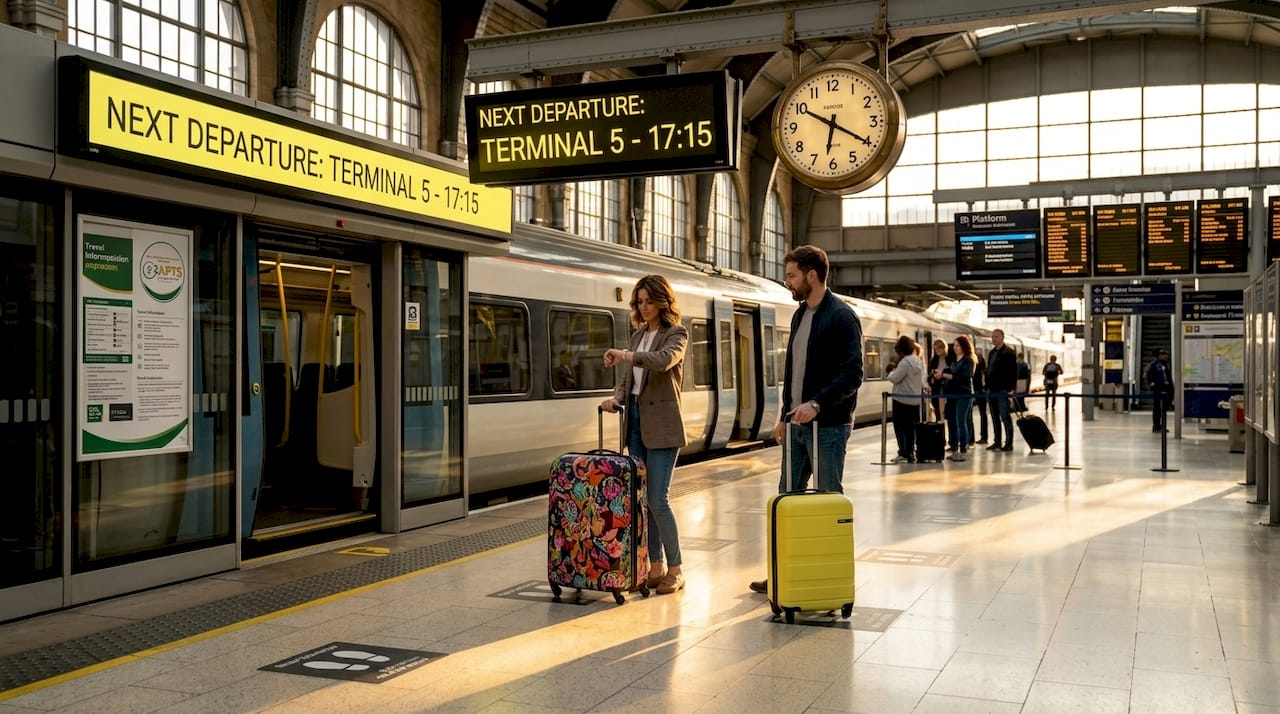
Some well-known examples illustrate the value of rail connections:
| Airport | Rail connection | Approximate cost | Journey time |
|---|---|---|---|
| JFK, New York | LIRR to Jamaica + AirTrain | $14.00 total | 45-60 min |
| Berlin Brandenburg | Airport express train | €3.80-4.40 | 30-50 min |
| San Francisco (SFO) | AirTrain + BART | Varies | 30-40 min |
The advantages of rail are clear for solo travellers with manageable luggage. Trains run to a fixed schedule, they are generally accessible for passengers with mobility needs, and they connect with broader transit networks, making onward travel simple.
The limitations are equally worth knowing. Carrying multiple large cases through a busy station is cumbersome. Group travel on rail can cost more than a shared taxi, particularly once luggage and the need for multiple tickets are factored in. Rail is also not always available 24 hours a day, which matters for very early or late departures.
4. Coach and shared shuttle services
Shared coaches and airport shuttle services sit between rail and taxi on both cost and convenience. They are among the most affordable airport transfer options available, particularly for solo travellers or those on a tight budget.
Shared shuttle services are cost-effective but typically involve longer journey times due to scheduled stops, indirect routing, and fixed departure windows. They work best when:
- You are travelling from a suburban area not served by rail
- Cost is a primary concern and you have flexibility in your schedule
- You have light luggage and do not mind sharing a vehicle with other passengers
- You are travelling as a solo passenger rather than a group
Many shuttle operators now offer greener vehicle options, including electric or hybrid coaches, which appeals to environmentally conscious travellers. This is worth checking when booking, particularly for travellers who wish to reduce their carbon footprint without switching to a premium private transfer.
The main trade-off with shared coaches is that scheduling is fixed. If your flight time shifts or you need to depart outside of a shuttle’s operating hours, you will need an alternative.
5. Airport transport comparisons: side-by-side overview
Choosing between transport modes becomes considerably easier with a direct comparison across the criteria that matter most.
| Transport type | Typical cost | Journey time reliability | Luggage handling | Best suited for |
|---|---|---|---|---|
| Private taxi / transfer | Higher | Moderate (traffic-dependent) | Excellent | Groups, families, executives |
| Train / rail | Low to moderate | High | Limited | Solo travellers, light luggage |
| Shared shuttle / coach | Low | Moderate | Moderate | Budget-conscious solo travellers |
| Rideshare app | Moderate | Moderate (traffic-dependent) | Good | Solo or small groups |
This table reflects general patterns. Costs and journey times vary considerably by city, airport, and time of day. Use it as a framework rather than a fixed rule.
6. How to decide the best transfer for your specific needs
The right airport transfer option is not universal. It depends on who is travelling, what they are carrying, and what they value most.
Here is a practical approach to working through the decision:
- Define your primary priority. Is it cost, speed, comfort, or reliability? Rank these before comparing options.
- Account for your luggage. Heavy or multiple bags make rail and shuttle travel significantly less practical. A private car becomes more justifiable the more luggage you carry.
- Consider the time of day. Early morning departures and late-night arrivals often rule out coaches and reduce rail frequency. Private taxis are available around the clock.
- Assess your group size. A family of four or a small business group often finds that the combined cost of rail or shuttle tickets approaches or exceeds a private transfer, without the same level of comfort.
- Check your airport distance. For airports within 15 kilometres of a city centre, rail is often the fastest and cheapest option. Beyond that, a private transfer frequently becomes more competitive.
- Use expedited security where available. Curbside check-in and expedited security programmes reduce the time you need at the airport itself. This affects how early you need to depart and therefore which transport options are viable.
Pro Tip: Boston Logan Airport runs a remote security pilot where passengers clear TSA screening at Framingham for just $9 each way, then travel by secure bus to the terminal. If your airport offers something similar, factor the full journey, including off-site security, into your transport planning.
My perspective on choosing airport transport
By Declan
I have seen travellers make the same mistake repeatedly. They choose the cheapest option, then spend the journey anxious about whether they will make it in time. Cost matters, but it should never be the sole deciding factor when the consequence of getting it wrong is missing a flight.
What I have learned from working in this space is that the true cost of transport is measured in reliability, not just price. A train delayed by engineering works or a shuttle that makes four stops before yours can cost you far more in stress and risk than the money you saved.
The other thing most people underestimate is how much their own profile changes the calculation. A business executive travelling light from a city centre to a nearby airport has genuinely good reasons to take the train. A family of four with three suitcases and a pushchair, travelling from a suburb, has equally good reasons to book a private transfer. Neither choice is wrong. The mistake is applying someone else’s logic to your own situation.
I would also pay close attention to innovations in airport security. Programmes like the Boston Logan remote terminal experiment show that the journey to the airport and the security process are starting to merge. As these models expand, the best transport choice will increasingly be one that integrates with how and where you clear security, not just how you get to the terminal door.
Plan deliberately. Do not default to habit.
— Declan
Travel with confidence: Apts airport transfers

When reliability and comfort are non-negotiable, a pre-booked professional transfer makes a measurable difference. Apts provides taxi, executive taxi, and chauffeur services to and from airports throughout Ireland and Spain, serving business travellers, families, and VIP clients who require punctuality and professionalism.
Every booking includes flight monitoring, meet-and-greet service, and fully licensed, insured drivers. Whether you need a Dublin airport taxi for a business departure or a private airport transfer for a family holiday, Apts offers tailored options built around your schedule. For travellers heading abroad, the airport taxi guide for international travel covers everything you need to book with confidence.
FAQ
What is the cheapest way to get to the airport?
Shared shuttle coaches and rail connections are generally the most affordable options. Rail fares, such as the combined JFK train cost of around $14, are significantly lower than taxi fares for the same route.
Are taxis or private transfers worth the extra cost?
For groups, families, or travellers with heavy luggage, taxis offer clear advantages in door-to-door convenience and luggage handling that often justify the higher fare compared to rail or shuttle alternatives.
How early should I leave for the airport?
Standard advice is to allow two hours for domestic and three hours for international flights, though experienced travellers using expedited security programmes may need less time depending on the airport.
Is rail travel reliable for airport transfers?
Rail is generally the most time-reliable option. Dedicated airport rail links such as Berlin’s express train offer consistent 30 to 50 minute journeys regardless of road conditions.
What should I know about rideshare pickup at airports?
Most major airports require rideshares to wait in designated lots rather than at the kerb. Official waiting area rules vary by airport, so check the specific pickup procedures before your trip to avoid delays.
Recommended
- Sustainable airport transfers: your 2026 green travel guide
- How to get airport pickup: a clear 2026 guide
- Top airport pick-up tips for stress-free travel in 2026
- Your essential UK airport taxi guide: easy, reliable rides
Article checked by Declan Rodden.