

Corporate ground transport is defined as any pre-arranged or on-demand vehicle service used to move employees between airports, hotels, and meeting venues during a business trip. Choosing the right business travel taxi options directly affects punctuality, cost control, and your company’s duty of care obligations. Yet two-thirds of corporate ground travel is untracked, leaving finance teams blind to spending and exposing travellers to avoidable risk. This guide covers every major transfer type, booking strategy, and expense consideration a corporate traveller needs to make informed decisions in 2026.
What are the main business travel taxi options available?
A business taxi is any licensed, pre-booked, or metered vehicle service used specifically to support corporate travel needs. The term covers a wide spectrum, from standard private hire cars to fully managed executive chauffeur services. Understanding the distinctions helps you match the right vehicle to each leg of your trip.
| Service type | Key features | Best suited for |
|---|---|---|
| Standard private hire | Metered or app-based, variable pricing | Short local journeys, low-priority trips |
| Executive saloon taxi | Fixed pricing, professional driver, premium vehicle | Airport transfers, client meetings |
| Estate or MPV taxi | Extra luggage space, up to 6 passengers | Team travel, equipment transport |
| Group minibus transfer | 8–16 seats, pre-booked, fixed route | Conference groups, team offsites |
| Wheelchair-accessible vehicle | Adapted interiors, ramp or lift access | Travellers with mobility requirements |
| Chauffeur service | Meet and greet, flight tracking, luxury vehicle | VIP clients, senior executives |

The most significant distinction in any business travel taxi guide is between pre-booked and on-demand services. Pre-booked transfers lock in a price, a driver, and a vehicle class before you travel. On-demand ride-hailing apps like Uber or Bolt offer convenience but deliver variable pricing and no guaranteed vehicle standard.
95% of business travellers use ride-hailing apps for at least some corporate journeys. Only 58% of companies formally manage that usage. The gap between employee behaviour and corporate policy is where expense leakage and duty of care failures occur.
For airport transfers specifically, the role of taxis in business travel is clearest. A pre-booked executive taxi removes the uncertainty of finding transport after a long-haul flight. It also removes the risk of surge pricing during peak departure times.
How can business travellers guarantee reliability and punctuality?
Reliability is the single most valued attribute in corporate ground transport. A missed flight or a late arrival to a client meeting carries consequences that far outweigh any saving made on a cheaper fare.
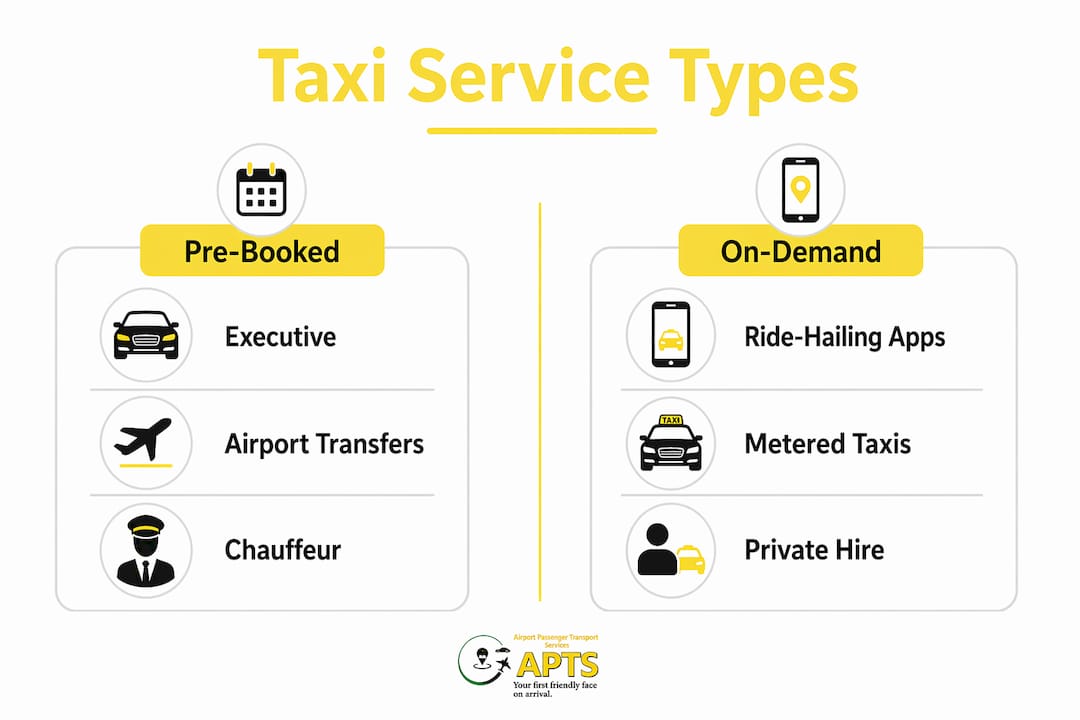
Managed transport services carry double the trust of ride-hailing apps in business-critical situations. That trust comes from consistency: a confirmed driver, a confirmed vehicle, and a confirmed price. Ride-hailing platforms offer none of those guarantees at the point of booking.
Follow these steps to protect punctuality on every corporate trip:
- Book 2–4 weeks in advance for airport transfers during peak travel periods. Last-minute bookings are possible with 30–60 minutes’ notice but carry limited vehicle choice and no price certainty.
- Choose a provider with flight tracking. Professional executive taxi services monitor your inbound flight and adjust pick-up times automatically. You are not charged for delays outside your control.
- Confirm driver wait policies before booking. Reputable providers include a standard waiting period of 45–60 minutes after landing, covering immigration and baggage collection.
- Select fixed-price transfers over metered fares. Fixed pricing removes the risk of unexpected costs caused by traffic, route changes, or driver detours.
- Use providers that operate 24/7. Taxis operate around the clock, unlike ride-hailing platforms where driver availability drops sharply during off-peak hours. Early morning flights and late-night arrivals require a service you can depend on regardless of the time.
Pro Tip: Book your return airport transfer at the same time as your outbound journey. Providers like Apts allow you to schedule both legs in a single booking, removing one more variable from a busy travel day.
What cost and expense factors should businesses consider?
Expense management is where corporate taxi use most frequently breaks down. The problem is not the cost of the journey. The problem is the documentation, the policy compliance, and the visibility of that cost within the company’s travel programme.
About 50% of business taxi journeys are organised independently by employees using personal funds. That figure means finance teams are reimbursing costs they cannot verify, categorise, or benchmark. It also means travel managers cannot enforce preferred supplier agreements or monitor safety.
The documentation issue compounds the problem. Corporations reject handwritten receipts that lack VAT numbers. Professional executive taxi services issue compliant fiscal invoices ready for direct submission to expense platforms such as SAP Concur or Expensify. Standard taxi receipts rarely meet that standard.
Key expense considerations for any business travel transfer include:
- VAT-compliant invoicing. Confirm your provider issues receipts that include their VAT registration number and a full breakdown of the fare.
- Centralised billing. Corporate account holders with providers like Apts can consolidate all journey costs into a single monthly invoice, removing the need for individual reimbursement claims.
- Fixed versus variable pricing. A fixed-price Rome-to-Naples transfer costs approximately €280. The same journey on a meter exceeds €300. Fixed pricing is not just convenient; it is measurably cheaper on longer routes.
- Policy integration. Travel managers should formally include ground transport in corporate travel policies. Only 33% of ground transport is captured by managed systems despite 83% of travel managers mandating approved providers.
Pro Tip: Set up a corporate account with Apts to centralise all airport transfer bookings. Corporate accounts provide consolidated invoicing, fixed pricing, and full journey visibility, addressing the three most common expense management failures in one step.
Duty of care is the legal and ethical obligation a company holds towards its travelling employees. Using personal ride-hailing accounts for business travel creates significant corporate risk, including incomplete location monitoring and no formal record of the journey. Managed taxi services provide a verifiable record of every trip, supporting both safety monitoring and insurance compliance.
Which specialised taxi services matter most for corporate travellers?
Not every business trip involves a single executive in a saloon car. Corporate travel regularly requires group transport, accessible vehicles, and luxury arrangements for senior clients. Choosing a provider that covers all these categories under one account simplifies logistics considerably.
The most relevant specialised options for corporate travellers include:
- Group minibuses and people carriers. Teams travelling to conferences or offsites need vehicles that keep the group together. A pre-booked minibus is more cost-effective per head than multiple individual taxis and removes the coordination burden from the traveller.
- Wheelchair-accessible vehicles. Safety and accessibility standards are non-negotiable in corporate travel. Providers must offer adapted vehicles with ramp or lift access as a standard part of their fleet. Apts provides accessible airport taxi options for travellers with mobility requirements across Ireland and Spain.
- Executive chauffeur services. A professional chauffeur service differs from a standard executive taxi in scope. Chauffeurs provide meet and greet at arrivals, assist with luggage, and maintain a formal standard of presentation throughout the journey. This level of service is appropriate for VIP clients, board-level executives, and high-value business delegations.
- Long-distance transfers. Some corporate trips require point-to-point transfers between cities rather than simple airport runs. Pre-booked long-distance taxis with fixed pricing are more reliable than train connections for time-sensitive journeys with heavy luggage.
27% of companies restrict taxi costs through hard spending limits. Limits set too low push employees towards cheaper, unvetted options that compromise vehicle maintenance and driver quality. The cost of a safety incident far exceeds the saving on a discounted fare. Choosing providers with verified safety records and professional driver standards is a corporate responsibility, not a luxury preference.
For a detailed comparison of executive taxi service types, Apts provides a clear breakdown of what each vehicle class includes and when each is the right choice for corporate use.
Key takeaways
The most reliable business travel taxi strategy combines pre-booked fixed-price transfers, VAT-compliant invoicing, and a managed corporate account to control costs and satisfy duty of care requirements.
| Point | Details |
|---|---|
| Pre-book well in advance | Book airport transfers 2–4 weeks ahead to secure vehicle choice and fixed pricing. |
| Demand compliant receipts | Only VAT-registered invoices are accepted by corporate finance; confirm this before booking. |
| Manage ride-hailing formally | 95% of employees use apps but only 58% of companies track it; close that gap with policy. |
| Use corporate accounts | Centralised billing removes individual reimbursement claims and gives full journey visibility. |
| Prioritise safety over cost limits | Spending caps set too low reduce driver quality and vehicle standards, increasing corporate risk. |
Why unmanaged ground transport is the quiet risk in corporate travel
Most travel managers I speak with are confident their ground transport is under control. The data says otherwise. Two-thirds of corporate ground travel is untracked, and that figure has barely moved in recent years despite the growth of managed travel platforms.
The real problem is not that employees make bad choices. It is that the systems around them make unmanaged bookings the path of least resistance. An employee who needs a taxi at 5am has no time to navigate a corporate booking portal. They open an app, book a ride, and submit a screenshot as a receipt. Finance rejects it. The employee resubmits. Everyone wastes time.
The fix is structural, not behavioural. Companies that set up pre-approved providers with direct billing remove the friction entirely. The employee books through a familiar interface, the cost goes to the corporate account, and the finance team receives a compliant invoice. Nobody chases receipts.
My view is that ground transport deserves the same policy rigour as flights and hotels. The business trip taxi process should be as clearly defined as the flight booking process. When it is, expense leakage drops, duty of care improves, and travellers arrive less stressed. That last point matters more than most finance teams realise. A traveller who arrives calm and on time performs better. The taxi is not a minor logistical detail. It is the first and last impression of the entire trip.
— Declan
Plan your next corporate transfer with Apts
Apts provides executive taxi and chauffeur services to and from airports across Ireland and Spain, with a focus on professional standards, fixed pricing, and corporate account management. Whether you need a single airport transfer or a fully managed ground transport solution for your team, Apts delivers the reliability and documentation that corporate travel demands.
Use the taxi service selection guide on the Apts website to identify the right vehicle class and booking approach for your next trip. From Dublin Airport executive transfers to accessible vehicles for travellers with specific requirements, Apts covers the full range of corporate ground transport needs. Book in advance, travel with confidence, and let your finance team receive the compliant invoicing they require.
FAQ
What is a business taxi?
A business taxi is a licensed, pre-booked vehicle service arranged specifically to support corporate travel, including airport transfers, client meetings, and inter-city journeys. It differs from a standard taxi by offering fixed pricing, professional drivers, and compliant invoicing for expense management.
How far in advance should I book a business airport transfer?
Book at least 2–4 weeks in advance for peak travel periods, particularly when larger vehicles or accessible transport is required. Last-minute bookings within 30–60 minutes are sometimes possible but carry limited availability and no price certainty.
Are ride-hailing apps suitable for business travel?
Ride-hailing apps are convenient but carry corporate risk. Only 58% of companies formally manage their employees’ app usage, creating expense leakage and duty of care gaps that pre-booked managed services resolve.
What receipts do I need for corporate taxi expenses?
Corporate finance departments require VAT-registered invoices, not handwritten slips or app screenshots. Professional executive taxi services and providers like Apts issue compliant fiscal receipts ready for submission to expense platforms such as SAP Concur.
Does Apts offer group transport for corporate travel?
Apts provides a range of vehicles including executive saloons, estates, and larger group carriers for corporate clients travelling to and from airports in Ireland and Spain. Corporate accounts allow centralised booking and billing for teams of any size.
Recommended
- Best transport options to airports: your 2026 guide
- Business trip taxi process: a complete guide for travellers
- Ways to save on airport taxis: your 2026 guide
- Taxi services for families: your 2026 guide
Article checked by Declan Rodden.