

The business trip taxi process is defined as the end-to-end workflow of booking, managing, and expensing taxi transport for professional airport transfers. Done well, it saves time, protects your reimbursement claims, and removes the stress of last-minute ground transport decisions. Done poorly, it creates delays, rejected expense claims, and unnecessary frustration before you even reach your first meeting. This guide covers every stage: from corporate travel taxi booking and pickup protocols to cost management and the tools that make the whole workflow faster and more reliable.
How do you book a taxi for a business trip airport transfer?
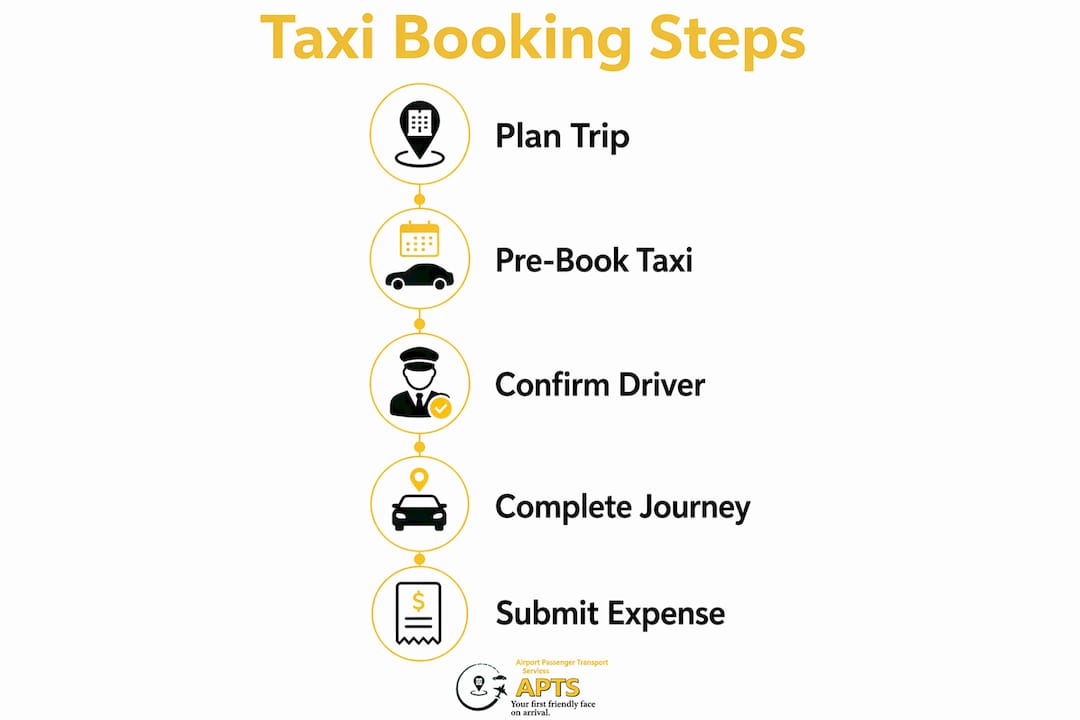
Pre-booking is the single most important step in any business travel taxi workflow. Arranging transport before you travel removes the risk of unavailability at the airport, particularly during peak hours or following flight delays. Approved ground transport should be integrated into your travel plan ahead of arrival, not treated as an afterthought once you land.
Most corporate travellers have three practical booking routes available:
- Company travel management platforms such as those offered through corporate accounts, which centralise bookings, apply policy rules automatically, and generate receipts in the correct format for finance teams.
- Direct pre-booking with a taxi or transfer provider, which gives you a confirmed vehicle, a fixed fare, and driver contact details before you depart.
- On-demand apps, which offer convenience but carry variable pricing and are not always aligned with company expense policies.
The most reliable option for airport transfers is direct pre-booking with a professional provider. You receive confirmation by email or SMS, driver details in advance, and a fixed price that simplifies expense reporting. Booking confirmations and driver details should be captured immediately upon receipt to protect your audit trail and facilitate smooth reimbursement.
Travel policy alignment matters here. Many organisations specify approved vendors or spending caps for ground transport. Booking outside these parameters can result in a rejected claim, regardless of how reasonable the fare was. Check your company’s corporate travel policy before booking, and use any preferred supplier arrangements your employer has in place.
Pro Tip: Save your company travel profile and preferred provider details in a single location on your phone. This cuts booking time to under two minutes and keeps every trip within policy from the outset.
What are the costs involved and how do you handle taxi expense reporting?
Taxi fares for business trips vary based on distance, time of day, local tariff rules, and the type of vehicle booked. Understanding these variables before you travel prevents billing surprises and makes expense reporting straightforward.
Tracking date, time, amount, place, and purpose is the standard required for reimbursement or tax deduction eligibility. This is not optional. Finance teams and tax authorities expect a complete log, and missing even one field can delay or invalidate a claim.
The following steps represent best practice for managing taxi expenses on a business trip:
- Request a receipt at the point of payment. Digital receipts from pre-booked services are preferable, as they include all required fields automatically.
- Log the business purpose immediately. Note the meeting, client, or event the journey relates to while it is still fresh.
- Photograph paper receipts on the same day. Paper fades and gets lost. A photograph taken immediately is far more reliable.
- Submit expenses within your company’s stated timeframe. Late submissions are a common reason for rejected claims.
- Cross-reference against your booking confirmation. If the fare differs from the quoted price, flag it before submitting rather than after.
“Ground transportation including taxis is typically reimbursable when reasonable, and clear reimbursement policies reduce employee disputes and set expectations upfront.”
Local fare systems add another layer of complexity. The Heathrow black cab local fares system, for example, applies specific short-journey rules that can confuse passengers unfamiliar with the structure. Fares for short trips from Heathrow may appear higher than expected relative to distance. Understanding that local tariff rules exist at major airports helps you anticipate costs and avoid disputes with your finance team over seemingly inflated fares. For a broader breakdown of how airport fares are calculated, the airport taxi pricing guide from Apts covers the key variables clearly.
What are the best practices for taxi pickup during a business trip?
Ground logistics at airports require preparation. Knowing where to go, who to look for, and what to do if something changes is as important as the booking itself.
Key practices for a smooth pickup experience include:
- Confirm your meeting point before you land. Most professional transfer services designate a specific arrivals area or use a meet-and-greet service where the driver holds a name board. Knowing this in advance means you walk directly to your vehicle rather than searching.
- Allow for realistic transfer times. Immigration, baggage reclaim, and customs can add 30 to 60 minutes to your exit time. Build this into your schedule and communicate it to your driver or provider.
- Keep your driver’s contact number accessible. If your flight is delayed or diverted, a direct line to your driver allows you to update them immediately. Professional services monitor flight arrivals, but direct communication removes any ambiguity.
- Understand the airport’s taxi rank rules. Not all airports operate the same system. Some require passengers to use a designated rank; others have separate zones for pre-booked vehicles versus on-demand taxis. Arriving at the wrong zone wastes time and can result in additional charges.
Safety is a non-negotiable consideration in any business trip transportation guide. Incorporating ground transport into duty-of-care planning means verifying that your chosen provider is licensed, insured, and operating within the regulatory framework of the country you are travelling in. Using an unlicensed vehicle to save money is not a risk worth taking, particularly when travelling alone or arriving late at night.
Handling disruptions calmly is a skill in itself. If your pre-booked vehicle is unavailable due to an unforeseen issue, a reputable provider will have a contingency process. Ask about this when you book. Providers who cannot explain their disruption protocol are not the right choice for professional travel.

Pro Tip: Screenshot your driver’s details and the pickup location map before you board. Airport Wi-Fi is unreliable, and having this information offline removes a common source of stress on arrival.
What tools and platforms simplify the business travel taxi workflow?
The right technology reduces the administrative burden of managing taxi bookings, approvals, and expense claims across multiple trips. Automation and centralised booking allow business travellers to book within policy, automate approvals, and reduce manual effort significantly.
| Tool type | Primary function | Business benefit |
|---|---|---|
| Corporate travel management platform | Centralised booking with policy controls | Keeps all trips within approved parameters automatically |
| Expense management app | Receipt capture and claim submission | Reduces processing time and minimises rejected claims |
| Pre-booking transfer service | Fixed-fare airport transfers with confirmation | Eliminates fare uncertainty and simplifies receipts |
| Travel administrator system | Documentation and crisis support | Provides a single point of contact for changes and emergencies |
Appointing a travel administrator and using a dedicated platform for documentation and crisis support is recommended for organisations managing frequent business travel. This removes the burden from individual travellers and creates a consistent, auditable process.
The shift from manual arrangements to digital workflows also benefits finance teams. When bookings, confirmations, and receipts flow through a single system, month-end reconciliation becomes a straightforward task rather than a time-consuming investigation. For organisations with regular airport transfer requirements, exploring corporate account services with a professional provider is a practical step towards this kind of consistency.
Pro Tip: Automate your expense approval workflow so that taxi receipts below a set threshold are approved without manual review. This alone can cut finance team processing time considerably on high-volume travel months.
Key takeaways
A well-managed business trip taxi process depends on pre-booking, policy alignment, detailed expense logging, and choosing a professional provider with clear pickup and disruption protocols.
| Point | Details |
|---|---|
| Pre-book before you travel | Confirmed vehicles, fixed fares, and driver details reduce airport stress and protect your audit trail. |
| Log all five expense fields | Date, time, amount, place, and purpose are required for reimbursement and tax deduction eligibility. |
| Know your pickup point | Confirm the arrivals meeting point before landing to avoid delays and unnecessary charges. |
| Use policy-aligned tools | Corporate travel platforms and expense apps keep bookings within approved parameters automatically. |
| Verify provider credentials | Licensed, insured providers are a duty-of-care requirement, not a preference. |
Why I think most business travellers underestimate the taxi stage
After years of observing how professionals manage airport transfers, the pattern is consistent. Travellers invest significant time planning flights, hotels, and meetings, then treat ground transport as something to sort out on arrival. This is where the process breaks down.
The taxi stage is where delays compound. A missed pickup, an unlicensed vehicle, or a rejected expense claim does not just cost money. It costs credibility with finance teams and creates unnecessary stress before a high-stakes meeting. I have seen experienced executives arrive flustered at client offices because their airport transfer fell apart, and the cause was almost always a failure to pre-book or confirm details in advance.
The other underestimated factor is documentation. Most travellers know they need a receipt. Far fewer understand that the purpose of the journey must be recorded at the time, not reconstructed weeks later when the expense claim is queried. The five-field log (date, time, amount, place, purpose) takes 90 seconds to complete and prevents hours of back-and-forth with finance.
Technology has made all of this easier, but only if you use it proactively. The travellers who manage this well are not doing anything complicated. They pre-book with a professional provider, capture their receipt and purpose note immediately, and keep their driver’s contact details offline. That is the entire process. The difficulty is not complexity. It is discipline.
For those travelling regularly through Irish airports, the airport to hotel transfer process is worth understanding in detail before your first trip.
— Declan
Plan your next airport transfer with Apts
Apts provides professional taxi, executive taxi, and chauffeur services to and from airports across Ireland and Spain. Every booking includes a fixed fare, flight monitoring, and a meet-and-greet service at arrivals, so you walk off the plane and straight to your vehicle. For frequent business travellers, Apts offers corporate account services with centralised billing, consistent receipts, and a dedicated booking process that aligns with company travel policies. Whether you need a standard airport taxi or a premium executive transfer option, Apts delivers the reliability and professionalism that business travel demands. Book in advance and arrive with confidence.
FAQ
How far in advance should you book a taxi for a business trip?
Pre-booking at least 24 hours before your flight is the recommended standard for business airport transfers. This secures your vehicle, locks in a fixed fare, and gives you driver details to manage any last-minute changes.
Are taxi fares reimbursable on a business trip?
Ground transportation including taxis is typically reimbursable when the journey is reasonable and within company policy. You must provide a receipt and log the date, time, amount, location, and business purpose to support the claim.
What information do you need to record for a taxi expense claim?
SIXT’s expense guidance specifies that date, time, amount, place, and purpose are the five fields required for a valid business travel expense record. Missing any one of these can delay or invalidate your reimbursement.
What is the difference between a pre-booked transfer and an airport taxi rank?
A pre-booked transfer confirms your vehicle, fare, and driver in advance, with flight monitoring included. An airport taxi rank operates on demand with metered fares that vary by traffic and time of day, and offers no guarantee of vehicle availability during busy periods.
How do corporate travel policies affect taxi bookings?
Well-defined reimbursement policies specify approved vendors, spending limits, and required documentation for taxi claims. Booking outside these parameters risks a rejected expense, regardless of the fare amount.
Recommended
- How to schedule a taxi pick up: a traveller’s guide
- Your essential UK airport taxi guide: easy, reliable rides
- Airport taxi pricing explained: a traveller’s guide
- Airport to hotel transfer process explained
Article checked by Declan Rodden.