

Arranging a taxi for meetings means securing scheduled, reliable transport through professional booking platforms or corporate transport services that prioritise punctuality above all else. A missed or late taxi before a client meeting is not a minor inconvenience. It signals disorganisation and undermines trust before a word is spoken. The most effective approach combines advance booking, the right vehicle type, and a clear communication plan for all attendees. This guide covers every step, from selecting a provider to avoiding the most common scheduling mistakes.
How to arrange taxi for meetings: what professional services offer
Professional taxi services for business meetings deliver a fundamentally different experience from flagging down a cab or using a consumer rideshare app. The core difference is reliability backed by operational systems.
Top corporate transport providers maintain 95% or higher on-time arrival rates, using flight tracking and live traffic data to adjust pick-up times automatically. That level of consistency is not achievable through ad-hoc bookings. For a business meeting where timing is fixed, that distinction matters enormously.
Professional services also offer vehicle types matched to corporate needs:
- Executive sedans such as the Mercedes S-Class and BMW 7-Series provide luggage capacity, comfort, and discretion for client-facing journeys
- Minibuses and coaches suit larger delegations travelling from a single point, such as a hotel or airport
- Standard saloons cover internal team transfers where executive presentation is less critical
Dedicated account management is another feature that separates professional providers from consumer apps. A corporate account gives you a single point of contact, consolidated invoicing, and the ability to set standing preferences such as preferred vehicle class or driver briefing notes.
Pro Tip: Ask your provider whether they operate a backup vehicle protocol. Reputable services dispatch a replacement within 15–30 minutes if a vehicle is delayed or unavailable. Confirm this in writing before you commit.

Real-time tracking gives travel managers visibility over every vehicle in a booking. You can share a live link with attendees so they know exactly when their car will arrive, removing the need for back-and-forth calls on the morning of the meeting.
Step-by-step: how to schedule a taxi for business meetings
A structured booking process removes ambiguity and protects against last-minute failures. The steps below apply whether you are arranging transport for one executive or a group of twenty delegates.
-
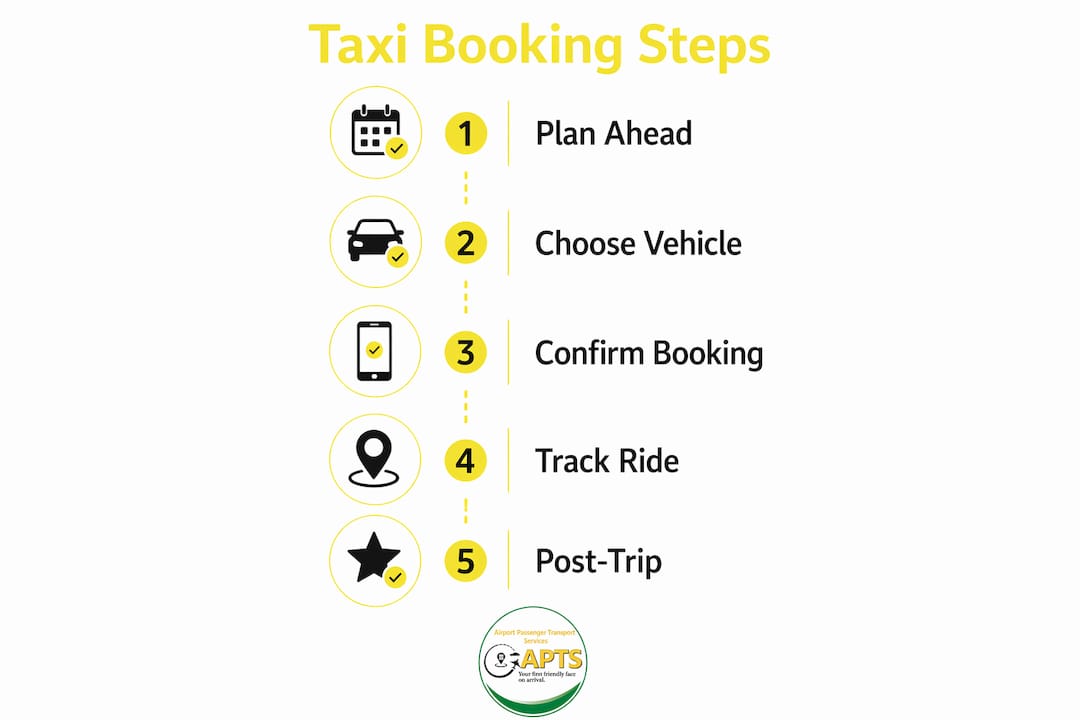
Define the requirement. Confirm the meeting date, location, number of travellers, and any special requests such as child seats, accessibility needs, or luggage volume. Vague briefs produce vague results.
-
Choose the right vehicle and service level. A client visit warrants an executive sedan. An internal team transfer to an off-site venue may suit a standard saloon or minibus. Match the vehicle to the impression you need to make.
-
Book well in advance. Booking 45–60 days ahead for standard corporate needs secures availability and better pricing. Rates increase significantly if you book within 30 days of the meeting date. For larger multi-vehicle events, 90 days is the recommended lead time.
-
Submit a detailed brief. Provide the provider with an attendee list, pick-up addresses, meeting start time, and any flight or train arrival details. For groups, submit flight manifests 14 days out, confirm attendee counts at seven days, and conduct a final driver briefing at 48 hours.
-
Use an online booking portal or corporate travel management platform. Centralised booking programmes reduce administrative burden, enforce travel policy compliance, and provide real-time itinerary updates. Manual phone bookings increase the risk of miscommunication.
-
Confirm the booking and distribute instructions. Send each traveller a confirmation note with the driver’s name, vehicle registration, pick-up time, and a contact number. Do not assume attendees will chase the details themselves.
The table below summarises the recommended booking timeline for different meeting scales.
| Meeting scale | Recommended booking lead time | Key action at each stage |
|---|---|---|
| Single executive transfer | 7–14 days | Confirm pick-up address and meeting time |
| Small group (2–9 passengers) | 14–30 days | Submit attendee list and vehicle preference |
| Large group (10+ passengers) | 45–90 days | Provide flight manifests and conduct driver briefing |
| Multi-day corporate event | 90 days | Agree full schedule, backup protocols, and billing terms |
For groups, consolidating arrivals within 30-minute windows enables shared vehicle use and can reduce costs by up to 35%. This is one of the most underused cost controls in corporate transport planning.
Comparing taxi service options for meetings
Not every transport option suits every meeting. The table below compares the three most common choices for business meeting transport.
| Service type | Cost level | Reliability | Best suited for |
|---|---|---|---|
| Professional corporate taxi | Medium to high | High, with SLA guarantees | Client meetings, executive transfers |
| Executive chauffeur service | High | Very high, with dedicated driver | VIP clients, board-level travel |
| Consumer rideshare app | Low | Variable, no SLA | Internal, low-stakes transfers |
| Shared shuttle | Low to medium | Medium | Large groups, fixed-route events |
Vetted professional transport providers mitigate duty of care risks more effectively than public or rideshare options. Higher upfront costs are offset by risk reduction and travel policy compliance. For corporate travel managers, duty of care is a primary concern, and a provider with documented safety standards and professional drivers addresses that directly.
Consolidated billing is a practical advantage that consumer apps cannot match. A corporate account with a professional provider produces a single monthly invoice, which simplifies expense reporting and supports travel policy audits. Consumer rideshare receipts require individual expense claims from each traveller, which adds administrative work and reduces oversight.
Private vehicles consistently outperform shared shuttles for client-facing meetings. Shared shuttles suit fixed-route group transfers where timing flexibility exists. For a meeting with a specific start time and a client who expects a private welcome, a shared shuttle is the wrong choice regardless of the cost saving.
Common challenges when arranging taxis for meetings
The most frequent failure in corporate taxi arrangements is last-minute booking. Vehicle availability drops sharply within 30 days of a meeting date, and rates increase significantly when demand outpaces supply. The solution is a standing booking policy that sets minimum lead times by meeting type.
Other challenges that regularly disrupt meeting transport include:
- Attendee list changes. A delegate added 24 hours before the meeting can leave a vehicle short on capacity. Update your provider immediately when headcounts change.
- Failure to confirm bookings. A booking made by phone or email is not confirmed until you receive written acknowledgement with a booking reference. Chase it if it does not arrive within two hours.
- Poor driver briefing. Drivers who do not know the meeting venue, the client’s name, or the preferred drop-off point create avoidable delays. Provide a written briefing note for every booking.
- No backup plan. Traffic incidents, vehicle faults, and driver illness happen. A provider without a documented backup protocol is a liability for time-critical meetings.
- Ignoring real-time tracking. Live tracking lets you alert attendees to delays before they become problems. Use it actively, not just as a passive feature.
Pro Tip: For high-stakes client meetings, schedule a taxi pick-up with a 20-minute buffer before the meeting start time. This absorbs minor delays without affecting your client’s first impression.
Modern corporate travel management has shifted from ad-hoc bookings to centralised programmes that provide cost control, oversight, and reporting. Professionals who still book taxis on an ad-hoc basis are accepting unnecessary risk and paying more than they need to.
Key takeaways
Arranging taxi transport for meetings requires advance booking, the right vehicle choice, and a structured communication plan to guarantee punctuality and professionalism.
| Point | Details |
|---|---|
| Book well in advance | Secure vehicles 45–60 days ahead for standard meetings to guarantee availability and pricing. |
| Match vehicle to meeting type | Use executive sedans for client visits and minibuses for larger group transfers. |
| Use centralised booking | Corporate booking platforms reduce admin, enforce policy, and provide real-time updates. |
| Brief drivers thoroughly | Provide written briefing notes with venue details, client names, and drop-off instructions. |
| Plan for disruptions | Confirm your provider has a backup vehicle protocol with a response time of 15–30 minutes. |
Why transport planning is the detail that defines the meeting
I have seen genuinely well-prepared meetings undermined by poor transport arrangements. A senior client left waiting outside a venue because a driver had the wrong address. A board delegation arriving in separate consumer rideshare cars, each with a different arrival time, each looking slightly flustered. These are not dramatic failures. They are quiet ones, and they set the tone before the meeting begins.
The professionals who get this right treat transport as part of the meeting itself, not a logistical afterthought. They choose providers based on documented reliability, not price alone. They brief drivers as carefully as they brief their own teams. And they build in time buffers that protect the meeting from the unpredictable.
One thing I have found consistently useful is separating the vehicle decision from the cost decision. The question is not “what is the cheapest option?” It is “what does this journey say about how we value this client?” For a first-time client meeting or a board-level visit, the answer almost always points toward an executive taxi service with a professional driver and a confirmed booking well in advance.
Corporate travel policies are also evolving. Organisations that once left transport to individual discretion are now building ground transport into their travel programmes, with preferred providers, consolidated billing, and duty of care standards. That shift reflects a broader recognition that transport is not a commodity. It is a professional service that carries real reputational weight.
— Declan
How Apts supports professional taxi arrangements for meetings
Apts provides taxi, executive taxi, and chauffeur services to and from airports across Ireland and Spain, with a fleet suited to both individual executive transfers and larger group bookings.
For professionals arranging transportation for meetings, Apts offers straightforward online booking, a range of vehicle options from standard saloons to executive cars, and reliable scheduling that supports time-critical travel. Whether you are coordinating a single airport pick-up for a visiting client or managing transport for a full delegation, the taxi service selection guide on the Apts website helps you identify the right service level for your specific needs. Explore the guide to make your next booking with confidence.
FAQ
How far in advance should I book a taxi for a business meeting?
Book 45–60 days ahead for standard corporate meetings and 90 days for large multi-vehicle events. Rates increase and availability drops significantly within 30 days of the meeting date.
What vehicle type is best for a client meeting?
Executive sedans such as the Mercedes S-Class or BMW 7-Series are the standard choice for client-facing meetings. They provide comfort, luggage capacity, and a professional presentation that reflects well on your organisation.
How do professional taxi services handle delays?
Reputable corporate transport providers maintain backup vehicle protocols with response times of 15–30 minutes. Confirm this arrangement with your provider before confirming the booking.
Is a corporate taxi account worth it for regular meeting transport?
A corporate account provides consolidated billing, dedicated support, and travel policy compliance. For organisations with regular meeting transport needs, the administrative saving and reliability improvement justify the account setup.
How do I manage transport when attendee numbers change?
Notify your provider immediately when headcounts change, even by one or two people. For groups, confirm final attendee counts seven days before the meeting and conduct a final review at 48 hours to avoid capacity shortfalls on the day.
Recommended
- How to schedule a taxi pick up: a traveller’s guide
- Ways to save on airport taxis: your 2026 guide
- Special needs airport taxi: your 2026 accessibility guide
- Taxi services for families: your 2026 guide
Article checked by Declan Rodden.