

Successful holiday airport travel depends on one thing above all others: precise planning of your timing and transport before you leave home. The standard guidance is 2 hours for domestic flights and 3 hours for international departures, but those figures assume normal conditions. During peak holiday periods, add at least 30 minutes to both. Transport to the airport is equally critical. A missed connection or a full car park can unravel even the best-laid plans. This guide covers arrival timing, transport options, terminal navigation, and return journey prep so you arrive at every stage with confidence.
How to plan holiday airport travel: timing your arrival correctly
Arrival time is the single most controllable variable in your airport experience. Arriving 2 hours before domestic flights and 3 hours before international flights is the baseline. During christmas, easter, and summer bank holidays, those baselines shift upward by 30 minutes minimum.
The reason is straightforward. Security queues at major hubs like Dublin Airport can double in length during peak periods. Check-in desks process more passengers, baggage drop queues extend, and car parks fill earlier than usual. Each of these adds time you cannot recover once you are inside the terminal.
Your personal circumstances also affect the right arrival time. Travelling with checked luggage adds 15–20 minutes to your airport process compared to carry-on only. Families with young children, passengers with mobility requirements, or travellers connecting through a large hub should build in additional time beyond the standard buffers.
The table below summarises recommended arrival times across common travel scenarios.
| Scenario | Recommended arrival time |
|---|---|
| Domestic flight, no checked bags | 90 minutes before departure |
| Domestic flight, checked bags | 2 hours before departure |
| International flight, standard | 3 hours before departure |
| International flight, peak holiday period | 3 hours 30 minutes before departure |
| Large hub, connecting flight | 3 hours 30 minutes or more before departure |
| Early morning long-haul departure | 3 hours 30 minutes before departure |
Pro Tip: If your flight falls on christmas day or new year’s day itself, consider shifting your travel date by one day. Changing your flight date by even 24 hours can reduce airport crowding significantly and often lowers the fare.
How can you plan transport to and from the airport during busy holiday seasons?
Transport planning is where most holiday travellers lose time and money. Leaving it to the day of travel is a reliable way to add stress to what should be a straightforward process.

Booking airport parking online at least a week before your departure secures your space and typically costs less than drive-up pricing. During peak periods, car parks at major airports fill days in advance. An online reservation removes that risk entirely. For guidance on keeping costs down, the Apts airport taxi savings guide covers practical options for travellers who prefer not to drive.
Drop-off logistics matter just as much as parking. Using alternative drop-off points such as ‘Kiss and Fly’ areas or arrivals-level drop-off zones can save 15–30 minutes compared to standard curbside drop-off during busy periods. That time saving is not trivial when queues are long and your departure window is tight.
The top transport planning steps for holiday airport travel are:
- Book parking or transfers in advance. Do not leave this until the week of travel during peak periods.
- Use ‘Kiss and Fly’ or alternative drop-off zones. These areas have less congestion and faster access to terminal entrances.
- Consider a pre-booked taxi or chauffeur service. A professional driver monitors your flight time and adjusts pick-up accordingly.
- Check public transport schedules the night before. Bus and rail timetables change during bank holidays, and reduced services catch travellers off guard.
- Book refundable or flexible fares where possible. Protection and flexibility now outweigh lowest cost for experienced holiday travellers.
- Coordinate your transport departure time with your arrival time target. Work backwards from your recommended airport arrival time to set when you leave home.
Pro Tip: For families or groups, a pre-booked airport transfer service removes the coordination burden entirely. One vehicle, one confirmed time, and a professional driver who tracks your flight.
What are the best practices for navigating airports efficiently?
Efficient airport navigation begins before you reach the terminal. Online check-in and mobile boarding passes allow you to bypass check-in queues entirely and move directly to security. Completing check-in 24 hours before departure is the single most effective step for reducing time spent at the airport.
Once inside, the layout of large hubs adds complexity that many travellers underestimate. Airport walking distances and airside transit trains can add 15–30 minutes to your journey from security to gate at major airports. Checking the terminal map before you travel means you know exactly where your gate is and whether you need a transit connection.
The following steps cover efficient airport navigation from kerb to gate:
- Complete online check-in 24 hours before departure. Download your boarding pass to your phone so you have it offline if connectivity fails.
- Check security wait times before you leave home. Many major airports publish live queue data through their official apps or websites.
- Download the official airport app. Real-time notifications about gate changes and security queue lengths reduce anxiety and help you respond quickly to changes.
- Review the terminal map in advance. Identify your check-in zone, security lane, and gate concourse before you arrive.
- Allow for transit trains post-security. At airports like Dublin, some gates require an airside bus or train connection. Build this into your timing.
- Know your pick-up point on arrival. If someone is collecting you, confirm the exact meeting point before you land. Arrivals halls at busy airports have multiple exit points.
Pro Tip: Set your airport app to send push notifications for your flight. Gate changes and security alerts delivered in real time mean you react in minutes rather than discovering a change at the gate.
What prep steps should holiday travellers take for departure and return journeys?
Departure preparation starts at least 24 hours before you leave. Check your passport validity, confirm any visa requirements for your destination, and complete online check-in as soon as the window opens. Leaving documentation checks until the morning of travel is a common source of avoidable stress.
Planning the return leg of your holiday is where most travellers fall short. Disruptions happen more frequently on return journeys, particularly during peak periods when flights are full and rebooking options are limited. Build a longer buffer into your return airport arrival time and identify alternate airports or flight schedules before you travel, not after a disruption occurs.
Booking travel insurance early and selecting flexible ticketing options gives you genuine protection when plans change. The cost difference between a standard and a flexible fare is modest compared to the cost of a missed flight or an unplanned overnight stay.
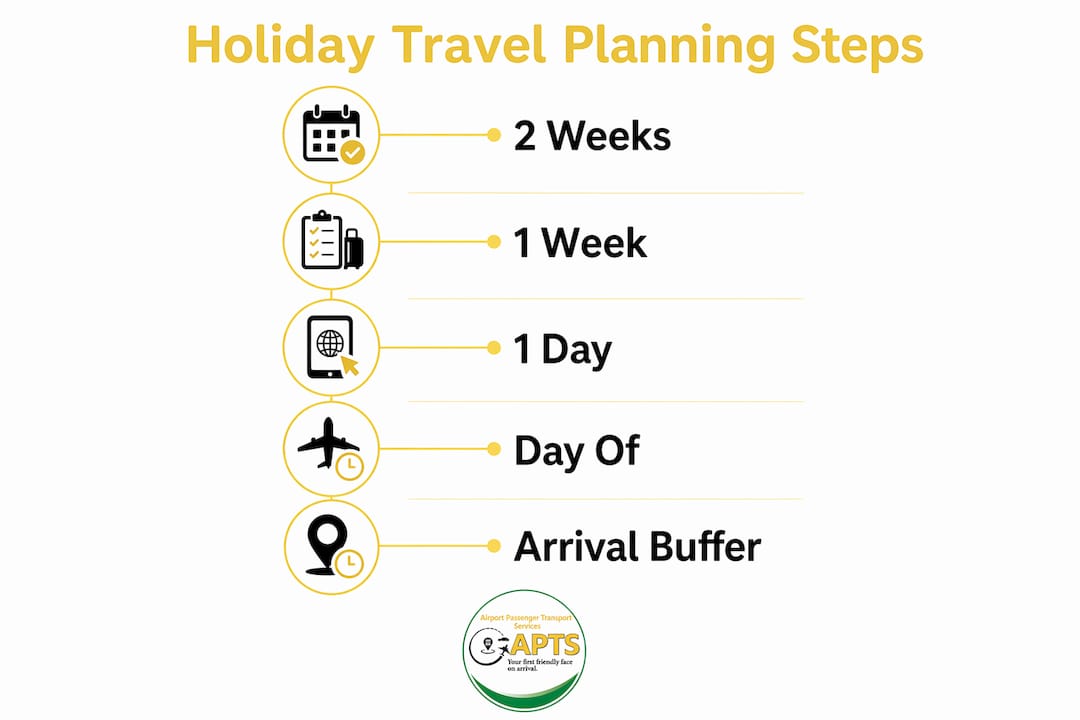
The table below outlines a practical prep timeline for both legs of your holiday journey.
| Stage | Departure | Return |
|---|---|---|
| 2 weeks before | Book parking or transfer; check passport validity | Confirm return flight details; check connection times |
| 1 week before | Book flexible or refundable fares if not done | Identify alternate airports as contingency |
| 24 hours before | Complete online check-in; review documentation | Check return flight status; confirm pick-up arrangements |
| Day of travel | Leave home at calculated time; use mobile boarding pass | Allow extended buffer; use airport app for real-time updates |
Pro Tip: For multi-leg or long-haul return journeys, check your connection time against the minimum connection time published by the airport. If your layover falls below that threshold, contact your airline before travel rather than hoping for the best at the gate.
Key takeaways
Effective holiday airport travel planning requires confirmed transport, correct arrival buffers, and thorough preparation for both the outbound and return legs of your journey.
| Point | Details |
|---|---|
| Arrival time buffers | Allow 2 hours for domestic and 3 hours for international flights, adding 30 minutes during peak holiday periods. |
| Book transport in advance | Pre-book parking or a transfer service at least one week ahead to avoid full car parks and last-minute costs. |
| Use alternative drop-off zones | ‘Kiss and Fly’ and arrivals-level drop-off areas save 15–30 minutes compared to standard curbside queues. |
| Navigate with technology | Download the official airport app and complete online check-in 24 hours before departure to reduce time at the terminal. |
| Plan the return journey | Most disruptions occur on return legs; build in longer buffers and identify alternate flight options before you travel. |
What I have learned from years of watching holiday travel go wrong
The single most consistent mistake I see is treating the outbound flight as the only journey that needs planning. Travellers spend weeks organising their departure and give almost no thought to how they will get home. Return journey disruptions are where holidays unravel, and they are almost always avoidable with 30 minutes of preparation before you leave.
The second mistake is underestimating the holiday surge. Travellers who fly regularly in quieter periods assume they know how long their airport takes. They do not account for the fact that a terminal operating at peak capacity behaves like a completely different building. Security queues, baggage drop, and car park access all slow down in ways that catch experienced travellers off guard.
Technology has genuinely changed what is possible here. Official airport apps now deliver gate change alerts and security queue data in real time. Travellers who use them arrive at their gates calmer and better informed than those who rely on departure boards alone. The habit takes five minutes to set up and pays back every time you travel.
My strongest recommendation is to plan your transport first, not last. Once you have a confirmed pick-up or drop-off arrangement, everything else falls into place around it. Apts offers pre-booked airport transfer services across Ireland and Spain, and the difference between a confirmed booking and an improvised arrangement on a busy holiday morning is considerable.
— Declan
Reliable airport transfers that take the pressure off your holiday travel
Pre-booked airport transfers remove the most unpredictable element from your holiday travel plan: getting to and from the terminal on time. Apts provides professional taxi, executive taxi, and chauffeur services to and from airports across Ireland and Spain, with drivers who monitor your flight and adjust pick-up times accordingly.

Whether you are travelling as a family, a business executive, or a group, Apts has a vehicle and service level to match. Families benefit from spacious, comfortable vehicles with no luggage stress. Business travellers can use the journey time productively in a quiet, professional environment. For a full overview of available options, the Apts taxi service selection guide covers everything you need to choose the right service for your journey. For those travelling with family, the dedicated taxi services for families guide outlines exactly what to expect.
FAQ
How early should I arrive at the airport during holidays?
Arrive 2 hours before domestic flights and 3 hours before international flights, adding 30 minutes during peak holiday periods such as christmas and easter.
What is the best way to travel to the airport during busy periods?
A pre-booked taxi or chauffeur service is the most reliable option, as the driver monitors your flight and adjusts timing. Public transport is a lower-cost alternative but check for reduced holiday timetables the night before.
Does online check-in really make a difference at the airport?
Yes. Completing check-in 24 hours before departure and using a mobile boarding pass allows you to skip check-in queues and move directly to security, saving significant time.
Should I book airport parking in advance for holiday travel?
Booking parking online at least a week ahead secures your space and typically costs less than drive-up pricing. During peak periods, car parks fill days in advance.
How should I plan my return journey from holiday?
Build a longer arrival buffer into your return trip and identify alternate airports or flight options before you depart. Most disruptions occur on return legs, so having a contingency plan in place before you travel is the most effective protection.
Recommended
- Best transport options to airports: your 2026 guide
- Top airport pick-up tips for stress-free travel in 2026
- Tips for stress-free airport transfers in 2026
- The role of airport transfer in holidays: 2026 guide
Article checked by Declan Rodden.