

Luggage policies for airport taxis are defined by vehicle capacity, driver safety obligations, and the accuracy of information provided at the time of booking. These policies vary depending on whether you travel in a standard saloon, an estate, an MPV, or an executive vehicle. Drivers hold the legal right to refuse luggage that cannot be safely secured, and no taxi transfer overrides your responsibility to comply with airline baggage allowances. Understanding these rules before you travel is the single most effective way to avoid refusals, delays, and unexpected costs at the airport.
What are the luggage policies for airport taxis?
Airport taxi baggage rules are not governed by a single universal standard. Instead, they are shaped by three factors: the licensed vehicle type, the number of passengers travelling, and the specific luggage disclosed at the time of booking. Taxi drivers can refuse fares if luggage is excessive or cannot be safely secured within the vehicle. This is not a matter of discretion. It is a legal and safety obligation.
Travellers also carry a separate responsibility that many overlook. Even when a taxi service assists with luggage transport, airline baggage rules apply independently. Your taxi provider does not absorb excess baggage charges from your airline. You remain liable for those costs regardless of how your bags travel to the airport.

The practical implication is straightforward. Matching your luggage to the right vehicle, and disclosing that luggage accurately when booking, is the foundation of a smooth airport transfer.
How do different vehicle types accommodate luggage?
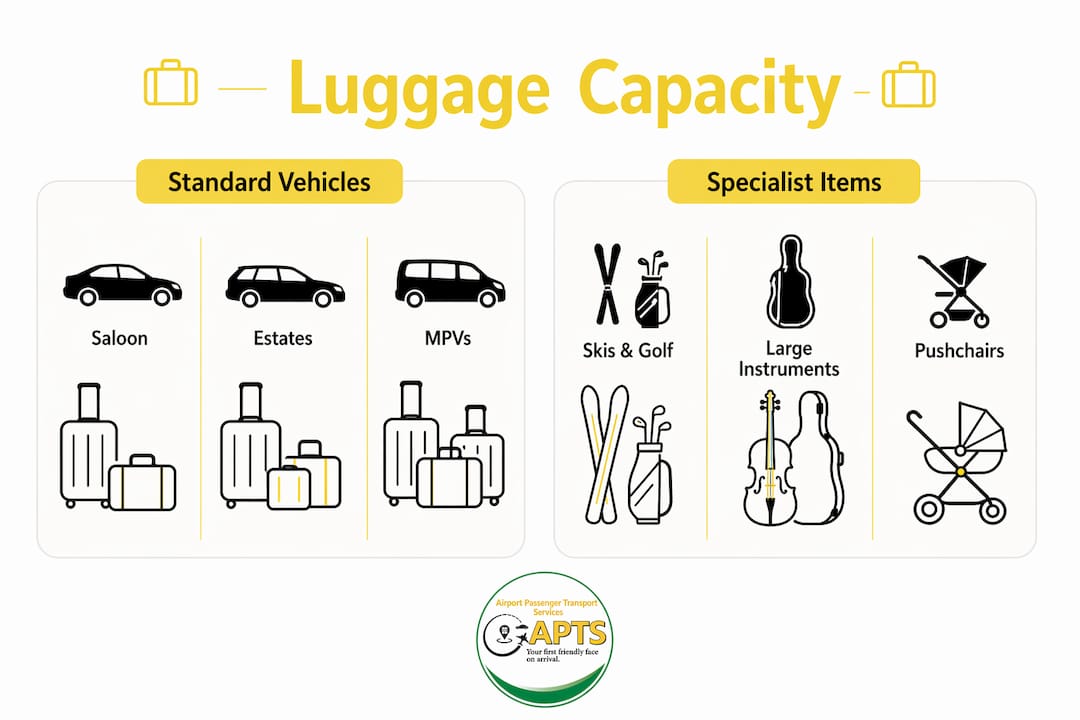
Vehicle type is the primary determinant of how much luggage an airport taxi can carry. The table below summarises typical capacities across the most common vehicle categories.
| Vehicle type | Passengers | Large suitcases | Carry-on bags | Notes |
|---|---|---|---|---|
| Standard saloon | Up to 4 | 2 | 2 | Limited boot space; suits light travellers |
| Estate car | Up to 4 | 3 | 2 | Larger boot; better for families |
| MPV (6 or 7 seat) | Up to 6 | 3 to 4 | 3 | Rear seat use reduces boot space |
| Executive saloon | Up to 4 | 2 | 2 | Premium comfort; similar boot to saloon |
| Minibus | Up to 8 | 6 to 8 | 4 to 6 | Best for groups with heavy luggage |
Standard saloon cars typically hold two large suitcases plus two carry-on bags, while estates and MPVs offer meaningfully larger capacities. The critical detail most travellers miss is that passenger seating directly affects available luggage space. A fully occupied MPV with six passengers will have considerably less boot room than the same vehicle carrying three. Vehicle luggage space is dynamically affected by passenger seating, so the number of people in the vehicle matters as much as the vehicle type itself.
Oversized and specialist items
Skis, golf clubs, pushchairs, and large musical instruments require specific planning. Larger items like skis or golf clubs require estate cars or MPVs with foldable seats, and prior notice to the provider is non-negotiable. Turning up at an airport taxi rank with a set of golf clubs and no pre-arrangement is one of the most common causes of refusal. The driver simply may not have the vehicle to accommodate the item safely.
Pro Tip: When booking for ski or golf travel, specify the exact number of bags, their approximate dimensions, and whether they are in hard or soft cases. This gives the operator the information needed to dispatch the correct vehicle.
For groups travelling with extensive luggage needs, a minibus or people carrier is almost always the right choice. It removes the guesswork and eliminates the risk of a last-minute refusal.
Why does pre-booking with accurate luggage details matter?
Pre-booking an airport taxi with precise luggage information is the most reliable way to guarantee the right vehicle arrives. Pre-booking allows matching vehicle size to luggage needs, reducing refusals and delays that are otherwise common at busy airport taxi ranks. Without a pre-booking, you are relying on whatever vehicle happens to be at the front of the queue. That vehicle may simply not fit your bags.
Incorrect luggage information on pre-booking can lead to wasted journeys, extra costs, and delays due to vehicle mismatch. This is a practical consequence, not a theoretical risk. If you book a standard saloon and arrive with four large suitcases, the driver is within their rights to decline the fare. You then face the cost and delay of arranging an alternative vehicle, often at short notice in a busy terminal.
When booking, provide the following details as standard:
- The total number of passengers travelling
- The number and size of large checked suitcases
- The number of carry-on bags or cabin bags
- Any oversized or specialist items (skis, golf clubs, prams, wheelchairs)
- Any special requirements, such as accessibility needs or fragile items
Travellers frequently underestimate luggage volume, and specifying exact counts and sizes in booking notes consistently improves outcomes. The discipline of counting your bags before you book, rather than estimating, takes thirty seconds and removes the most common source of airport taxi problems.
Pro Tip: If you are unsure whether your luggage will fit, book up one vehicle size. The marginal cost difference is far smaller than the cost of a refused fare or a missed flight.
For guidance on scheduling your transfer around your luggage volume and group size, planning ahead makes a measurable difference to the experience.
What are the driver and passenger responsibilities for luggage?
Both drivers and passengers carry defined responsibilities when it comes to airport taxi luggage handling. Understanding these responsibilities prevents disputes and protects both parties.
Driver responsibilities:
- Accommodate reasonable luggage that fits safely within the licensed vehicle
- Refuse luggage that obstructs the driver’s view or cannot be properly secured
- Operate within the conditions of their vehicle licence, which may restrict certain vehicle configurations
- Assist with loading where reasonable, without obligation to handle items beyond safe capacity
Passenger responsibilities:
- Disclose accurate luggage details at the time of booking
- Comply with all airline baggage allowances, regardless of taxi transfer arrangements
- Accept that drivers may refuse luggage that obstructs view or risks safety, such as loose or oversized items not secured properly
- Arrange appropriate vehicles for oversized or specialist items in advance
Taxi drivers’ practical luggage policy balances safety and service: if luggage fits securely, it is accepted. If it cannot be safely accommodated, refusal is both permitted and appropriate.
Some transfer services disclaim liability for excess airline baggage charges despite assisting with luggage. Verifying both your airline’s baggage policy and your taxi provider’s terms before travel is the responsible approach. The two sets of rules operate independently, and confusion between them is a frequent source of unexpected costs. For more on driver standards and responsibilities, understanding what your driver is and is not obligated to do helps set realistic expectations.
Practical tips for managing luggage on your airport taxi journey
Preparation before the journey is far more effective than problem-solving at the kerbside. The following practices consistently produce smoother airport taxi experiences for travellers with varying luggage volumes.
- Book in advance and specify everything. Hailing a taxi at the rank with significant luggage is a risk. Without pre-booking, travellers risk inappropriate vehicle allocation, often leading to refusal of luggage that could otherwise have been accommodated.
- Choose the right vehicle for your group. Two passengers with four large suitcases need an estate or MPV, not a standard saloon. Match the vehicle to the luggage, not just the headcount.
- Arrive at the correct meeting point. Many airports have designated pick-up zones for pre-booked taxis. Knowing your meeting point in advance avoids rushed loading in restricted areas.
- Secure loose items before travel. Bags placed in the passenger compartment rather than the boot must be secured. Loose items that shift during transit are a safety concern and a legitimate ground for refusal.
- Confirm oversized items at booking and again at confirmation. A brief note at booking and a confirmation message the day before travel removes any ambiguity about what the driver should expect.
- Check your airline’s baggage rules independently. Your taxi provider does not manage your airline allowance. Arriving at the airport with overweight bags is your responsibility to resolve, regardless of how smoothly the taxi transfer went.
For travellers with specific accessibility or special requirements, the same principle applies. Disclose requirements at booking, confirm them in advance, and choose a provider experienced in accommodating those needs.
Standard luggage fitting into taxi vehicles typically incurs no extra fee. However, oversized items or situations requiring a second vehicle will result in additional costs. Knowing this in advance allows you to budget accurately and avoid surprises.
Key takeaways
Luggage policies for airport taxis depend on vehicle type, passenger numbers, and booking accuracy. Pre-booking with precise luggage details is the single most effective way to avoid refusals, delays, and extra costs.
| Point | Details |
|---|---|
| Vehicle type determines capacity | Standard saloons hold two large cases; MPVs and estates carry significantly more. |
| Passenger numbers reduce boot space | A fully occupied MPV has less luggage room than the same vehicle with fewer passengers. |
| Pre-booking prevents refusals | Accurate luggage disclosure at booking ensures the correct vehicle is dispatched. |
| Drivers can legally refuse unsafe loads | Luggage that cannot be safely secured is grounds for refusal under licensing conditions. |
| Airline rules remain your responsibility | Taxi transfers do not affect your obligation to comply with airline baggage allowances. |
Why travellers get this wrong more often than they should
Declan’s perspective
After years of working in ground transport across Ireland and Spain, the pattern I see most often is straightforward. Travellers think about their luggage in terms of how many bags they have, not how much space those bags actually occupy. A family of four with two large checked bags, two cabin bags, a pushchair, and a car seat is not a standard saloon booking. It is an MPV booking at minimum, and possibly a minibus.
The second issue is confidence in estimation. Most people genuinely believe they know how much luggage they have until they are standing at the kerbside counting it. Specifying exact bag counts and sizes during booking is not bureaucratic. It is the difference between a smooth transfer and a stressful one.
I have seen drivers turn away fares not because they were being difficult, but because the passenger arrived with twice the luggage they declared. The driver had no choice. The vehicle could not safely carry it. That situation is entirely avoidable, and the fix costs nothing beyond a few extra seconds during the booking process.
The travellers who consistently have the best experiences are the ones who over-communicate. They list every bag. They mention the golf clubs. They confirm the day before. That level of preparation is not excessive. It is simply what good travel planning looks like.
— Declan
Travel with confidence: how Apts handles your luggage needs
Planning an airport transfer with significant luggage should not be a source of concern. Apts offers a range of vehicle types across Ireland and Spain, from executive saloons to spacious MPVs and minibuses, each suited to different passenger counts and luggage volumes.

When you book with Apts, you can specify your exact luggage requirements during the booking process. Professional chauffeurs are briefed in advance, and the correct vehicle is dispatched to match your needs. There are no last-minute surprises at the kerbside. For families travelling with pushchairs and multiple cases, the family taxi guide outlines the vehicle options best suited to your journey. For business travellers, executive taxi services combine premium comfort with practical luggage capacity. Book in advance, specify your bags, and travel with confidence.
FAQ
What are the standard luggage limits for airport taxis?
Airport taxi luggage limits depend on vehicle type. A standard saloon typically accommodates two large suitcases and two carry-on bags, while estates, MPVs, and minibuses carry significantly more.
Can a taxi driver refuse my luggage at the airport?
Yes. Hackney carriage drivers can refuse fares if luggage is excessive or cannot be safely secured within the vehicle. This applies to oversized items, unsecured loads, and luggage that obstructs the driver’s view.
Are there extra fees for luggage in airport taxis?
Standard luggage that fits within the vehicle typically incurs no additional fee. Oversized items or situations requiring a second vehicle will result in extra costs, so declaring all luggage at booking is the best way to receive an accurate price.
Do I need to tell my taxi provider about oversized items like skis or golf clubs?
Yes, and prior notice is non-negotiable. Specialist items require estate cars or MPVs with foldable seats. Arriving at a taxi rank with skis or golf clubs without a pre-arranged vehicle is one of the most common causes of fare refusal.
Does my taxi transfer affect my airline baggage allowance?
No. Airline baggage rules apply independently of any taxi transfer arrangement. Your taxi provider does not manage your airline allowance, and excess baggage charges from your airline remain your responsibility regardless of how your bags travel to the airport.
Recommended
- Your essential UK airport taxi guide: easy, reliable rides
- Ways to save on airport taxis: your 2026 guide
- Airport taxi pricing explained: a traveller’s guide
- Your guide to reliable airport taxi services abroad
Article checked by Declan Rodden.