

A special needs airport taxi is a dedicated transport service designed to carry passengers with disabilities or complex mobility requirements safely and comfortably to and from airports. These vehicles go beyond standard taxis by incorporating ramps, hydraulic lifts, wheelchair securement systems, and trained drivers who understand the specific demands of accessible airport transfers. For families and individuals managing conditions such as spinal cord injuries, cerebral palsy, or degenerative mobility disorders, choosing the right accessible airport transportation is not a minor logistical detail. It is the difference between a dignified journey and a distressing one.
What makes a taxi suitable for special needs airport passengers?
The physical features of a vehicle determine whether an accessible airport transfer is genuinely safe or merely compliant on paper. Suitable vehicles typically include rear or side-entry ramps, hydraulic or fold-out lifts, and reinforced floor tracking for wheelchair securement. Larger modified minivans and purpose-built WAVs (Wheelchair Accessible Vehicles) are the most common formats used by professional providers.
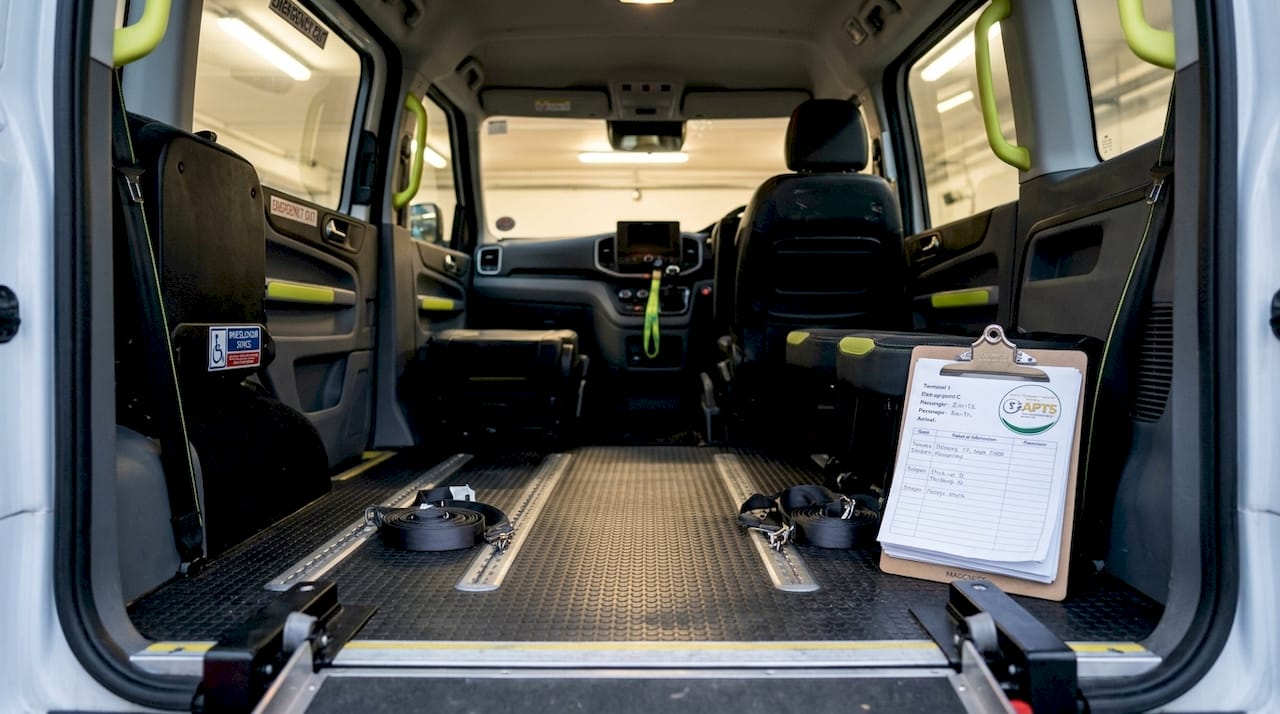
Device-specific requirements often determine successful boarding more than the vehicle type itself. A vehicle labelled “accessible” may not accommodate a power wheelchair exceeding certain weight limits or a scooter with a wide turning radius. Passengers must share exact dimensions, weight, and battery type for their mobility device at the time of booking, not on the day of travel.
Key vehicle features to confirm before booking:
- Ramp or lift type: Fold-out ramps suit manual wheelchairs; hydraulic lifts are required for heavier power chairs
- Floor securement: Four-point tie-down systems or Q-Straint-style belts hold wheelchairs safely during transit
- Interior headroom: Power wheelchair users often require higher roof clearance than standard WAVs provide
- Seatbelt provision: Shoulder and lap restraints must be available for passengers who transfer to a seat
- Driver training: Confirm the driver is trained in operating securement equipment and assisting with boarding
Pro Tip: Ask the provider to confirm the exact vehicle model and its maximum wheelchair weight capacity before you finalise your booking. “Wheelchair accessible” is a category, not a specification.
How do legal requirements influence airport taxi for special needs passengers?
The Americans with Disabilities Act (ADA) sets the benchmark most frequently cited in accessible ground transport discussions, and its principles inform similar frameworks in Ireland, Spain, and across the EU. Under the ADA, private transportation providers including taxis and airport shuttles must provide accessible or equivalent service at comparable cost and timing, in an integrated setting. This means a provider cannot charge more for an accessible vehicle or make a disabled passenger wait significantly longer than a non-disabled passenger.
Passengers should understand that compliance is a legal obligation, not a courtesy. Providers who fail to meet these standards can face formal complaints and regulatory action. Knowing your rights before you travel gives you the confidence to advocate clearly if a service falls short.
The table below summarises the core accessibility obligations and how they translate into real service expectations:
| Obligation | What it means in practice |
|---|---|
| Equivalent service | Accessible vehicles must be available at comparable wait times to standard taxis |
| Non-discrimination on fares | Providers cannot charge a premium for wheelchair accessible taxis |
| Reservation access | Passengers with disabilities must be able to book through the same channels as other passengers |
| Schedule parity | Accessible services must operate during the same hours as standard services |
| Integrated setting | Disabled passengers must not be segregated or directed to inferior facilities |
JFK Airport provides a practical example of this framework in action, offering accessible taxis, ride shares, shuttles, and rental options with dedicated contact information for passengers with disabilities. This multi-modal approach reflects the standard that major international airports are expected to meet.
What are best practices for booking a special needs airport taxi?
Pre-booking is the single most important step in any accessible airport transfer. Barcelona El Prat Airport does not provide same-day wheelchair accessible transfers at all, due to the limited number of ramp-equipped vehicles available. This is not unusual. At most busy airports, the pool of genuinely accessible taxis is small, and same-day requests frequently cannot be fulfilled.
Follow these steps to book and coordinate effectively:
- Book as early as possible. Confirm your accessible vehicle at least 48 to 72 hours before travel, and ideally at the time you book your flight.
- Coordinate with your airline. Qatar Airways requires passengers to request mobility assistance at least 48 hours before departure. Aligning your taxi booking with your airline’s assistance timeline prevents gaps at the airport.
- Provide complete device information. Share the make, model, dimensions, and weight of your wheelchair or mobility aid when booking. Do not assume the provider will ask.
- Clarify pick-up type. Confirm whether the service is door-to-door or curbside. Access-A-Ride in New York City operates a door-to-door model specifically because curbside pick-up is insufficient for many passengers with disabilities.
- Understand the waiting time policy. Many accessible transfer providers in Europe include approximately one hour of waiting after the scheduled arrival time before additional charges apply. Confirm this figure in writing before travel.
- Share your flight number. Reputable providers use flight tracking to monitor delays automatically, but you should still notify them of any significant changes as early as possible.
Pro Tip: Prepare a short written summary of your mobility requirements, device specifications, and any medical considerations. Send it to your driver or provider the day before travel. It removes ambiguity and gives the driver time to prepare the correct vehicle configuration.
Accessible taxis vs shuttle services vs paratransit: which is right for you?
These three transport modes serve different needs, and choosing the wrong one creates unnecessary stress. Understanding the distinctions helps families and individuals select the service that genuinely fits their situation.
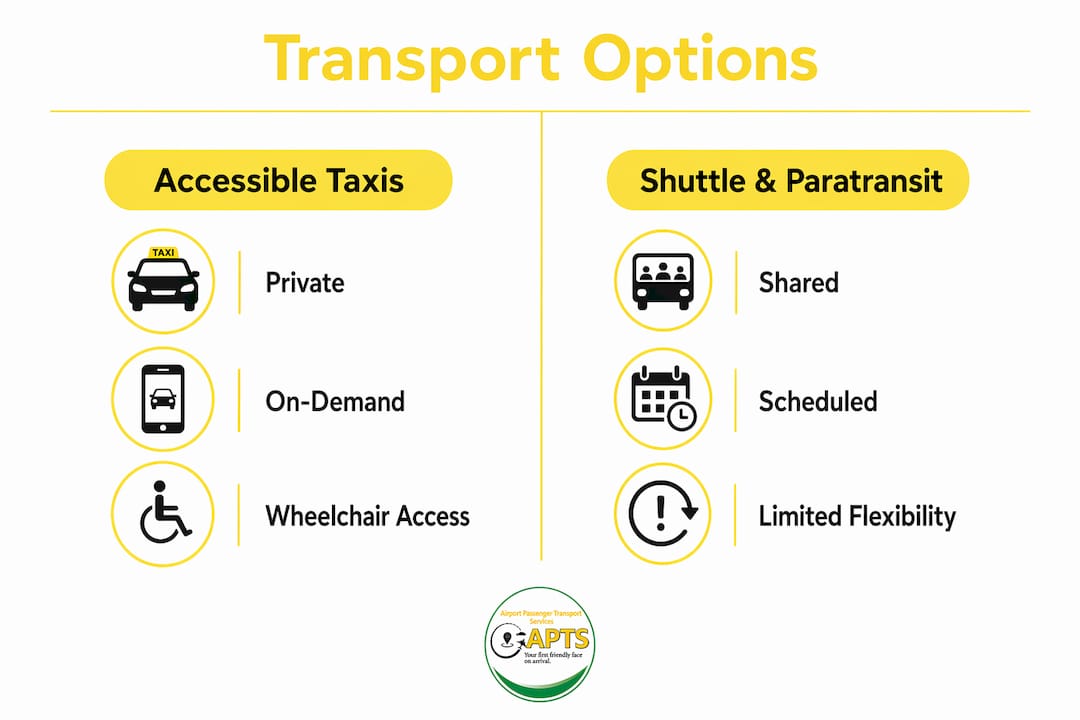
Accessible taxis offer private, on-demand transport with a single vehicle dedicated to your party. They are the most flexible option and the most appropriate for passengers with complex mobility needs, time-sensitive connections, or large amounts of equipment.
Airport shuttle services carry multiple passengers and follow fixed routes or schedules. Some shuttle operators offer accessible vehicles, but shared routing means longer journey times and less control over boarding and alighting points. For passengers who transfer independently and have straightforward mobility needs, an accessible shuttle can be a cost-effective choice.
Paratransit services such as Access-A-Ride provide 24-hour, door-to-door transport for people whose disabilities prevent them from using standard public transit. Fares match public transit pricing, but eligibility requires medical documentation and advance registration. Paratransit is not available at all airports and is generally unsuitable for one-off or tourist journeys.
| Service type | Best for | Key limitation |
|---|---|---|
| Accessible private taxi | Complex mobility needs, direct routes | Higher cost than shared options |
| Accessible shuttle | Budget-conscious, independent travellers | Shared routing, longer journey times |
| Paratransit (e.g., Access-A-Ride) | Registered local residents with disabilities | Requires eligibility documentation; not tourist-friendly |
How to prepare and communicate for a smooth accessible airport transfer
Clear communication before travel is the most reliable way to prevent problems on the day. Providers cannot accommodate needs they do not know about, and assumptions on either side lead to mismatched vehicles, delayed departures, and unnecessary distress.
Practical preparation steps for families and individuals:
- Prepare documentation. Carry any medical or eligibility paperwork that confirms your mobility requirements. Some providers and airports request this for specialist assistance.
- Use flight tracking tools. Apps such as FlightAware or Flightradar24 let you monitor your flight status in real time and share updates with your driver promptly.
- Confirm the meeting point in writing. Accessible pick-up points at airports are often separate from standard taxi ranks. Confirm the exact location with your provider before you travel.
- Know your rights. Accessibility obligations are a compliance requirement, not a favour. If a provider fails to supply the agreed vehicle or charges an unjustified premium, you have grounds to raise a formal complaint.
- Build buffer time. Disembarkation for passengers with mobility aids takes longer than standard deplaning. Allow at least 30 additional minutes between your scheduled landing and your taxi pick-up window.
Pro Tip: Create a one-page “transport information sheet” listing your name, flight details, mobility device specifications, emergency contact, and any medical considerations. Give a copy to your driver, your airline’s ground assistance team, and a family member at home.
Key takeaways
Successful accessible airport transfers depend on pre-booking, precise device information, and clear communication with both the provider and the airline.
| Point | Details |
|---|---|
| Pre-book without exception | Same-day accessible taxis are often unavailable; book 48 to 72 hours in advance at minimum. |
| Share device specifications | Provide wheelchair dimensions, weight, and battery type to confirm genuine vehicle compatibility. |
| Align airline and taxi bookings | Coordinate mobility assistance requests with your airline’s deadlines to avoid timing gaps at the airport. |
| Understand waiting time policies | Confirm how long the provider waits after arrival and what additional charges apply if your flight is delayed. |
| Know your legal rights | Under the ADA and equivalent EU frameworks, accessible services must be provided at comparable cost and timing to standard options. |
Why empathy and preparation matter more than vehicle specs alone
From my experience working with travellers who have complex mobility needs, the most common point of failure in accessible airport transfers is not the vehicle. It is the communication gap between what the passenger needs and what the provider has been told.
Drivers who arrive with the right vehicle but the wrong configuration, families who discover at the airport that their power chair exceeds the vehicle’s weight limit, passengers who are left waiting because no one confirmed the accessible pick-up point. These situations are avoidable, and they are almost always the result of assumptions rather than malice.
The regulatory frameworks are clear. Providers are obligated to deliver equivalent service at comparable cost. But compliance on paper does not guarantee a smooth experience in practice. The families and individuals who travel most confidently are those who treat the booking process as a detailed briefing, not a simple reservation.
My honest recommendation is this: do not rely on a provider’s general accessibility claim. Ask specific questions. Confirm in writing. And build your itinerary around the assumption that disembarkation will take longer than expected, because it almost always does. Preparation is not pessimism. It is the most respectful thing you can do for yourself or the person you are travelling with.
— Declan
Plan your accessible airport transfer with Apts
Apts provides professional taxi and executive chauffeur services to and from airports throughout Ireland and Spain, with vehicles and drivers selected for reliability, comfort, and attentiveness to passenger needs.

Whether you are arranging an airport transfer for a family member with mobility requirements or coordinating a group journey with specialist equipment, Apts offers a tailored, pre-bookable service with full flight monitoring and clear communication from booking to arrival. Explore the taxi services for families guide for a full overview of accessible options, or visit the airport transfer process guide to understand exactly what to expect on the day. For immediate bookings, visit Apts book now.
FAQ
What is a special needs airport taxi?
A special needs airport taxi is a vehicle service equipped with accessibility features such as ramps, lifts, and wheelchair securement systems, designed to transport passengers with disabilities safely to and from airports. These services are distinct from standard taxis and require advance booking in most cases.
How far in advance should I book an accessible airport taxi?
Book at least 48 to 72 hours before travel. Barcelona El Prat Airport does not offer same-day accessible taxi bookings at all, and limited vehicle availability at most airports makes last-minute requests unreliable.
Are accessible airport taxis more expensive than standard taxis?
Under the ADA and equivalent EU regulations, providers cannot charge more for accessible vehicles than for standard taxis. If a provider applies a premium specifically for accessibility, this may constitute a breach of non-discrimination obligations.
What information should I provide when booking an accessible taxi?
Provide the make, model, dimensions, and weight of your mobility device, along with any medical considerations, your flight number, and your preferred pick-up point. Detailed information at the booking stage prevents vehicle mismatches on the day of travel.
What is the difference between paratransit and an accessible airport taxi?
Paratransit services such as Access-A-Ride are publicly funded, door-to-door programmes for registered residents with disabilities, operating at public transit fares. Accessible airport taxis are private, on-demand services available to any passenger, without eligibility requirements or advance registration.
Recommended
- How to get airport pickup: a clear 2026 guide
- Taxi services for families: your 2026 guide
- Sustainable airport transfers: your 2026 green travel guide
- Your essential UK airport taxi guide: easy, reliable rides
Article checked by Declan Rodden.