

Arriving at an unfamiliar airport and stepping into a taxi should be straightforward. Yet for many travellers, the moment the meter starts or a driver quotes a price, the anxiety begins. Airport taxi pricing explained properly is not something most providers bother to do, which leaves passengers guessing, overpaying, or arguing on the kerb. Whether you are travelling for business or leisure, understanding how fares are structured, what surcharges apply, and how to secure a fair price before you leave the terminal gives you a significant advantage. This guide covers everything you need to make informed, confident decisions on your next airport transfer.
Table of Contents
- Key takeaways
- Airport taxi pricing explained: the core structure
- Metered vs fixed fares: which offers better value?
- Hidden cost drivers you need to know about
- How to compare and confirm airport taxi prices
- Declan’s perspective on getting airport pricing right
- Book with confidence through Apts
- FAQ
Key takeaways
| Point | Details |
|---|---|
| Two core pricing models | Airport taxis operate on metered or fixed fares, each with distinct advantages depending on traffic and timing. |
| Fixed fares absorb delays | Fixed-price services offer better value when traffic delays would push a metered fare significantly higher. |
| Advance booking reduces cost | Booking 24 to 48 hours ahead can secure better rates by reducing driver deadheading costs. |
| Share your flight details | Providing flight information at booking allows drivers to monitor arrivals and avoid unnecessary waiting charges. |
| Tipping varies by region | Standard tips range from 10% to 20%, though customs differ widely across Ireland, Spain, and internationally. |
Airport taxi pricing explained: the core structure
Understanding how your fare is calculated starts with knowing which pricing model is in use. Across airports worldwide, two systems dominate: metered fares and fixed fares. Each works very differently, and confusing the two is where most travellers get caught out.
Metered fares calculate your cost in real time based on a combination of factors:
- A base fare charged the moment you enter the vehicle
- A per-kilometre or per-mile rate
- A time-based rate that increases when the vehicle is stationary or moving slowly in traffic
- Additional surcharges for nights, weekends, public holidays, and extra luggage
Metered pricing is common for street-hailed taxis and rank taxis outside most terminal buildings. The problem is that the final figure is unknown until you arrive. A 20-minute airport run can double in cost during rush-hour congestion, and there is nothing the driver or passenger can do about it.
Fixed fares work on a pre-agreed price between you and the operator before the journey begins. Lisbon airport rides, for example, typically cost €15 to €20 as a fixed transfer into the city centre. JFK airport in New York charges a $70 flat fee to Manhattan, plus a $5 peak-hour surcharge on weekday afternoons. These standardised models exist precisely because passengers demanded price clarity.
Beyond the base model, several surcharges apply in most markets:
- Night rates: Applied typically between 22:00 and 06:00, adding 20% to 50% to the standard fare
- Peak-hour charges: Common in major cities and airports during morning and evening rush periods
- Luggage fees: Some operators charge per additional bag or per oversized item
- Toll and airport access charges: Many airports levy a departure fee that is passed directly to the passenger
- Vehicle upgrade surcharges: Executive saloons, MPVs, and people carriers carry a higher base rate
Vehicle type is one of the most overlooked cost variables. A standard saloon and an executive vehicle covering the same route at the same time of day will carry meaningfully different price tags. If you are travelling alone with one bag, a standard taxi is sensible. If you are travelling with colleagues, luggage, or require a higher standard of comfort, an executive or MPV option is often more cost-effective per person.
Pro Tip: Always confirm whether airport access fees and tolls are included in any quoted price. These charges are often listed separately and can add €5 to €20 to your total, particularly at major international airports.
Metered vs fixed fares: which offers better value?
The choice between metered and fixed pricing is not simply about which is cheaper in isolation. It depends on your route, the time of day, and how much uncertainty you can tolerate.
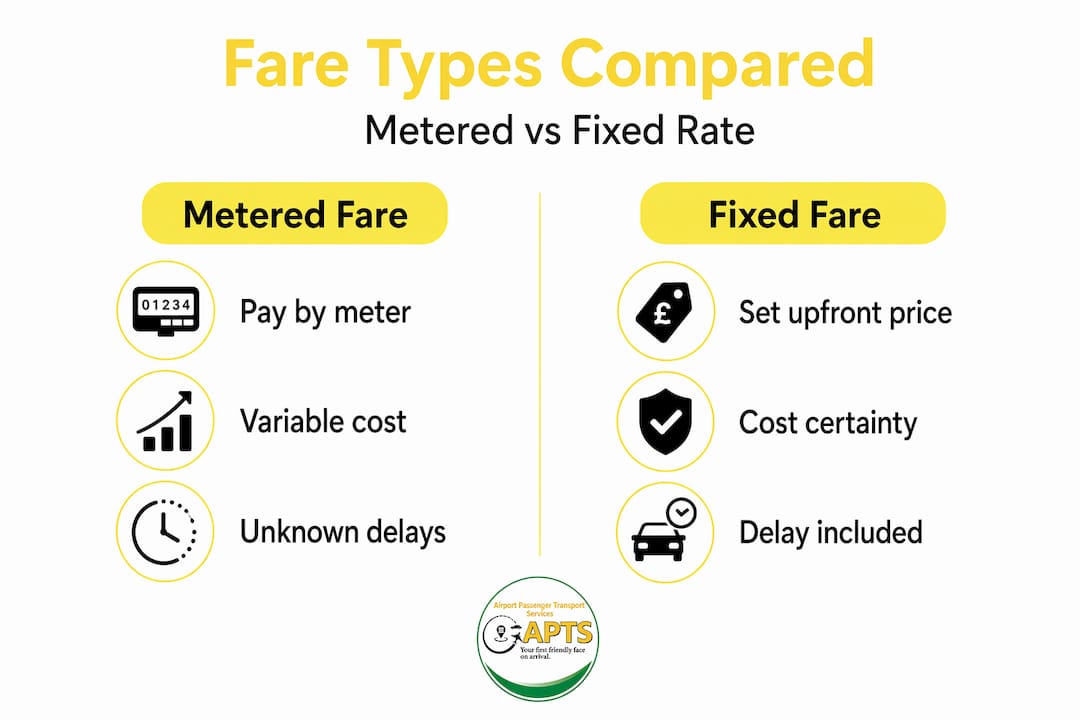
Many airports worldwide now offer both options, with a clear trend towards fixed pricing for airport transfers driven by traveller demand for transparency. Here is how the two models compare directly:
| Feature | Metered fares | Fixed fares |
|---|---|---|
| Price certainty | Unknown until arrival | Agreed before travel |
| Traffic impact | Cost increases with delays | Price unaffected by delays |
| Peak-hour risk | High. Costs can spike significantly | Low. Rate locked in at booking |
| Suitability for short trips | Often better value | May include minimum charge |
| Suitability for long airport runs | Higher risk of overpaying | Generally better value overall |
| Pre-booking required | Usually not | Yes |
| Surge pricing risk | Present in congested conditions | Absent once price confirmed |
Fixed-price services absorb traffic delay costs that would otherwise fall entirely on the passenger in a metered vehicle. If your airport is served by a motorway prone to congestion, a fixed fare is almost always the wiser choice. You pay one agreed amount and that is the end of it.
The benefits of pre-booked taxis extend beyond price predictability. Pre-booking also allows operators to assign the right vehicle for your group size and luggage requirements in advance, reducing the chance of arriving at a rank to find only unsuitable vehicles available.
Pro Tip: When comparing quotes for airport taxis, request the all-inclusive price specifically. Ask the operator to confirm that tolls, airport access fees, and VAT are included. A quote that appears cheaper may carry hidden additions.
Hidden cost drivers you need to know about
Price is shaped by more than just distance and time. Several subtle factors influence what you ultimately pay, and being aware of them puts you in a stronger position.
Vehicle class and capacity. Standard taxis, executive saloons, and MPVs are priced differently even for identical routes. Travelling with three or more passengers often makes an executive MPV transfer more economical per person than booking multiple standard taxis. Always factor in your group size before selecting a vehicle class.
Advance booking versus walk-up pricing. Pre-booking 24 to 48 hours in advance allows operators to plan routes efficiently and reduce deadheading. Deadheading refers to the cost incurred when a driver returns empty after completing a fare. Operators factor this cost into airport transfer quotes. When you book ahead, drivers can coordinate multiple bookings and absorb that deadheading cost more effectively, often passing a portion of the saving to you.
Flight information and arrival monitoring. Sharing your flight number at the time of booking is one of the most underutilised cost-saving tools available to travellers. Flight monitoring at booking allows your driver to adjust for delays in real time, meaning you are not paying for a car that has been waiting an hour because your flight was late. Operators who offer this service provide genuine cost and stress benefits.
Tipping customs by region. Tips are an often-forgotten component of the overall cost. Standard tips typically range from 10% to 20%, with the higher end expected when a driver assists with heavy luggage, waits beyond the agreed time, or provides a particularly attentive service. In Spain, rounding up the fare is common. In Ireland, 10% to 15% is standard practice. In parts of Asia and the Middle East, tipping taxi drivers is not customary at all. Knowing the convention before you travel prevents both awkwardness and overpaying.
Regional regulations. Pricing regulations differ significantly across markets. Dublin Airport, for instance, operates within Irish transport licensing rules. Spanish airports like Barcelona and Malaga have regulated fixed-rate structures for transfers. Being aware of local regulations helps you identify when a quoted price falls outside the expected range and gives you the confidence to question it.
How to compare and confirm airport taxi prices
Securing a fair fare is not complicated, but it does require a few deliberate steps before you travel. Here is a straightforward approach to getting airport taxi pricing right every time.
- Request a fixed quote before committing. Contact operators directly or use their online booking tools to obtain a confirmed price for your specific route. Avoid any provider that cannot give you a fixed price in advance.
- Confirm what is included. Ask explicitly whether the quote covers airport access charges, tolls, and VAT. Get this confirmed in writing, or at minimum via a booking confirmation email.
- Compare at least two or three providers. Use the knowledge you have gained here to compare airport taxi prices across operators. Do not compare only the headline price. Compare the total all-inclusive figure for the same vehicle class.
- Check vehicle suitability. Confirm that the booked vehicle accommodates your full party and all luggage. Arriving with three large suitcases for a vehicle rated for two will either result in a second car or a tense discussion on the kerb.
- Provide your flight details at booking. Share your flight number and expected arrival time so the operator can monitor your flight and adjust accordingly. This single step removes a significant source of transfer-day stress.
- Review the cancellation and amendment policy. Plans change. A reputable operator offers reasonable terms for cancellations and flight-related delays without penalising you unfairly.
- Check how to communicate with your driver before arrival. Knowing the meet point, the driver’s name, and how to contact them means you spend zero time searching the arrivals hall.
Private taxi services offer clear advantages over shuttle buses and shared transfers for travellers who value reliability and price certainty. Shuttles may appear cheaper at face value, but waiting for other passengers, making multiple stops, and carrying heavy luggage through a shared coach can significantly extend your transfer time. For business travellers especially, the value of a direct, private transfer is substantial.
Declan’s perspective on getting airport pricing right
I have spoken with a lot of travellers who assume that pre-booking a private transfer is going to cost them more than simply hailing a taxi at the rank. In my experience, that assumption is wrong more often than people realise.
The metered fare looks cheaper on paper at the start. But I have seen passengers pay significantly more than expected because their metered cab sat in airport departure traffic for 45 minutes and the meter kept running. With a fixed fare, that 45 minutes costs you nothing extra. The price you agreed is the price you pay.
The other thing I consistently see undervalued is the act of sharing your flight information. It sounds like a minor administrative detail, but it completely changes the transfer experience. Your driver knows your flight is delayed. They adjust. You walk out of arrivals and your car is ready. You have not been charged for an hour of waiting time. That coordination is worth more than most people account for when they are choosing a provider purely on headline price.
My honest advice is this: stop comparing the cheapest starting price and start comparing the total, confirmed, all-inclusive price for the right vehicle class for your trip. Add the realistic tipping convention for your destination. Factor in whether your route is prone to delays. When you do that properly, pre-booked fixed-fare transfers win the value comparison far more often than not.
— Declan
Book with confidence through Apts

Apts provides professional airport taxi, executive taxi, and chauffeur services across Ireland and Spain, with transparent fixed pricing confirmed at the time of booking. Every transfer includes flight monitoring so your driver adjusts to your actual arrival time, not just your scheduled one. There are no hidden airport access charges added at the end, and no metered surprises when traffic delays your route.
Whether you need a standard taxi, an executive saloon, or a premium chauffeur service, Apts matches the right vehicle to your journey. You can explore private transfer advantages in detail, or review airport taxi options across Ireland, UK, and Spain to find the service that fits your itinerary. For full booking details and to secure your next transfer, visit Apts airport transfers directly and get a confirmed quote in minutes.
FAQ
What is the difference between metered and fixed airport taxi fares?
Metered fares calculate cost in real time based on distance and time, meaning traffic delays increase your bill. Fixed fares are agreed before travel and remain unchanged regardless of road conditions.
Are pre-booked airport taxis cheaper than rank taxis?
Fixed-price pre-booked taxis frequently offer better overall value than metered rank taxis, particularly on routes prone to congestion where metered costs can spike unpredictably.
Why should I share my flight number when booking?
Providing your flight number allows your driver to monitor your arrival in real time and adjust for delays, avoiding unnecessary waiting charges and making your transfer stress-free.
How much should I tip an airport taxi driver?
Tips typically range from 10% to 20% depending on service quality and regional customs. In Ireland and Spain, 10% to 15% is standard, with more appropriate when a driver assists with heavy luggage or waits beyond the agreed time.
What surcharges are common on airport taxi fares?
Standard surcharges include night rates, peak-hour fees, airport access charges, toll costs, and luggage fees. Always confirm which charges are included in your quoted price before booking to avoid unexpected additions on arrival.
Recommended
- Your essential UK airport taxi guide: easy, reliable rides
- Airport Taxi Explained: What to Expect in Ireland, UK, and Spain
- How to Compare Airport Taxi Prices for Smart Travel
- Airport taxi vs shuttle: best choice for cost and convenience
Article checked by Declan Rodden.