

Not all airport taxis are alike. Across Europe’s top travel destinations, rules, costs, and service standards differ more than most travelers ever anticipate. Booking what looks like a straightforward ride can quickly become confusing when you encounter unfamiliar payment systems, licensing requirements, or pricing structures you weren’t prepared for. Whether you’re flying into Dublin, London Heathrow, or Malaga, understanding how airport taxi services actually operate in each country can save you time, money, and real frustration. This guide gives you the clarity you need before your next trip.
Table of Contents
- What is an airport taxi? The basics and beyond
- Key differences: Ireland vs. UK vs. Spain airport taxi rules
- Pricing: What will your airport taxi really cost?
- How to book and what to expect from your airport taxi
- What most travelers miss about airport taxis in Europe
- Get reliable airport taxi service for your next trip
- Frequently asked questions
Key Takeaways
| Point | Details |
|---|---|
| Airport taxis differ by country | Ireland, the UK, and Spain each have their own taxi rules, fares, and licensing systems. |
| Understand booking and fare rules | Fixed, metered, and surcharge-based fares all require travelers to confirm details beforehand. |
| Group size impacts cost | Larger taxis can offer lower per-person rates than public transport for groups. |
| Book with regulation in mind | Licensed, official taxis ensure safety and compliance at major European airports. |
What is an airport taxi? The basics and beyond
Now that you’ve seen why airport taxi services aren’t one-size-fits-all, let’s define exactly what sets them apart from other ground transport options.
An airport taxi is a licensed vehicle specifically permitted to collect and drop off passengers at an airport. That definition sounds simple. In practice, it’s layered with local regulations, special airport permits, and service expectations that vary significantly depending on where you land.
In Ireland, the UK, and Spain, airport taxis fit into each country’s broader taxi licensing laws. But the airport environment adds another layer. Drivers often need separate airport-specific permits, and the vehicles must meet particular standards for size, cleanliness, and accessibility. These aren’t the same as a local cab you flag down on a city street.
So how do airport taxis differ from other forms of transport?
- Airport shuttles operate on fixed routes and shared capacity. They’re cheaper but slower, as they stop at multiple hotels or terminals.
- Rideshare apps may or may not be permitted at certain airports. Pickup zones vary and regulations are tightening in several European markets.
- Local cabs are often not licensed to pick up from airport taxi ranks, even if they can drop passengers off.
- Private hire vehicles (PHVs) must be pre-booked and cannot be hailed from the curb, a key distinction in the UK.
As explained in detail through private airport transfers explained, the difference between a registered airport taxi and a generic ride matters for your safety, fare protection, and reliability.
Before booking any airport taxi, travelers should clarify the following:
- Is the driver licensed for airport pickups specifically?
- Is the fare fixed, metered, or negotiated?
- What is the exact pickup location at the terminal?
- What is the policy if your flight is delayed?
- What payment methods are accepted?
Booking an unlicensed or improperly permitted taxi at an airport is not just inconvenient. It can expose you to unregulated fares and no legal recourse if something goes wrong.
In the UK, airport taxis are licensed as either hackney carriages (the classic black cab, which can be hailed) or private hire vehicles that must be pre-booked. Licensing is managed by local councils or by Transport for London (TfL) within the capital. Proposed 2025 to 2026 reforms aim to introduce national minimum safety and DBS (background check) standards, but for now, the system remains fragmented across regions.
Key differences: Ireland vs. UK vs. Spain airport taxi rules
Having established the basics, let’s break down how key rules, fares, and booking options differ side by side in Ireland, the UK, and Spain.
| Factor | Ireland | United Kingdom | Spain |
|---|---|---|---|
| Regulator | NTA (National Transport Authority) | Local councils / TfL (London) | Local bodies (e.g., IMET in Barcelona) |
| Vehicle type | SPSV (Small Public Service Vehicle) | Hackney carriage or PHV | Licensed taxi (auto or saloon) |
| Booking method | Pre-book or airport rank | Hail (black cab) or pre-book (PHV) | Airport rank or pre-book |
| Fare system | Fixed national tariffs | Metered with local tariffs | Metered plus surcharges |
| Payment | Cashless mandatory | Card widely accepted | Card or cash, varies by city |
| Airport permit required | Yes (€300/year, e.g., Dublin) | Varies by airport | Varies by municipality |
| Surge pricing | No | Possible via apps | No |
Ireland operates one of the most tightly regulated airport taxi systems in Europe. All taxis are classified as SPSVs under NTA oversight, and drivers serving Dublin Airport must hold an additional airport-specific permit costing €300 per year. Fares follow fixed national tariffs. For example, a Dublin Airport to city center journey runs between €25 and €45. Cashless payment is mandatory. There is no surge pricing. You know exactly what you’ll pay before you even step into the vehicle.

The UK presents a more variable picture. As noted in analysis of UK taxi regulations, the fragmented local licensing structure means rules and standards can shift significantly from one airport to another. Manchester, Edinburgh, and Heathrow each sit under different regulatory jurisdictions. The ongoing reforms aim for consistency, but travelers should not assume uniform standards across UK airports in 2026.
Spain falls somewhere in between. Major airports like Malaga and Barcelona operate metered taxis with airport surcharges between €4.50 and €5.50, and some fixed routes exist. The Barcelona airport to city center fare, for instance, is set at a flat €39. Regulation falls to local bodies like IMET in Barcelona, which means rules differ between cities.
For travelers, the Dublin airport taxi regulations represent the most predictable environment. Spain offers a moderate level of consistency, while the UK requires the most pre-trip research.
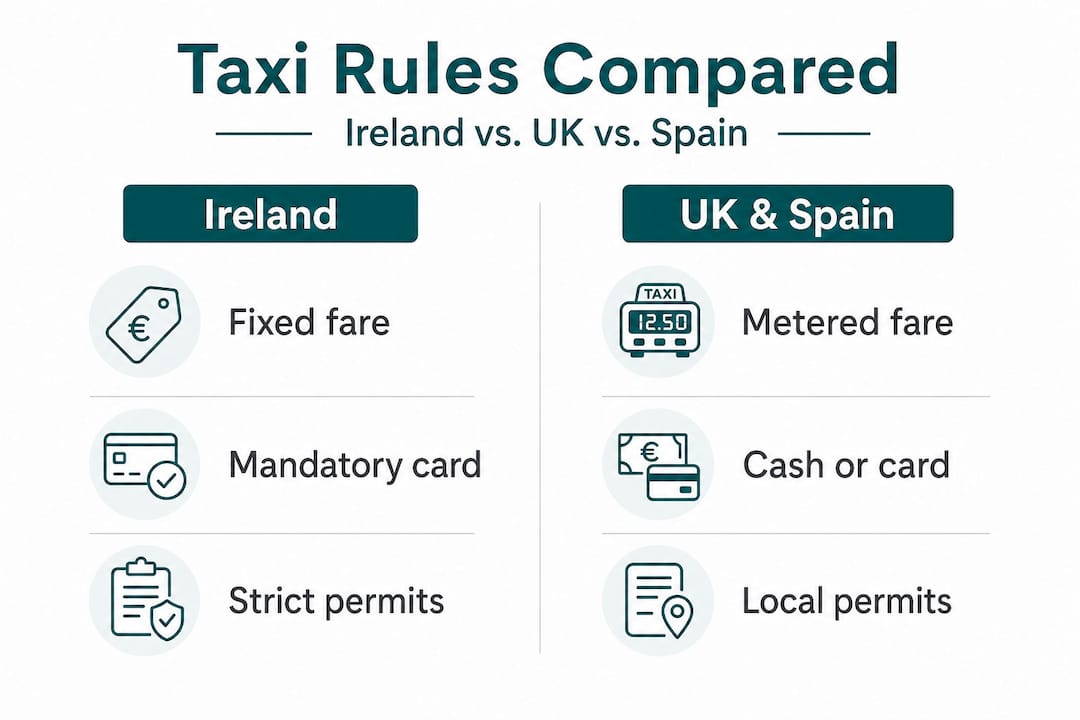
Pro Tip: Always check the specific airport taxi service rules for your destination country before you travel. What applies at Dublin Airport may not apply at Heathrow or Malaga.
Before departing, confirm:
- Whether card payment is guaranteed at your destination airport
- Whether pre-booking is required (especially for PHVs in the UK)
- What the official taxi rank or pickup zone is at your terminal
- If any route-specific fixed fares apply to your journey
A quick review of the UK airport taxi guide can help you navigate British airports with far greater ease.
Pricing: What will your airport taxi really cost?
With those service rules in mind, what does an airport taxi actually cost? Let’s look at typical fares, surcharges, and the practical factors that influence your final bill.
Typical fare ranges by country
| Route | Estimated fare | Fare type |
|---|---|---|
| Dublin Airport to city center | €25 to €45 | Fixed tariff |
| London Heathrow to central London | £55 to £85 | Metered |
| Barcelona Airport to city center | €39 | Fixed route fare |
| Malaga Airport to Malaga city | €20 to €30 (metered + surcharge) | Metered + airport surcharge |
Ireland’s fixed national tariffs eliminate pricing uncertainty entirely. You pay what the tariff schedule says, regardless of traffic, time of day, or demand. That consistency is a genuine advantage for business travelers and families alike.
In Spain, metered fares with standard surcharges of €4.50 to €5.50 per airport trip are common. Fixed routes exist in some cities, but tariff schedules shift depending on the time of day and day of the week. Night fares and weekend rates apply in many Spanish cities, so your return trip could cost more than your arrival ride.
Factors that affect your total cost
- Group size: A larger group traveling together can reduce per-person cost significantly. A 7-seater taxi can cut per-head costs to around £15 per person, compared to £20 or more per ticket on rail or bus.
- Luggage volume: Oversized bags or multiple large cases may require a larger vehicle, which carries a higher base fare.
- Time of travel: Night tariffs, early morning rates, and weekend pricing affect metered fares in the UK and Spain.
- Flight delays: Waiting time charges can apply if your driver holds for an extended period. Many reputable providers offer a grace period, typically 30 to 60 minutes, after your scheduled arrival.
- Airport drop-off fees: Some airports charge vehicles a fee for entering drop-off zones. Professional operators often build this into their quoted price, but it’s worth confirming.
- Tolls and additional charges: Certain routes in Ireland and the UK include toll road costs, which may be added to the fare.
Pro Tip: For groups of four or more, compare the airport taxi vs shuttle costs before you commit to either option. The taxi often wins on both price per person and total travel time once you factor in shuttle stops and waiting.
If you want to understand why professional airport transfers often justify their price, the breakdown of why airport transfers save time is worth reviewing. Reliability, door-to-door service, and predictable pricing deliver real value, particularly after a long-haul flight.
How to book and what to expect from your airport taxi
Knowing typical prices, here’s your step-by-step guide to booking an airport taxi and what the travel experience actually looks like.
Booking your airport taxi
- Choose your method: Options include online pre-booking, telephone reservation, airport taxi desk, or on-the-spot at an official taxi rank. Pre-booking is required for PHVs in the UK and is strongly recommended in all three countries for guaranteed availability.
- Provide flight details: Share your flight number, arrival time, and terminal. This allows the driver to track any delays automatically.
- Specify group size and luggage: Accurate information ensures the right vehicle is assigned. A saloon car works for two travelers with standard bags. A family of five with ski equipment needs something larger.
- Confirm your destination: Provide the full address, not just the area. Some airports serve multiple nearby cities, and the driver’s routing depends on precision.
- Agree on payment: Confirm whether the fare is fixed or metered, and ensure your preferred payment method is accepted.
What to expect on the day
- Meet and greet service: Many professional providers offer a driver waiting in the arrivals hall with a name sign. This removes all guesswork after a long journey.
- Flight monitoring: Reputable operators track flight delays and adjust waiting policy accordingly. If your flight is delayed by an hour, a good provider knows before you land.
- Clear meeting points: Airports designate specific taxi pickup zones. Know yours before you arrive. Dublin Airport, Heathrow, and Malaga Airport all have clearly marked taxi bays, but terminal numbers and zones vary.
- Professional conduct: Licensed airport taxi drivers in all three countries are required to follow codes of conduct covering behavior, vehicle presentation, and route transparency.
Pro Tip: Review the airport pick-up tips specific to your destination before you travel. Confirming the pickup point, payment method, and vehicle type in advance eliminates nearly every source of last-minute stress.
For drop-offs, prepare your destination address in full before you get in the vehicle. Allow time for airport vehicle access fees to be processed, and keep your confirmation details accessible if there’s any dispute over the booked fare.
What most travelers miss about airport taxis in Europe
Even experienced, frequent travelers make assumptions about airport taxis that simply don’t hold up across borders. The single most common mistake is assuming that the system at one airport mirrors the system everywhere else.
A business traveler who regularly uses Dublin Airport knows that cashless payment is mandatory, fares are fixed, and drivers hold airport-specific permits. They arrive confident. Then they land at a regional UK airport, try to pre-book what they think is a standard taxi, and encounter a private hire vehicle operator with different pricing, different pickup protocols, and a dispute about the waiting charge.
The stakes are higher than they appear. A missed transfer connection, an unexpected charge at a foreign airport, or a pickup location confusion at 11 PM after a delayed flight causes genuine disruption. These aren’t minor inconveniences for business travelers or families arriving in an unfamiliar city.
Ireland’s predictability is a genuine advantage that travelers underestimate until they’ve experienced the alternatives. Spain’s surcharge structure is standard and well-documented, but travelers from Ireland or the UK often don’t anticipate those additional fees. The UK’s evolving regulatory landscape means standards genuinely shift between airports and cities.
The most overlooked detail across all three countries is the airport-specific permit system. In Ireland, it’s formalized and enforced rigorously. In Spain, local rules vary by municipality. In the UK, reforms are still working their way through the system. Understanding which operators hold the correct credentials protects you from unlicensed operators who can legally wait outside official taxi zones and solicit passengers.
Reviewing airport taxi rules abroad before each trip, not just once, is the habit that separates informed travelers from frustrated ones. Rules change. Tariff schedules update. Airport pickup zones move. A few minutes of research before departure saves far more time at the arrivals terminal.
Get reliable airport taxi service for your next trip
Armed with a clear picture of how airport taxi services operate across Ireland, the UK, and Spain, you can now make confident, informed decisions for every journey.

Choosing a trusted, licensed provider means more than just getting from the airport to your destination. It means traveling with a team that knows local regulations, tracks your flight, and has the right vehicle waiting when you land. At APTS, we offer professional Dublin airport taxi service and executive transfers across Ireland, the UK, and Spain, covering both business and leisure travel with consistent, regulated, and comfortable service. Whether you need a standard airport transfer or want to explore airport taxi services abroad, our team is ready to arrange every detail. Discover the full range of luxury taxi features that make a real difference in your travel experience and book your next transfer with confidence.
Frequently asked questions
Can I pay for airport taxis by card in Ireland, the UK, and Spain?
Ireland mandates cashless payment for all airport taxis, while most UK airports and major Spanish cities also accept card payment. Always confirm accepted payment methods when booking, as practices can vary at smaller regional airports.
What happens if my flight is delayed?
Most professional airport taxi operators track flight delays automatically and adjust their waiting policy accordingly, typically providing a complimentary grace period before any additional waiting charges apply.
Are airport taxi fares fixed or metered?
Ireland applies fixed national tariffs with no surge pricing, while the UK and Spain use metered fares. Spain also adds standard airport surcharges, and some Spanish routes carry a fixed rate, such as the Barcelona airport to city center fare of €39.
Are there extra charges for groups or luggage?
Large groups traveling together can benefit from lower per-person pricing in a 7-seater vehicle, while oversized luggage, night travel, and airport drop-off fees may add to the total cost. Always specify your full group size and luggage requirements at the time of booking.
How do I know my driver is licensed?
In Ireland, all airport taxi drivers must hold NTA-issued SPSV authorization plus an airport-specific permit, while in the UK, drivers must be licensed by local councils or TfL. Look for official vehicle markings, a displayed license number, and a driver ID badge as confirmation of legitimate authorization.
Recommended
- Your guide to reliable airport taxi services abroad
- Private Airport Transfers Explained: Reliable, Hassle-Free Travel
- Airport taxi vs shuttle: best choice for cost and convenience
Article checked by Declan Rodden.