

Airport taxis cost more because they layer multiple surcharges on top of the base meter rate, including airport access fees, time-based congestion charges, tolls, and mandatory levies that most travellers never see coming. These are not arbitrary markups. They reflect genuine operational costs specific to airport environments. Understanding why airport taxi prices are higher than standard city fares helps you budget accurately, choose the right service, and avoid unpleasant surprises at the end of a long journey. This article breaks down every cost driver, compares metered fares with fixed-price transfers, and gives you practical tools to manage your airport transport spend.
Why airport taxis cost more than regular city rides
Airport taxi fares are higher than standard city taxi fares for one core reason: airports impose costs on operators that city streets do not. Drivers pay to enter airport pickup zones, queue in holding areas, and comply with licensing requirements specific to each airport. Those costs pass directly to passengers.
Metered airport taxi fares expose travellers to real-time traffic delays, waiting times, and airport infrastructure fees. That means the final fare depends on conditions outside anyone’s control. A 40-minute journey can become a 90-minute one during peak hours, and the meter runs the entire time.
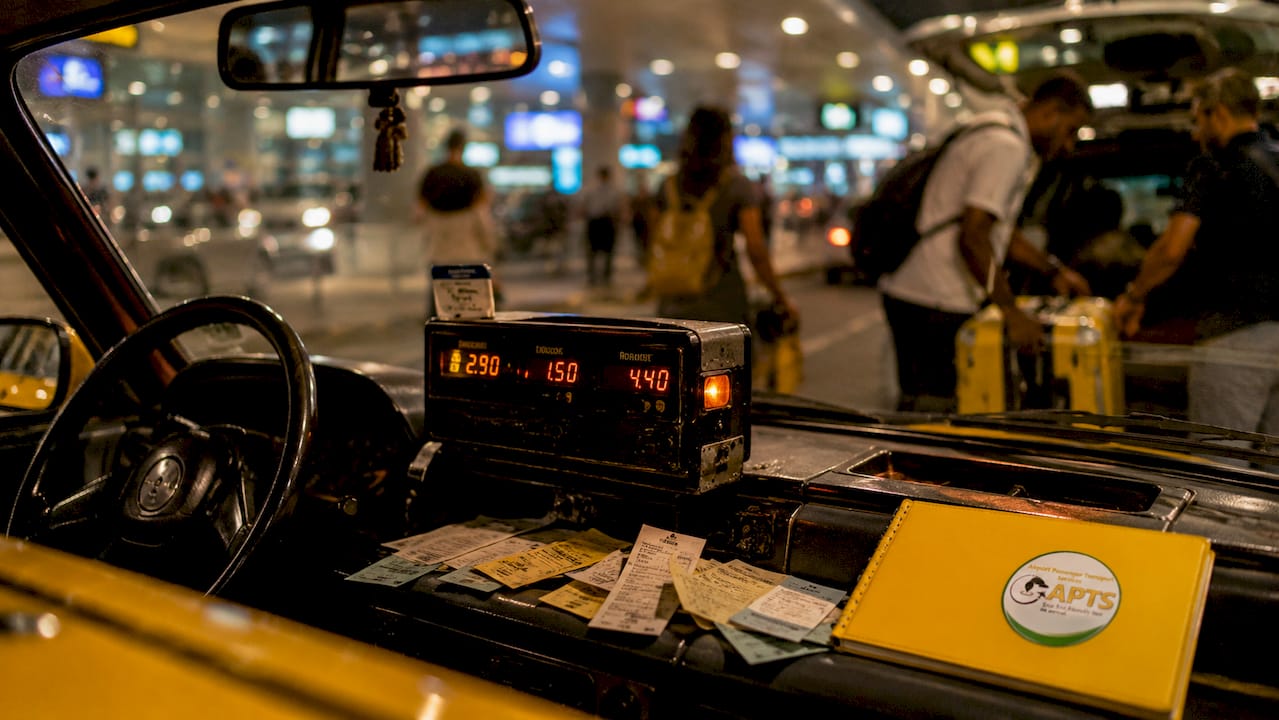
The result is that final fares run 30–40% higher than the initial meter quote once all surcharges are applied. That is not a rounding error. On a £60 base fare, that gap represents £18–£24 in additional charges.
What are the main components that push airport taxi fares higher?
Several distinct cost layers combine to produce the high airport taxi rates travellers experience. Each one is legitimate, but together they create a fare that bears little resemblance to the opening meter reading.
- Airport access fee. Most major airports charge taxis a pickup levy. Drivers pay to enter the terminal zone and recoup that cost through the fare.
- Time-based meter charges. Traffic congestion inflates fares because the meter runs continuously, including during standstill traffic on approach roads.
- Late-night and holiday surcharges. Fares at Heathrow, Dublin, and most European airports carry a premium between roughly 22:00 and 06:00, and on public holidays.
- Tolls and motorway charges. Routes from airports often cross toll roads or bridges. These costs are added directly to the fare.
- Luggage fees. Large bags, oversized luggage, or additional items frequently attract a per-item charge.
- Card processing fees. Many taxi operators add a percentage surcharge for card payments, which most travellers now use by default.
Each fee is individually modest. Cumulatively, they are the reason why airport taxi prices feel disproportionate compared to a similar distance in a city centre.
Pro Tip: Ask the driver to confirm the total estimated fare before you set off, including all surcharges. A reputable operator will give you a clear answer. If they cannot or will not, that is a warning sign.
Metered taxis vs fixed-price transfers: which costs less?
The most useful comparison for any traveller is not taxi versus bus. It is metered airport taxi versus fixed-price pre-booked transfer. The pricing structures are fundamentally different, and the gap matters.
A metered taxi calculates the fare in real time based on distance and time. Every minute in traffic adds to the total. A fixed-price transfer quotes one amount upfront, regardless of how long the journey takes. That single difference has significant financial implications.
The Heathrow to Central London route illustrates this clearly. Fixed-price transfers cost £50–£90 for that route, while metered taxis typically reach £75–£130 depending on traffic. The fixed option is cheaper in most scenarios, and always more predictable.
| Journey type | Pricing model | Typical cost range | Traffic impact |
|---|---|---|---|
| Metered airport taxi | Real-time distance and time | £75–£130 (Heathrow to Central London) | High. Fare rises with delays |
| Fixed-price transfer | Upfront flat rate | £50–£90 (Heathrow to Central London) | None. Price locked at booking |
| Group fixed transfer | Per-vehicle flat rate | Lower per person for 3+ travellers | None |
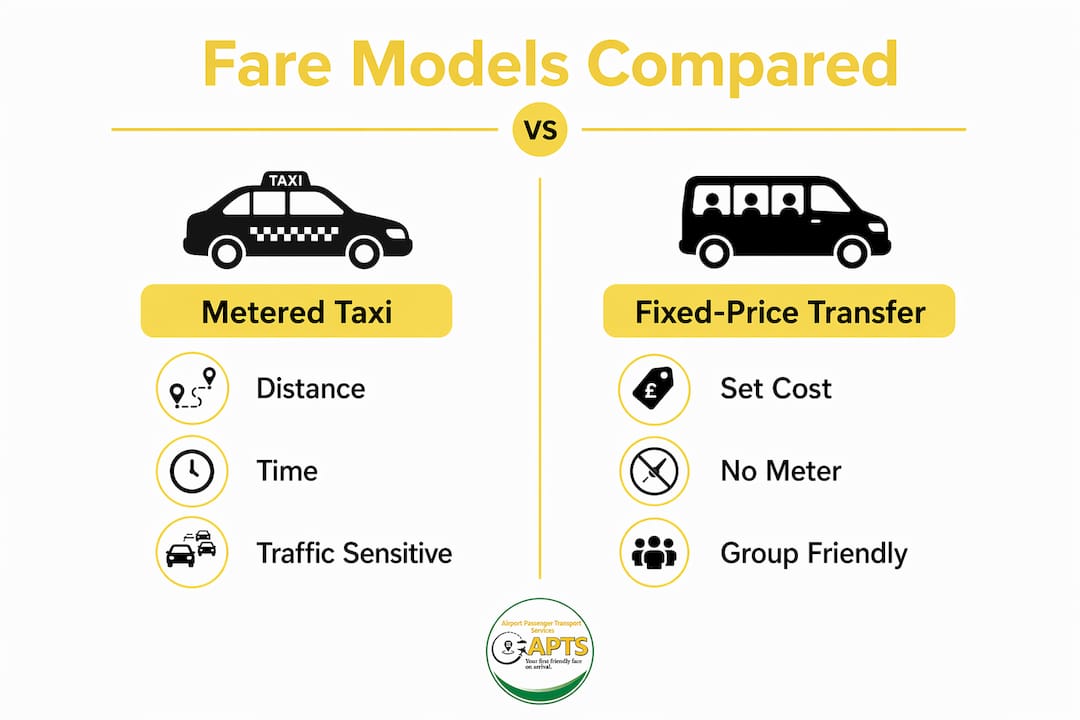
For travellers with luggage, families, or groups, the fixed-price model offers a further advantage. The per-person cost drops significantly when the flat rate is shared across multiple passengers. A metered taxi for four people with bags can easily exceed £100. The same journey on a pre-booked group transfer often costs considerably less per head.
Pro Tip: If your flight lands during peak hours, the metered fare gap widens further. Pre-booking a fixed-price transfer for morning and evening peak arrivals is the single most effective way to control the cost of airport transportation.
Why do hidden charges make airport taxi fares more expensive?
Beyond the visible surcharges, a second tier of costs catches travellers off guard. These are the fees that do not appear on any sign at the taxi rank and are rarely mentioned until the journey ends.
- Airport pickup levies. Many airports charge operators a fee for each passenger pickup. At busy hubs, this can be a fixed amount per trip or a percentage of the fare. Drivers pass this on.
- Terminal drop-off fees. Some airports charge for vehicle access to departure terminals. On return journeys, this cost can appear as a line item on the receipt.
- Mandatory gratuities. Certain operators include a service charge automatically. Travellers who add a tip on top pay twice.
- Child seat charges. Requesting a child seat often triggers an additional fee, which varies by operator and is rarely advertised upfront.
- Airport exclusivity contracts. Some airports grant exclusive operating rights to specific taxi companies. That lack of price transparency reduces competition and keeps fares elevated.
- Unlicensed operators. Unofficial drivers who approach travellers in arrivals halls often charge inflated fares with no accountability. Official taxi ranks protect travellers from this risk.
The practical implication is clear. The cost of airport transportation is rarely what the meter shows at the start of the journey. Travellers who understand this go in with realistic expectations and make better decisions.
Pro Tip: Always use the official taxi rank or a pre-booked service. Unofficial operators at arrivals halls are the most common source of inflated fares and have no regulatory oversight.
Practical ways to reduce your airport taxi costs
Knowing why airport taxi prices are high is useful. Knowing how to reduce them is better. These steps give travellers direct control over what they spend.
- Pre-book a fixed-fare transfer. Locking in a price before you travel removes all fare variability. You know the exact cost before you leave home. Apts offers fixed-price airport transfers across Ireland and Spain, with upfront pricing and no hidden fees.
- Travel off-peak where possible. Arriving or departing outside morning and evening rush hours reduces time-based meter charges significantly. Late morning and early afternoon slots typically see the lightest congestion.
- Share the ride. Group transfers reduce the per-person cost substantially. A vehicle that costs €60 shared between three travellers costs €20 each. That is often cheaper than public transport once luggage is factored in.
- Use official taxi ranks only. Accredited taxi ranks at airports operate under regulated fare structures. Unofficial operators do not. The few minutes saved by accepting an offer in the arrivals hall rarely justify the premium charged.
- Compare prices before you travel. Online fare calculators and pre-booking platforms let you compare airport taxi prices across multiple operators. Apts provides transparent pricing at the point of booking, so there are no surprises on arrival.
- Factor in the full cost. Meter fare uncertainty carries a practical cost beyond money. The stress of watching a meter climb in traffic, negotiating with drivers, or disputing a fare at the end of a long flight is a real burden. Fixed-price transfers eliminate it entirely.
For a detailed breakdown of how to compare airport taxi prices across operators and routes, Apts has a dedicated guide covering the key variables to check before booking.
Key takeaways
Airport taxi fares are higher than standard city fares because multiple legitimate surcharges, including airport access fees, time-based meter charges, tolls, and hidden levies, combine to push the final cost 30–40% above the base meter rate.
| Point | Details |
|---|---|
| Surcharges are cumulative | Airport access fees, tolls, and time charges together push fares 30–40% above the base meter rate. |
| Fixed-price transfers cost less | Heathrow to Central London costs £50–£90 fixed versus £75–£130 metered, a consistent saving. |
| Hidden fees add up | Pickup levies, card surcharges, and luggage fees rarely appear upfront but significantly raise the final fare. |
| Groups save more with fixed transfers | A flat-rate vehicle shared between three or more travellers costs less per person than a metered taxi. |
| Official ranks protect travellers | Using accredited taxi ranks avoids unlicensed operators who charge inflated, unregulated fares. |
What I have learned about airport taxi pricing after years in ground transport
Declan’s perspective
The question travellers ask most often is not “why is this expensive?” It is “why did no one tell me it would be this expensive?” That gap between expectation and reality is the real problem with airport taxi pricing.
Most travellers assume the meter reading they see at the start of the journey is roughly what they will pay. They are wrong. The JFK flat fare of $52 is a good example. The final cost including surcharges and tolls typically reaches $70–$90. That is a 35–73% increase on what sounds like a fixed price. The same pattern plays out at Dublin, Malaga, and every other major airport.
My view is that the metered taxi model is poorly suited to airport journeys specifically. City rides are short, predictable, and low-stakes. Airport journeys involve luggage, time pressure, and often a flight connection at the other end. Adding financial unpredictability to that situation is unnecessary. Fixed-price transfers exist precisely because the market recognised this problem.
The travellers who consistently spend less on airport ground transport are not the ones who haggle at taxi ranks. They are the ones who book in advance, confirm the price upfront, and arrive knowing exactly what they will pay. That is not a luxury. It is a straightforward planning decision that anyone can make.
— Declan
Confident airport transfers with Apts
Understanding the full cost of airport transportation is the first step. Choosing a service that removes the uncertainty is the second.

Apts provides fixed-price taxi, executive taxi, and chauffeur services to and from airports across Ireland and Spain. Every booking comes with an upfront fare, no hidden surcharges, and professional drivers who meet you on arrival. Whether you are travelling solo, with family, or as part of a business delegation, Apts has a service to match. The taxi service selection guide helps you identify the right option for your journey, from standard transfers to executive comfort. Families can also find tailored advice in the taxi services for families guide, covering vehicle options, child seats, and cost-effective group pricing.
FAQ
Why are airport taxis more expensive than city taxis?
Airport taxis carry additional costs including airport access fees, holding area charges, and mandatory surcharges that standard city taxis do not face. These costs pass directly to passengers and push final fares 30–40% above the base meter rate.
What is an airport taxi surcharge?
An airport taxi surcharge is an additional fee added to the base meter fare to cover costs such as airport pickup levies, late-night rates, tolls, or luggage handling. Surcharges vary by airport and operator but are a standard feature of airport taxi pricing worldwide.
Are fixed-price transfers always cheaper than metered taxis?
Fixed-price transfers are cheaper in most airport scenarios, particularly during peak traffic hours. The Heathrow to Central London route costs £50–£90 on a fixed transfer versus £75–£130 on a metered taxi, with the gap widening during congestion.
How can I avoid overpaying for an airport taxi?
Pre-book a fixed-price transfer before you travel, use only official taxi ranks, and confirm the full fare including all surcharges before the journey begins. Comparing prices online before arrival is the most reliable way to avoid overpaying.
Is a metered taxi or a pre-booked transfer better for groups?
A pre-booked fixed-price transfer is better for groups. The flat rate is shared across all passengers, reducing the per-person cost significantly. A metered taxi for a group with luggage can cost considerably more than a single fixed-price vehicle covering the same route.
Recommended
- Airport taxi pricing explained: a traveller’s guide
- Ways to save on airport taxis: your 2026 guide
- How to Compare Airport Taxi Prices for Smart Travel
- Airport taxi vs shuttle: best choice for cost and convenience
Article checked by Declan Rodden.