

A taxi fare in the UK is the sum of four parts: a flag fall (initial charge), distance increments, time or waiting increments, and any permitted extras such as airport surcharges or night premiums. The formula is straightforward: Start charge + (distance units × unit price) + (time units × time rate) + extras = total fare. The taximeter shows the legal maximum for any regulated journey, so the figure on the meter is your protection, not a suggestion.
Quick estimates using TfL Tariff 1 (weekday daytime) as a reference point:
- 2-mile urban trip: flag fall £4.20 + roughly 20–25 distance increments at 20p each = approximately £8–£9 before extras
- 30-minute inner-city ride with traffic: flag fall £4.20 + time increments during slow-speed sections + distance increments on faster stretches = typically £12–£16 before extras
What to check on your meter and receipt:
- Which tariff is active (Tariff 1, 2, 3, or the longer-journey rate)
- The final meter reading before any extras are added
- Each extra itemised separately (airport barrier, luggage, night premium)
- The fare card displayed inside the vehicle
Table of Contents
- What every component of a taxi fare actually means
- How to calculate a taxi fare step by step
- Worked examples: short trips, 20-minute and 30-minute rides
- City tariff snapshots: London, Manchester, Glasgow and Northern Ireland
- How local authorities set taxi fares
- Common extras, airport surcharges and practical ways to reduce your fare
- What to do if you think you have been overcharged
- Does your payment method change the final fare?
- Maximum fare limits and no-ride zones: what local authorities enforce
- How traffic conditions change your fare in real time
- Key takeaways
- Travelling beyond the UK? Apts covers airport transfers across Ireland and Spain
What every component of a taxi fare actually means
Every line on a meter or receipt maps to one of four building blocks.
Flag fall (initial charge) is the amount that appears the moment you set off. Under TfL Tariff 1, that minimum charge of £4.20 covers the first 161.0 metres or 34.6 seconds, whichever is reached first. It is not a booking fee; it is the cost of the first slice of your journey built into the meter’s starting position.
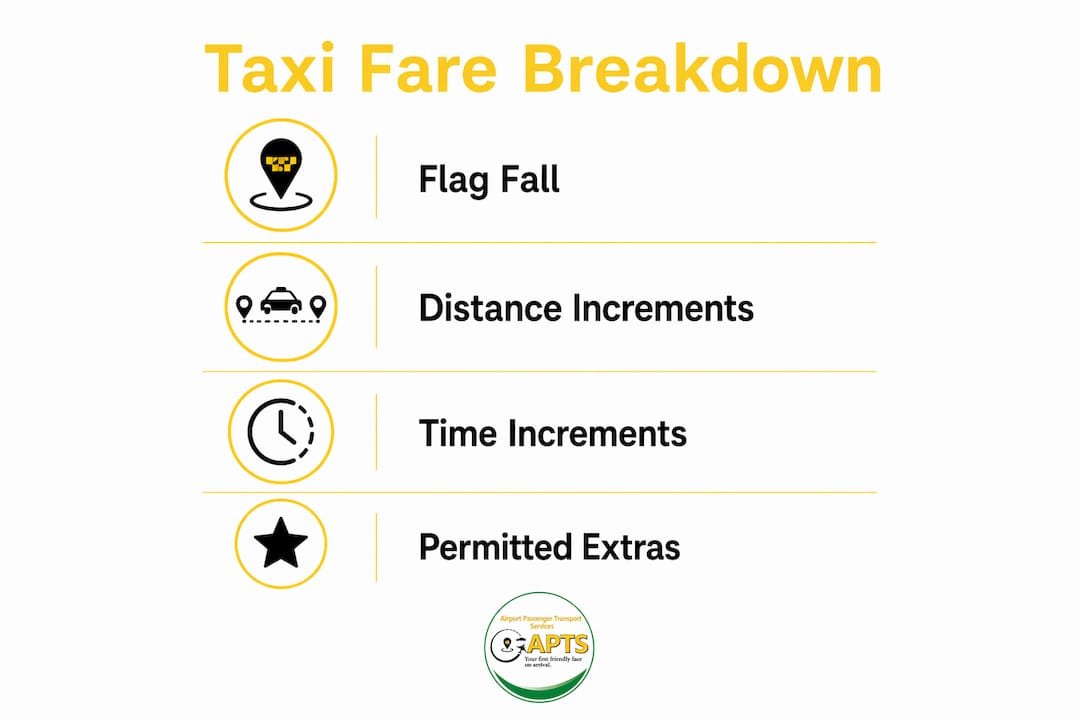
Distance increments are the 20p steps the meter adds as you travel. Under Tariff 1, each step covers 80.5 metres (or 17.3 seconds, whichever comes first). The phrase “or part thereof” in the tariff rules means a partial increment is charged as a full one, so the meter always rounds up, never down. Once a TfL journey passes 9,579.5 metres, the increment shortens to 66.6 metres per 20p step, making longer journeys slightly more expensive per metre.
Waiting and slow-speed charges use the same 20p increment structure but switch from distance to time when the vehicle slows below a threshold. TfL sets that threshold at 10.4 mph; below that speed, the meter charges by time rather than distance. In heavy traffic, this is the component that can push a fare well above a simple per-mile estimate.
Permitted extras sit on top of the metered fare and vary by city and circumstance. Common ones include:
- Airport or railway station barrier charges
- Luggage fees (typically per item above a set number)
- Assistance dog or pet charges
- Soiling or cleaning charges (Glasgow’s reviewed tariff proposed raising this from £42 to £46)
- Christmas Day, New Year’s Day, and night premiums
- Booking or telephone-order fees
Pro Tip: Always ask the driver to point out the fare card displayed inside the vehicle before you set off. It lists every permitted extra and the active tariff, so you know exactly what can be added to the meter reading.
How to calculate a taxi fare step by step
The method below works with any UK council tariff card or TfL tariff table. You need three inputs: the tariff in force, the distance travelled, and the total time spent at slow speed or waiting.
-
Identify the active tariff. Check the time of day, day of week, and whether it is a public holiday. In London, Tariff 1 applies Monday to Friday between 05:00 and 20:00; Tariff 2 covers evenings and weekends; Tariff 3 covers nights and public holidays.
-
Apply the flag fall. Record the initial charge. This is fixed regardless of how short the journey is; it is the minimum fare.
-
Convert distance to increments. Divide the distance travelled (in metres) by the increment distance for the active tariff. Under TfL Tariff 1, divide by 80.5 metres per 20p step. Round any partial increment up to the next whole number.
-
Convert slow-speed or waiting time to increments. Divide total seconds spent below the speed threshold (or waiting) by the time increment for the active tariff. Under TfL Tariff 1, divide by 17.3 seconds per 20p step. Again, round up.
-
Take the higher of distance or time for each segment. The meter uses whichever clock or odometer trigger is reached first, so you do not add both; the meter switches automatically between the two modes.
-
Multiply total increments by 20p and add the flag fall. This gives the base metered fare.
-
Add permitted extras. List each extra separately: airport barrier, luggage, night premium, and so on.
-
The result is the maximum lawful fare for that journey under the regulated tariff.
Worked examples: short trips, 20-minute and 30-minute rides
The table below shows three representative journeys calculated against TfL Tariff 1 and Manchester’s published average-cost figures, so you can cross-check your own meter reading.

| Journey | Distance | Approx. time | Flag fall | Increments (est.) | Extras | Estimated total |
|---|---|---|---|---|---|---|
| Short urban (TfL T1) | 2 miles / ~3,200 m | 12 min | Flag fall starting at £4.20 | Multiple increments charged at 20p each | None | Estimated total £8–£9 fare |
| 20-min inner-city (TfL T1, traffic) | — | 20 min (slow sections) | Flag fall at £4.20 | Multiple increments charged at 20p each | None | Estimated total fare typically £12–£16 |
| 30-min high-traffic (TfL T1) | 3 miles | 30 min (heavy traffic) | Flag fall around £4.20 | Multiple increments charged at 20p each | None | Total fare approximately £16 |
| 1 mile (Manchester day rate) | 1 mile | Typical | Starting at £4.20 | Per council fare structure | None | Approximate fare about £5.80 |
| 5 miles (Manchester day rate) | 5 miles | Typical | Starting at £4.20 | Per council fare structure | None | Approximate fare about £16 |
Manchester City Council’s published average-cost table lists 1 mile at £5.80 and 5 miles at £16.20 for the day rate, which provides a useful sanity check against your meter.
Two practical notes on rounding: first, the “or part thereof” rule means a 2.1-mile journey costs the same in increments as a 2.15-mile one if both fall within the same 80.5-metre step. Second, the 20-minute ride with significant slow-speed sections can cost more than a 3-mile free-flow trip because the time increments accumulate faster than distance increments do at low speed.
City tariff snapshots: London, Manchester, Glasgow and Northern Ireland
Tariffs differ meaningfully between cities. The table below draws on official regulator sources; all figures are maximum fares.
| City / Authority | Initial charge | Key increment | Night / holiday rate | Effective from / notes |
|---|---|---|---|---|
| London TfL Tariff 1 | £4.20 (first 161.0 m or 34.6 s) | 20p per 80.5 m or 17.3 s | Tariff 3: 20p per 80.5 m or 17.3 s | Current published tariff |
| London TfL Tariff 2 | £4.20 (first 161.0 m or 34.6 s) | 20p per 66.6 m or 17.3 s | Applies evenings and weekends | Current published tariff |
| Manchester Tariff 1 (day) | £4.20 (first 176 yards) | Per council increment table | Night and bank holiday rates listed separately | Council fare card in update |
| Glasgow | £4.40 (post-review flag fall) | Adjusted yards/seconds per review | Applied after 9.72% cost increase | Sep 2022 to Feb 2024 review |
| Northern Ireland | Varies by local council | Check local licensing page | Surcharge triggers vary | Consult local licensing authority |
Key points from each city:
- London (TfL): The tariff switches automatically mid-journey if you cross a time boundary (for example, from Tariff 1 into Tariff 2 at 20:00). Journeys over approximately six miles move to a longer-journey rate of £4.83 per mile at all times, sometimes called Tariff 4. A recent TfL board paper recorded the minimum fare rising by 40p to £4.20 as part of a broader tariff review.
- Manchester: All hackney carriages must display a council fare card. The compellable area extends 4 miles beyond the council boundary; within that zone, the meter must be used and fares are capped. Airport and station barrier charges are listed separately on the fare card.
- Glasgow: The council applied a measured 9.72% change in operating costs (September 2022 to February 2024) to produce recommended increases, including raising the flag fall from £4.00 to £4.40. The review adjusted both yards per increment and seconds per increment, not just the headline rate.
- Northern Ireland: Local licensing authorities set fares; NIDirect notes that precise tariff tables vary by council and should be confirmed on the relevant local licensing page. No single national tariff applies across Northern Ireland.
How local authorities set taxi fares
Councils do not simply track consumer price inflation when they review tariffs. The process is more specific than that.
A typical review begins with a cost audit: the authority measures changes in the actual operating costs of running a licensed taxi, covering fuel, vehicle maintenance, licensing fees, and insurance. Glasgow’s review calculated a 9.72% change in costs over a defined period and applied that figure to each tariff component individually, producing different percentage changes for flag fall, distance increments, and time increments.
“The review calculated a 9.72% change in costs of operating a taxi between September 2022 and February 2024, and applied recommended increases including a flag fall change from £4.00 to £4.40, alongside minor adjustments to unit distances in yards and seconds per increment.” — Glasgow City Council taxi tariff review executive summary
TfL follows a similar principle: board papers present multiple options with different percentage uplifts and show how each option affects rates per mile and per hour across all tariffs. The TfL tariff review process also involves public consultation before implementation.
Councils set maximums, not fixed commercial prices. A driver may charge less than the meter shows, but never more. When a review reduces the metres or seconds per increment (so the 20p step is reached sooner), short trips can become disproportionately more expensive even when the headline percentage rise looks modest. A 5% increase applied to a shorter increment means the meter ticks faster, which matters most on journeys under two miles.

Common extras, airport surcharges and practical ways to reduce your fare
Understanding what can legally be added to a meter reading is the first step to avoiding surprises. Permitted extras typically include:
- Airport pickup or drop-off barrier charges (covering the cost of entering a controlled airport zone)
- Railway station charges where a barrier or rank fee applies
- Luggage fees for items beyond a set number or size
- Waiting charges for late arrivals or delayed pickups
- Soiling or cleaning charges (a fixed tariff item for unacceptable mess)
- Christmas Day, New Year’s Day, and night premiums applied automatically by the meter or listed on the fare card
- Booking or telephone-order fees charged by the operator, not the driver
Card payment surcharges are a separate matter. Manchester’s fare card guidance states that no extra card fees should be added to the meter figure, though local practice varies. Check the fare card displayed in the vehicle before you travel; if a card surcharge is listed, it must be declared there.
Practical ways to keep costs down:
- Travel slightly off-peak to stay within Tariff 1 rather than Tariff 2 or 3
- Walk a short distance away from an airport or station barrier zone before hailing a cab, where safe and practical
- Pre-book a fixed fare for airport transfers; for context on airport taxi pricing, fixed fares remove the uncertainty of meter-based charging in heavy traffic
- Ask the driver to confirm the tariff before setting off on a longer journey
- For out-of-area journeys, negotiate a price before departure; the conventional starting point is the estimated meter fare plus one third
Private hire vehicles (PHVs) operate differently from licensed hackney carriages. PHVs must be pre-booked and typically use a fixed fare agreed at the time of booking rather than a running meter. That fixed fare is not regulated in the same way as a hackney carriage meter, so comparing pre-booked fixed fares with metered options before you travel is worthwhile for longer or airport journeys.
What to do if you think you have been overcharged
Act at the scene first, calmly and methodically.
Check the meter tariff indicator before you pay. If the displayed tariff does not match the time of day or the fare card inside the vehicle, note the discrepancy. Ask the driver for a printed receipt and request a brief explanation of any extras added above the meter reading. Most overcharging disputes arise from misapplied extras rather than a tampered meter.
Evidence to preserve immediately:
- A photograph of the meter reading and the tariff indicator
- The printed receipt (or a photo of it)
- A photo of the vehicle licence plate and the fare card displayed inside
- A record of your payment method and the amount paid
- Journey start and finish times, and the route taken if you know it
If the driver cannot explain an extra or disputes your reading, contact the operator directly first. If that does not resolve the matter, escalate to the local council’s taxi licensing or compliance team. Manchester’s guidance confirms that fare disputes should be reported to the council’s licensing authority, and most councils publish a dedicated complaints page. TfL has its own complaint route for London black cabs via its website.
Pro Tip: Screenshot the meter reading before you open the door to pay. Once you step out and the meter resets, that evidence is gone. A timestamped photo takes three seconds and can resolve a dispute in minutes.
Investigations typically involve the council contacting the driver and reviewing any in-vehicle camera footage. Keep all receipts and communications until you receive a formal response.
Does your payment method change the final fare?
For licensed hackney carriages, the answer is: it should not, but it sometimes does in practice. The regulated meter fare is the maximum the driver may charge. Any card surcharge must be declared on the fare card inside the vehicle before the journey begins. If it is not listed there, it cannot lawfully be added.
Manchester’s council guidance is explicit: no additional card fees should be applied on top of the meter figure. TfL’s position is similar; the fare shown on the meter is the fare owed. In practice, some operators add a small card-processing fee, which is only permissible where it is clearly displayed on the fare card and the passenger is informed before travel.
Cash remains the simplest option for avoiding any ambiguity. If you prefer to pay by card, check the fare card in the vehicle before setting off and confirm with the driver whether a surcharge applies. For pre-booked PHV journeys, the fixed fare agreed at booking typically includes all charges, so the payment method is less likely to affect the total.
Maximum fare limits and no-ride zones: what local authorities enforce
Every licensed hackney carriage operates under a maximum fare set by its licensing authority. The meter cannot legally display more than the regulated maximum for an in-area journey. Drivers may charge less, but the meter is the ceiling.
The concept of a “compellable area” defines where the meter obligation applies. In Manchester, that area extends 4 miles beyond the council boundary. Within it, the driver must use the meter and must not charge more than it shows. Outside the compellable area, the meter is not legally required; the convention is to negotiate a fare in advance, often starting from the estimated meter fare plus one third.
London’s regulated zone covers all journeys that begin within Greater London. TfL sets the tariff and the meter is mandatory for all such journeys. There is no equivalent of a “no-ride zone” in the sense of a geographic area where taxis refuse to operate, though drivers may decline journeys in certain circumstances permitted by licensing rules.
For Northern Ireland, fare limits and compellable areas are set by individual district councils. The structure varies, so checking the relevant local licensing authority’s page before travelling is the most reliable approach.
How traffic conditions change your fare in real time
Traffic is the variable that makes taxi fare calculation genuinely unpredictable. The meter does not pause in a jam; it switches modes.
When a London black cab drops below 10.4 mph, the meter stops counting distance and starts counting time instead, at the rate of 20p per 17.3 seconds under Tariff 1. A 20-minute journey that flows freely at 30 mph produces a very different fare from the same route crawling at 5 mph for half that time.
Consider two versions of a 3-mile journey under TfL Tariff 1:
- Free-flow (average 25 mph): Distance dominates. Approximately 3,200 metres ÷ 80.5 metres per increment = roughly 40 increments = £8.00 + £4.20 flag fall = ~£12.20
- Heavy traffic (average 8 mph for 15 minutes of the journey): Time dominates during slow sections. 15 minutes = 900 seconds ÷ 17.3 seconds per increment = roughly 52 time increments = £10.40 for that segment alone, plus distance increments for faster sections, plus flag fall = £16–£18 or more
The same route, the same distance, but a fare that is 30–50% higher in heavy traffic. This is why pre-booked fixed fares for airport transfers can offer genuine value: they remove the traffic variable entirely. For guidance on airport surcharges and fixed fares, understanding the difference between metered and pre-booked pricing is particularly useful when travelling to or from a major airport.
Key takeaways
A taxi fare in the UK is always the sum of flag fall, distance increments, time increments, and permitted extras, with the meter displaying the legal maximum for any regulated journey.
| Point | Details |
|---|---|
| The fare formula | Flag fall + distance increments + time increments + extras = total; the meter shows the legal maximum. |
| Tariff selection matters | The active tariff (1, 2, 3, or longer-journey rate) depends on time of day, day of week, and public holidays. |
| Traffic raises fares | Below 10.4 mph (TfL), the meter switches to time mode; a 30-minute heavy-traffic ride costs significantly more than the same distance in free-flow. |
| Check extras before travel | Airport barriers, luggage, night premiums, and soiling charges are all permitted but must be listed on the fare card inside the vehicle. |
| Apts for pre-booked transfers | For fixed-fare airport transfers across Ireland and Spain, Apts removes the meter uncertainty that this guide describes. |
Why knowing the tariff structure genuinely pays off
Most passengers treat the meter as a black box. That is understandable, but it leaves them unable to spot a misapplied tariff, an undisclosed extra, or a fare that has drifted into Tariff 3 territory when Tariff 1 should still apply.
Knowing the structure changes the dynamic. A passenger who understands that the meter switches to time mode below 10.4 mph can make an informed choice between waiting in traffic and asking the driver to take an alternative route. Someone who knows that the compellable area in Manchester extends 4 miles beyond the council boundary can negotiate an out-of-area fare with confidence rather than simply accepting whatever is quoted. And anyone who has photographed the meter reading and the fare card before paying is in a far stronger position if a dispute arises.
The regulator sources cited throughout this guide, particularly TfL’s tariff pages and the relevant council licensing pages, are the definitive references for exact unit values and effective dates. Tariffs change; the method for reading them does not.
Travelling beyond the UK? Apts covers airport transfers across Ireland and Spain

For travellers who want the certainty of a fixed fare rather than a running meter, Apts provides professional taxi, executive taxi, and chauffeur services to and from airports across Ireland and Spain. Every booking is priced upfront, so there is no meter switching between tariffs mid-journey and no traffic surcharge to absorb on the way to a flight.
Apts serves business executives, VIPs, and discerning travellers who value punctuality and transparency over the unpredictability of a metered fare in heavy traffic. The fleet covers a range of airports across Ireland and Spain, with professional chauffeurs and confirmed pricing at the point of booking.
To arrange a fixed-fare airport transfer with Apts, visit the Apts airport transfers page and request a quote for your journey.
Recommended
- Your essential UK airport taxi guide: easy, reliable rides
- Airport taxi pricing explained: a traveller’s guide
- Why airport taxis cost more: the full fare breakdown
- Airport taxi safety guide for smart travellers
Article checked by Declan Rodden.