

Most travellers assume any taxi waiting outside an airport is safe to board. That assumption is wrong, and in some countries, it carries a financial penalty before you even reach your hotel. Travel safety with airport taxis matters more than most people realise, particularly in Spain, Ireland, and the UK, where regulations differ significantly by region and airport. This guide covers the key things to know about airport taxis across all three countries, from licensing rules and visual checks to practical advice that protects you from scams, fines, and uninsured vehicles.
Table of Contents
- Understanding airport taxi safety regulations in Ireland, the UK, and Spain
- Key indicators to identify legitimate airport taxis
- Risks and consequences of using unlicensed or unauthorised airport taxis
- Comparing airport taxi systems and safety measures across Ireland, the UK, and Spain
- Practical tips for safe airport taxi travel
- Why traveller vigilance matters more than ever in airport taxi safety
- Ensuring safe and comfortable airport taxi rides with professional services
- Frequently asked questions
Key Takeaways
| Point | Details |
|---|---|
| Use licensed taxis only | Always choose officially licensed taxis to comply with local laws and ensure safety. |
| Check visual indicators | Recognise legitimate taxis by local signs like Spain’s blue number plates and official taxi ranks. |
| Beware of financial penalties | Using unlicensed taxis can lead to fines of up to 600 euros in Spain and other penalties elsewhere. |
| Regulations vary by region | Licensing standards and safety enforcement differ across and within countries, requiring local knowledge. |
| Traveller vigilance is vital | Complement regulations by verifying taxi legitimacy and following safety best practices for safe travels. |
Understanding airport taxi safety regulations in Ireland, the UK, and Spain
Regional regulations shape what “safe” actually means when you step off a flight and need ground transport. The rules are not uniform, and that gap is where most travellers get caught out.
Spain takes a particularly firm stance. Passengers using unlicensed taxis face fines of up to 600 euros. These are not warnings issued to drivers alone. The passenger is legally liable. That means stepping into the wrong car outside Málaga or Barcelona Airport could cost you more than your original taxi fare.
The United Kingdom operates a fragmented system. Licensing is handled by 263 separate local authorities, and each sets its own standards for driver vetting, vehicle condition, and passenger protections. The notable exception is London, where TfL applies the same safeguarding standards across both taxi and private hire sectors. Outside London, what counts as “licensed” in one town may not reflect the same rigour in another.
Ireland operates an additional permit layer for airport operations. A taxi driver holding a general licence is not automatically authorised to pick up passengers at Dublin Airport. Specific airport operating permits are required, adding a layer of vetting that standard licences do not cover.
Key regulatory facts to keep in mind:
- Spain penalises both drivers and passengers who use unlicensed taxi services
- London enforces consistent safety standards across all taxi and private hire licence holders
- UK licensing outside London varies by local authority, so standards differ region to region
- Ireland requires separate airport operating permits beyond general taxi licensing
- Visual indicators such as official signage, number plates, and taxi decals vary by country
Understanding these distinctions is the first step. You can learn more about reliable airport taxi services abroad before you travel to avoid any confusion on arrival.
Key indicators to identify legitimate airport taxis
Knowing the rules matters, but knowing what to look for at the kerb is what protects you in practice. Each country uses different visual and procedural signals to indicate a licensed taxi.
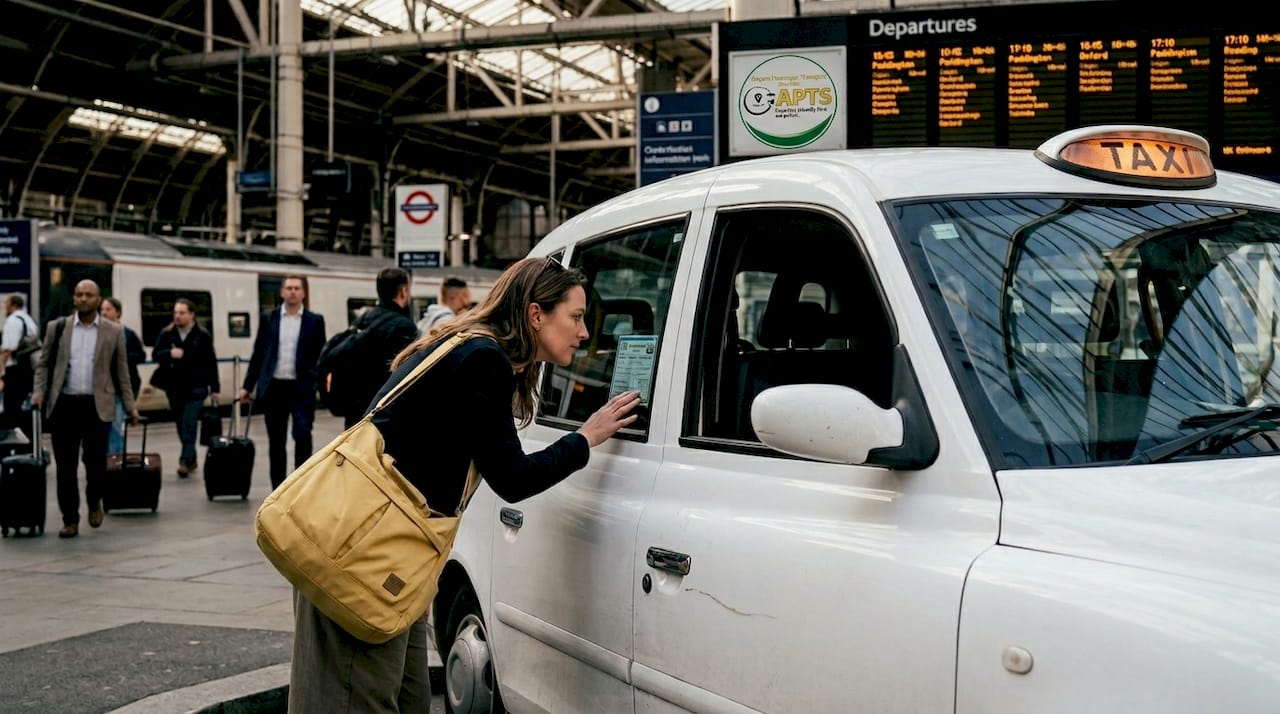
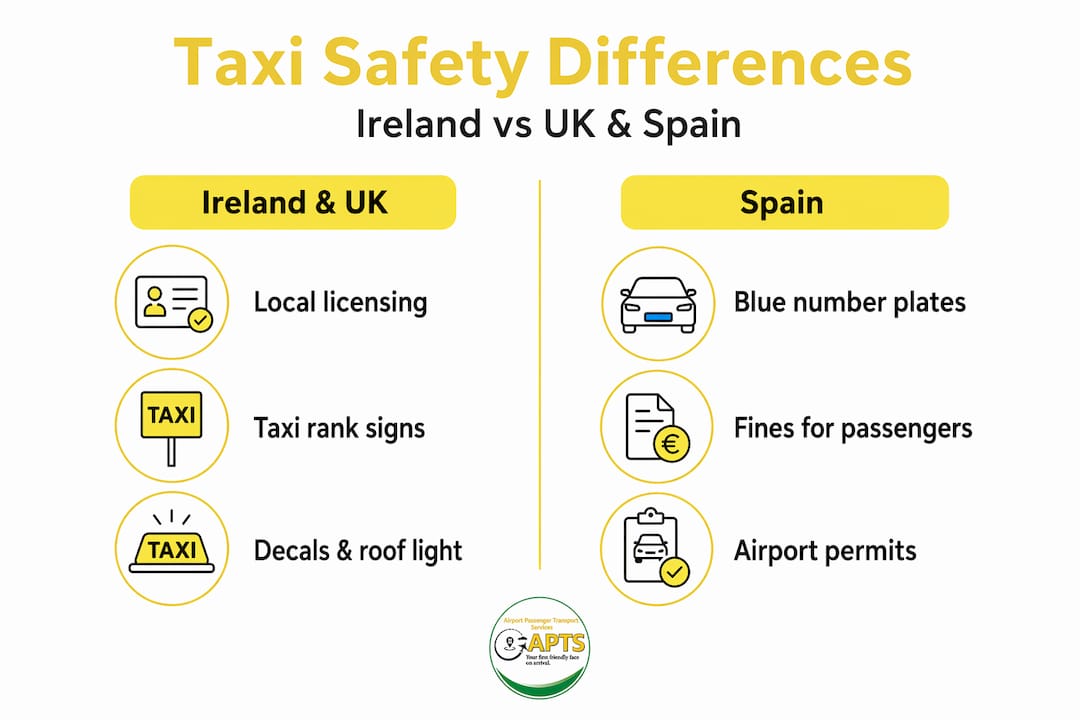
Spain uses colour-coded number plates as a clear compliance marker. Blue plates with white lettering identify licensed taxis and VTC (vehicle with driver) operators. If the plate does not match this format, do not board the vehicle.
Ireland and the UK rely on official taxi rank signage, vehicle roof signs, and regulatory decals displayed on the car. In Dublin, look specifically for the taxi licence disc in the windscreen, which is mandatory for all licensed vehicles.
Across all three countries, one rule applies universally: the meter should start running at the beginning of your journey, not mid-route. A driver who delays activating the meter or claims it is “broken” is a warning sign.
Indicators to check before you board:
- Correct number plate format for the country (blue and white in Spain)
- Official taxi rank location within the airport, not the car park or drop-off zone
- Roof sign, licence disc, or regulatory decal displayed on the vehicle
- Meter visible and activated at journey start
- Driver can produce identification and vehicle documentation on request
- Booking confirmation matches the vehicle registration and driver name
Pro Tip: At Dublin Airport, taxis operating from the official ranks are required to hold specific airport permits. If a driver approaches you inside the terminal and offers a ride, they are almost certainly not operating within the rules.
Choosing a pre-booked service removes most of this uncertainty. Guidance on choosing reliable airport taxis before you depart gives you a verified operator and confirmed vehicle details before you land.
Risks and consequences of using unlicensed or unauthorised airport taxis
The risks go well beyond a fine. Unlicensed taxis operate outside the regulatory framework that protects you as a passenger, and that has real consequences.
“Passengers caught using unlicensed taxi services in Spain face fines of up to 600 euros. This is not a theoretical risk. Enforcement is active at major Spanish airports.”
Here are the primary risks travellers face when using unverified airport taxis:
- No insurance cover. Unlicensed vehicles are not required to carry the specific passenger liability insurance that licensed operators must hold. If you are injured in an accident, you may have no legal recourse.
- Fare manipulation. Without a regulated meter, drivers can charge whatever they choose. Tourists are a common target, particularly at busy international airports.
- Vehicle safety failures. Unlicensed vehicles are not subject to regular roadworthiness inspections required of licensed taxis. Mechanical failures are more likely.
- Identity fraud and scams. So-called “highway pirates” target arriving passengers by falsely claiming vehicle damage or using aggressive pressure tactics to extract additional payments.
- Lack of driver vetting. Licensed taxi operators must submit to criminal record checks and health assessments. Unlicensed drivers face no such requirements, meaning passenger safeguarding is entirely absent.
The financial penalty in Spain alone should give travellers pause. But the absence of insurance cover is the less visible and potentially far more serious consequence. Reviewing airport taxi safety practices before every trip is a worthwhile precaution.
Comparing airport taxi systems and safety measures across Ireland, the UK, and Spain
Understanding how these three systems compare helps set realistic expectations before you travel.
| Country | Licensing authority | Driver vetting | Visual identifiers | Passenger penalties for unlicensed use |
|---|---|---|---|---|
| Ireland | National Transport Authority (NTA) | Criminal record checks, medical fitness | Licence disc, roof sign, airport permit | Not standard, but no protection if incident occurs |
| UK (London) | Transport for London (TfL) | Consistent across all licence types | Licensed plate, TfL badge, PHV markings | None, but uninsured risk applies |
| UK (outside London) | 263 local authorities | Varies by area | Varies by authority | None, but uninsured risk applies |
| Spain | Regional transport authorities | Required for licensed operators | Blue/white number plates | Up to 600 euros per passenger |
The UK licensing variation across authorities is a particular concern for business travellers moving between cities. A licensed taxi in one English city may have been vetted to a lower standard than one operating from a different authority. London remains the clear outlier with its higher and more consistent enforcement.
Ireland’s airport permit requirement adds a level of specificity that many travellers overlook. It is not enough for a driver to hold a general taxi licence. Operating at Dublin Airport requires additional authorisation, which is worth confirming when booking.
For a full breakdown of what to expect from ground transport across the UK, our UK airport taxi guide covers the key differences in more detail.
Practical tips for safe airport taxi travel
Clear steps make safer choices straightforward. These airport ride safety tips apply across Ireland, the UK, and Spain.
- Use designated taxi ranks only. Official ranks are located within the airport’s controlled areas. Do not accept rides from drivers who approach you in the terminal building or car park.
- Pre-book with a licensed operator. A confirmed booking gives you driver details, vehicle registration, and a fixed fare before you land. This removes the guesswork entirely.
- Check the meter at journey start. If the meter is not activated immediately, ask the driver to do so. If they refuse, exit the vehicle.
- Confirm payment methods before departure. Some operators are cash-only; others accept cards. Agree on this before the journey begins to avoid disputes on arrival.
- Request driver identification if uncertain. Licensed drivers in Ireland and the UK carry official identification. In Spain, the vehicle licence and driver credentials should be displayed or available on request.
- Avoid unsolicited approaches. Any driver who seeks you out directly at an airport is operating outside official channels. This applies at all three countries’ major airports without exception.
TfL requires all licensees to meet safety standards not just at the point of licensing but throughout the full duration of their licence. This ongoing compliance requirement is one reason London consistently offers higher passenger protections.
Pro Tip: Screenshot your booking confirmation and save the driver’s name and vehicle registration to your phone before landing. If your flight is delayed and you lose mobile signal, you have the details offline.
For stress-free arrivals, understanding how to communicate your requirements in advance makes a significant difference. Our guide on communicating with airport taxis covers pre-arrival arrangements that reduce uncertainty at pickup.
Why traveller vigilance matters more than ever in airport taxi safety
Regulation provides a framework. It does not guarantee your safety in the moment you arrive, tired and disoriented, at an unfamiliar airport. That gap between policy and practice is where risks concentrate.
The uncomfortable truth about airport transportation safety is this: licensing standards vary regionally, and “licensed” does not mean the same thing across all UK localities, let alone across three separate countries. A traveller who boards a vehicle assuming that any official-looking taxi is properly vetted is making an assumption the regulatory framework does not support.
What this means practically is that your due diligence remains essential regardless of where you travel. Knowing the local visual identifiers, using official ranks, and confirming booking details before arrival are not bureaucratic inconveniences. They are the actions that close the gap between regulatory intention and real-world protection.
Technology helps. Booking apps that show driver profiles, vehicle registrations, and real-time tracking have raised the baseline for safe taxi services significantly. But these tools only work when travellers use them intentionally rather than defaulting to whatever transport is available at the kerb.
The travellers most at risk are not those unfamiliar with airports. They are those who travel frequently enough to feel confident, and who stop checking because they assume familiarity equals safety. It does not. Regular travellers on business routes between Dublin, London, and Spanish airports are precisely the demographic that enforcement operations in Spain have identified as likely targets for pirate taxi operators. Complacency is the real vulnerability. Reviewing airport taxi safety practices as part of your pre-travel routine is the simplest way to counter it.
Ensuring safe and comfortable airport taxi rides with professional services
Professional airport taxi services remove the guesswork that makes independent taxi use stressful. Strict licensing compliance, continuous safety monitoring, and driver vetting come as standard, not as features you need to verify yourself on arrival.

At APTS, we provide taxi, executive taxi, and chauffeur services to and from airports throughout Ireland, the UK, and Spain. Every vehicle is fully licensed and insured. Every driver is professionally vetted. Pricing is transparent and confirmed at booking, so there are no surprises on arrival. Our reliable airport taxi services are designed for business and holiday travellers who prioritise safety, comfort, and reliability in equal measure. Whether you require a standard airport transfer or a premium executive vehicle, our safety practices and luxury taxi features ensure you arrive in comfort and confidence every time. Book in advance and travel with complete peace of mind.
Frequently asked questions
How can I identify a licensed airport taxi in Spain?
Look for blue plates with white lettering on the vehicle, use only official airport taxi ranks, and confirm the meter is activated at the start of your journey.
What are the penalties for using unlicensed taxis in Spain?
Passengers face fines up to 600 euros for using unlicensed taxi services, making it a financial risk as well as a safety concern.
Are all licensed taxis in the UK subject to the same safety and vetting standards?
No. Licensing standards differ across 263 local authorities in the UK, meaning vetting rigour and safety requirements vary significantly by area.
What safety standards does Transport for London require for taxis?
TfL enforces consistent safeguarding standards across all licensed taxi and private hire operators, covering driver vetting and ongoing conduct throughout the licence period.
What practical tips can improve safety when using airport taxis?
Use official taxi ranks or pre-booked licensed services, confirm the meter is running at journey start, agree on payment methods before departure, and avoid any driver who approaches you directly inside the terminal.
Recommended
- Your essential UK airport taxi guide: easy, reliable rides
- Your guide to reliable airport taxi services abroad
- How to communicate with airport taxis for smooth transfers
- safety-practices – Apts
Article checked by Declan Rodden.