
Most travellers assume that any taxi waiting outside an airport terminal is qualified to be there. That assumption is wrong. Airport taxi drivers must hold a specific, layered set of qualifications that go well beyond a standard driving licence. From national licensing requirements to airport-specific stand permits, background checks, and operational standards, the barriers to entry are deliberately high. Understanding these requirements helps you make smarter choices about who you trust with your journey.
Table of Contents
- What makes airport taxi driver qualifications different?
- Ireland airport taxi driver qualifications explained
- UK airport taxi driver licensing and local variations
- Spain: airport taxi standards in context
- Why layered airport taxi qualifications are essential for travellers
- Choosing a qualified airport taxi: your next step
- Frequently asked questions
Key Takeaways
| Point | Details |
|---|---|
| Layered qualifications matter | Airport taxi drivers need more than basic taxi licences to operate at airport ranks. |
| Permits ensure safety | Extra airport permits and checks protect travellers from unqualified drivers. |
| Check for credentials | Always verify your airport taxi driver’s permit and ID before you travel. |
| Local rules vary | Requirements differ across Ireland, the UK, and Spain, so check the details for each airport. |
| Picking the right service | Travellers should favour verified airport taxi services for reliability and peace of mind. |
What makes airport taxi driver qualifications different?
Now that you know qualifications matter, let’s break down what actually sets airport taxi drivers apart from general taxi operators.
Most people picture a taxi licence as a single document. In reality, it is a stack of credentials, and airport access requires every layer of that stack to be in place. A driver might be legally permitted to carry passengers in a city or town, yet be entirely ineligible to operate from an airport taxi rank.
The distinction matters because airports are high-volume, high-pressure environments. Passengers are often tired, unfamiliar with the area, carrying significant luggage, and sometimes travelling alone. Regulatory bodies and airport operators recognise this vulnerability, which is why they impose standards above and beyond standard taxi licensing.
As the Dublin Airport taxi code of conduct makes clear, even when drivers are legally licensed to operate as taxis, airports may require an additional, separate airport permit or stand permit, with ID display and payment and operational standards attached.
“A taxi licence is the foundation, not the finish line. Airport permits are a separate, higher standard that drivers must earn and maintain.”
Here is a quick overview of how base taxi licensing compares to what airport ranks typically require:
| Requirement | Standard taxi licence | Airport taxi qualification |
|---|---|---|
| Valid driving licence | Yes | Yes |
| National taxi/SPSV licence | Yes | Yes |
| Background/suitability check | Often | Always |
| Medical check | Sometimes | Usually required |
| Airport-specific permit | No | Yes |
| ID display at rank | No | Mandatory |
| Payment standards (card, etc.) | Varies | Strictly enforced |
| Vehicle standards inspection | Basic | Enhanced |
Key differences between a standard licence and airport access include:
- Airport permits are issued separately and can be revoked independently of the taxi licence
- Drivers must actively apply and meet ongoing compliance standards
- Airports regularly audit permit holders for continued adherence
- Failure to display ID or meet operational standards can result in immediate removal
Pro Tip: When you arrive at an airport, always look for a driver’s airport permit and ID displayed prominently in the vehicle. If either is missing, this is a clear signal to find an alternative.
Understanding this layered structure helps travellers choose services with genuine confidence. The difference between a compliant airport taxi and an unlicensed alternative can directly affect your safety, comfort, and the reliability of your journey. For a broader comparison of transport options, the airport taxi vs shuttle guide covers the practical distinctions clearly.
Ireland airport taxi driver qualifications explained
Having explored why airport qualifications are different, let’s look closely at the Irish standards, especially at the key airports of Dublin and Shannon.
In Ireland, taxi and private hire vehicles are classified as Small Public Service Vehicles (SPSVs). The regulation of these vehicles and their drivers falls under the National Transport Authority (NTA). The standards are rigorous and multi-layered, which directly benefits every passenger who steps into a licensed vehicle.

According to the NTA SPSV manual, to drive a taxi or SPSV in Ireland, you need an SPSV driver licence plus a valid driving licence, and applicants must meet suitability, tax compliance, and training and testing requirements. This means a driver’s character, criminal history, financial compliance, and professional competence are all assessed before a licence is ever issued.
Here is a step-by-step breakdown of what a driver must complete before operating at an Irish airport:
- Hold a full, valid Irish or EU driving licence
- Apply for and receive an SPSV driver licence from the NTA
- Pass a suitability assessment (including Garda vetting and character evaluation)
- Meet tax compliance obligations with Revenue
- Complete mandatory SPSV driver training and testing
- Ensure their vehicle meets SPSV vehicle licence requirements
- Apply for and receive the airport-specific stand permit from the relevant airport authority
- Display their SPSV driver ID card and airport permit at all times while operating at the airport rank
The additional airport layer is not a formality. Dublin Airport operates under a detailed regulatory framework. As confirmed in the Dublin Airport taxi code of conduct, taxi licences alone do not automatically grant access to taxi stands. Drivers need a Dublin Airport taxi permit and must meet minimum requirements, including full NTA regulatory compliance.
Shannon Airport applies the same principle. The Shannon Airport taxi stand operations manual confirms that taxi stand operation requires both an SPSV/PSV driver licence and a separate Taxi Stand Permit. Drivers must display their ID card and meet payment, vehicle, and driver criteria while operating at the airport.
| Requirement | Ireland (NTA standard) | Dublin Airport | Shannon Airport |
|---|---|---|---|
| SPSV driver licence | Mandatory | Mandatory | Mandatory |
| Valid driving licence | Mandatory | Mandatory | Mandatory |
| Suitability and Garda vetting | Mandatory | Mandatory | Mandatory |
| Tax compliance | Mandatory | Mandatory | Mandatory |
| Airport stand permit | Not applicable | Mandatory | Mandatory |
| ID card display | Required | Required | Required |
| Card payment acceptance | Not always | Required | Required |
| Vehicle standards | NTA standards | Enhanced | Enhanced |
“A Shannon Airport permit is not simply issued on application. Drivers must actively demonstrate ongoing compliance with vehicle, payment, and conduct standards.”
Pro Tip: Before booking an airport taxi in Ireland, confirm that your driver holds the relevant airport permit for Dublin or Shannon, and verify that they accept card payment. Both requirements are non-negotiable for legitimate airport rank operators. You can also review our Dublin Airport meeting points guide to understand exactly where qualified drivers are permitted to collect passengers.
If you are travelling with family, it is worth noting that family friendly Dublin taxis must meet the same high qualification standards, with additional considerations for child seats and vehicle suitability. Our Dublin Airport taxi service operates under all applicable NTA and airport permit requirements, providing full compliance and professional standards on every journey.
UK airport taxi driver licensing and local variations
Ireland isn’t the only place with strict qualification layers. Let’s see how the UK’s system works, especially given its significant local variations.
The United Kingdom does not operate under a single national taxi licensing authority. Instead, licensing is managed at a local council level, with the exception of London, where Transport for London (TfL) serves as the regulator. This creates a landscape that varies considerably depending on where a driver is based and where they intend to operate.
According to the UK National Careers Service, becoming a licensed taxi driver in England is regulated by local authorities or TfL in London, and typically includes licence approval plus enhanced background checks, a medical check, and local tests and assessments. The enhanced background check is a Disclosure and Barring Service (DBS) check, which examines criminal history in detail, specifically in relation to working with passengers.
Crucially, UK licensing is not one universal rule set. While there are national themes such as DBS checks, medical assessments, and local knowledge tests, the specific requirements, including knowledge and English language tests, can vary by local council area or by London’s TfL framework. This means that a driver licensed in one council area may face entirely different requirements when applying to operate in another, or at a specific airport.
At major UK airports, the additional layer of access control applies just as firmly as it does in Ireland. Airport stand access typically requires:
- A valid local authority or TfL taxi licence
- An enhanced DBS criminal record check
- Proof of medical fitness to drive
- Completion of any required local knowledge or language assessments
- A separate airport operator permit or access pass
- Vehicle compliance with the airport’s own standards
- Ongoing compliance audits and permit renewals
London’s TfL framework is particularly demanding. The famous Knowledge of London test requires drivers to memorise thousands of routes, landmarks, and points of interest. It can take several years to complete. When combined with airport access requirements at Heathrow, Gatwick, or Stansted, the qualification burden is substantial.
The benefit to passengers is significant. A fully qualified UK airport taxi driver has passed multiple independent assessments, meaning their competence, character, and vehicle have all been verified by different authorities. Our UK airport taxi guide outlines how to navigate this system confidently, and our airport taxi services abroad resource covers the broader picture for international travellers.
Pro Tip: If you are travelling through a UK airport, do not assume that any taxi at the terminal is fully licenced for that specific airport. Always use the official designated taxi rank or a pre-booked service with verified credentials.
Spain: airport taxi standards in context
With Ireland and the UK qualifications covered, let’s briefly contrast what you can expect in Spain and why the similarities matter.
Spain operates within the broader European Union framework for passenger transport, meaning taxi drivers must meet established national and regional standards. Each autonomous community, such as Catalonia, Madrid, or Andalusia, has responsibility for regulating taxi services within its territory. This creates a similar pattern to the UK’s local authority model.
At major Spanish airports including Madrid Barajas, Barcelona El Prat, and Málaga, access to official taxi ranks is subject to additional authorisation. Drivers must generally hold a municipal taxi licence specific to the relevant city or region, as well as separate authorisation to operate from the airport zone.
When selecting an airport taxi in Spain, passengers should look for the following:
- A visible municipal taxi licence displayed in the vehicle
- Official airport rank access, rather than a driver approaching you informally
- A clearly visible driver ID card
- A functioning taximeter with approved tariff rates displayed
- Acceptance of card payment, which is increasingly required at major airports
- A vehicle that meets regional standards for age and condition
The common thread across Spain, Ireland, and the UK is clear. Layered qualification requirements exist precisely because airports attract both legitimate operators and those seeking to exploit passengers who are unfamiliar with local transport. In all three countries, the safest approach is to use pre-booked services from verified operators or to use the official designated airport taxi rank exclusively.
Why layered airport taxi qualifications are essential for travellers
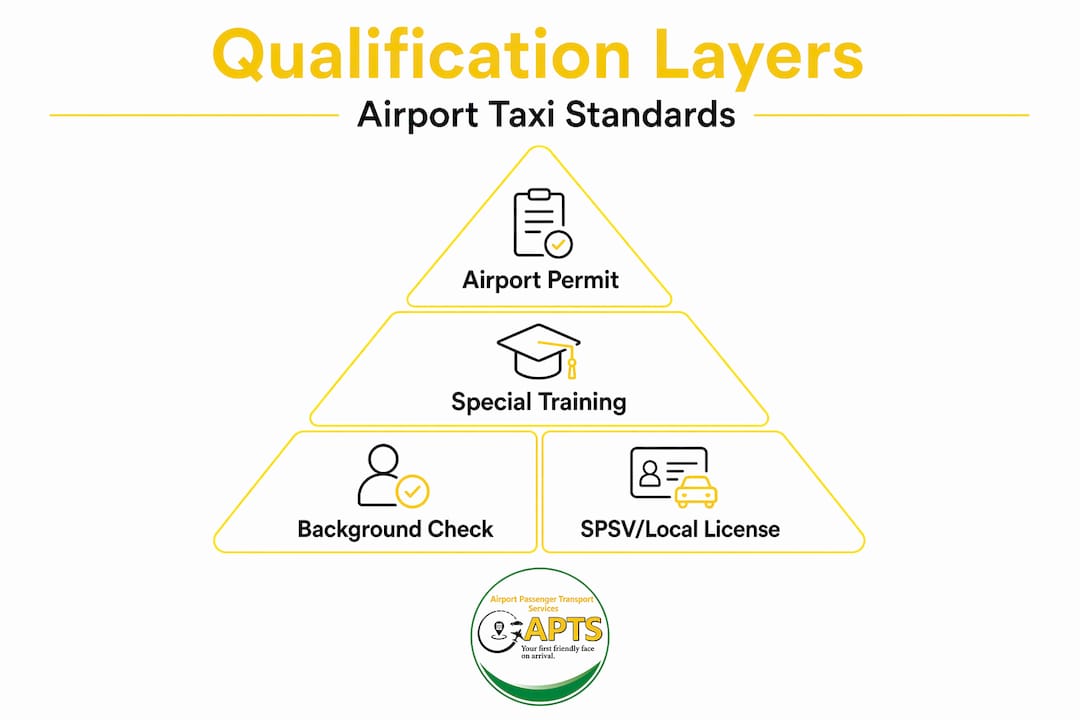
Here is a perspective worth considering carefully. The double-permit system and layered checks are sometimes dismissed as bureaucratic excess, as if airports are simply adding paperwork for its own sake. That view misses the point entirely.
The honest reality is this: many travellers wrongly assume that a taxi licence alone is sufficient proof of a driver’s suitability. It is not. A basic taxi licence tells you that a driver passed a test at a point in time. It does not tell you about their conduct since then, their criminal history, their vehicle’s condition, or whether they meet the specific operational standards of the environment they are working in.
Airports are not ordinary pickup points. They handle millions of passengers annually, many of whom are travelling alone, arriving at unfamiliar times, carrying valuable belongings, or are otherwise in a position of vulnerability. The layered qualification system exists precisely to address that reality.
Airport taxi ranks are regulated precisely because airports handle vulnerable travellers and high-value journeys. The permit system creates accountability that a single licence cannot provide.
There is also a broader quality argument. Drivers who hold airport permits have a stronger commercial incentive to maintain standards. Loss of an airport permit is a serious professional consequence. That accountability drives better behaviour, better vehicle maintenance, and more professional conduct overall.
Travellers who book a pre-verified, airport-permitted taxi service are not simply paying for a vehicle. They are paying for the assurance that a driver has passed multiple independent checks, holds the relevant credentials, and operates under a regime that can be enforced. Our resource on airport taxi safety practices covers in practical detail how these standards protect you on every journey.
The next time someone suggests that any taxi will do at an airport, the evidence firmly disagrees.
Choosing a qualified airport taxi: your next step
Understanding qualifications is good, but selecting a taxi service with fully verified drivers is the practical next step that actually protects your journey.

At APTS, every driver operating across our Ireland, UK, and Spain airport services holds the relevant national licence and airport-specific permits required for their operating location. We work exclusively with professional chauffeurs and taxi drivers who meet the highest verification standards, so you never have to question whether your driver is genuinely qualified. Whether you need a reliable taxi service from Dublin Airport or executive transport from a UK or Spanish airport, our team is ready to arrange a seamless, fully compliant journey. Book your airport transfer today and travel with complete confidence.
Frequently asked questions
Can any licensed taxi driver operate at airport taxi stands?
No, most airports require an extra permit or authorisation beyond a standard taxi licence for access to official taxi ranks. As confirmed in the Dublin Airport taxi code of conduct, taxi licences alone do not automatically grant access to taxi stands, and a separate Dublin Airport taxi permit is required.
Do airport taxi drivers have to pass extra tests or training?
Yes, in Ireland and the UK, airport taxi drivers must meet medical, suitability, background, and compulsory training requirements before receiving permits. In Ireland, the NTA SPSV requirements include suitability assessment, tax compliance, and mandatory training, while in the UK, the National Careers Service confirms that enhanced background checks, medical checks, and local assessments are standard.
How do I know if my airport taxi driver is fully qualified?
Check that your driver displays a valid airport permit and ID, and that their taxi has up-to-date payment and licence details as required by airport regulations. The Shannon Airport taxi stand operations manual confirms that drivers must display their ID card and meet payment, vehicle, and driver criteria at all times while operating at the airport.
Why are airport taxi driver requirements stricter than regular taxi drivers?
Airports enforce stricter standards to ensure safety, passenger protection, and reliability in high-traffic environments where travellers are often in a position of vulnerability. The layered permit system creates additional accountability that a single national taxi licence alone cannot provide.
Recommended
- Your essential UK airport taxi guide: easy, reliable rides
- Your guide to reliable airport taxi services abroad
- safety-practices – Apts
- How to communicate with airport taxis for smooth transfers
Article checked by Declan Rodden.