

An airport transport provider is defined as a professional ground transport operator that coordinates pre-arranged, punctual transfers between airports and passenger destinations. The role of airport transport provider goes well beyond simply driving a car. It encompasses real-time flight tracking, fixed pricing, luggage assistance, duty-of-care compliance, and precision timing that removes uncertainty from the final leg of any journey. Understanding what these providers actually do helps you make a far better decision the next time you land.
What are the primary functions of airport transport providers?
Airport transport providers perform a specific set of functions that standard taxis and public transport do not replicate. The industry standard for professional providers is built around predictability and passenger welfare, not convenience for the driver.
The core functions include:
- Real-time flight tracking. Premium providers track actual landing times, not scheduled arrivals, adjusting pickup times to account for customs and baggage claim delays. This removes the risk of a driver leaving before you clear the terminal.
- Fixed, all-inclusive pricing. Private pre-booked transfers use 100% fixed pricing, unlike rideshare apps where fares fluctuate during peak demand. You know the cost before you book.
- Complimentary waiting periods. Reputable providers include a 60-minute free wait after actual landing to cover customs and baggage collection. That standard protects you from being charged for delays outside your control.
- Luggage assistance. Drivers assist with bags at both the terminal and your destination. This matters most for families, older travellers, and anyone with oversized luggage.
- Meet and greet service. Some providers meet passengers inside terminals, escort them through the building, and handle luggage directly to the vehicle.
- Direct routing. Professional transfers take you point to point without detours or additional passenger stops.
Pro Tip: Always confirm whether your provider tracks actual landing time or scheduled arrival time. The difference can mean a missed pickup after a delayed flight.
These functions combine to create a service that operates closer to a logistics operation than a taxi ride. Airport transfers manage timing and route optimisation to eliminate uncertainty between aircraft arrival and your final destination, much like freight logistics manages last-mile delivery.

How do airport transport providers differ from other transport modes?
The clearest difference between a professional airport transfer and other transport options is price predictability. Fixed pricing versus surge pricing is not a minor detail. It is the difference between a known travel cost and an unpleasant surprise at the end of a long flight.
| Transport mode | Pricing model | Pre-booking | Luggage handling | Direct routing |
|---|---|---|---|---|
| Professional transfer | Fixed, all-inclusive | Yes | Yes | Yes |
| Standard taxi | Metered or negotiated | Rarely | Limited | Usually |
| Rideshare app | Surge-based | App only | No | Yes |
| Public transport | Fixed fare | No | No | No |
Each mode suits a different situation. The right choice depends on your luggage, group size, timing, and how much uncertainty you are willing to accept.
- Professional transfer: Best for business travellers, families with luggage, groups, and anyone with a tight connection or early morning flight. Pre-booking removes all guesswork.
- Standard taxi: Suitable for short, simple journeys where you are travelling light and timing is flexible. No guarantee of availability at peak times.
- Rideshare apps: Convenient for solo travellers with minimal luggage during off-peak hours. Surge pricing during busy periods can make these significantly more expensive than a pre-booked transfer.
- Public transport: The lowest cost option for budget travellers with light luggage and flexible schedules. Not practical for large groups or heavy bags.
Private transfers offer advantages that become most visible when things go wrong. A delayed flight, a long queue at passport control, or a heavy bag all become manageable when your driver is tracking your flight and waiting for you.
What technology and logistics enable provider reliability?
Reliability in airport transport is not accidental. It is the product of specific operational practices that professional providers build into every booking.
Flight tracking and dynamic scheduling
The most important technical capability a provider can have is live flight monitoring. Providers that track actual landing times rather than scheduled arrivals can adjust driver dispatch times dynamically. This means your driver arrives when you land, not when the airline originally planned for you to land. The practical result is no wasted waiting time for you and no missed pickups after delays.
Route optimisation and congestion management
Professional providers use route planning to avoid known congestion points around airport terminals. This is particularly relevant at busy airports where drop-off and pick-up zones are heavily regulated. Optimised routing reduces the time your vehicle spends circling or queuing, which directly affects your arrival time at the destination.
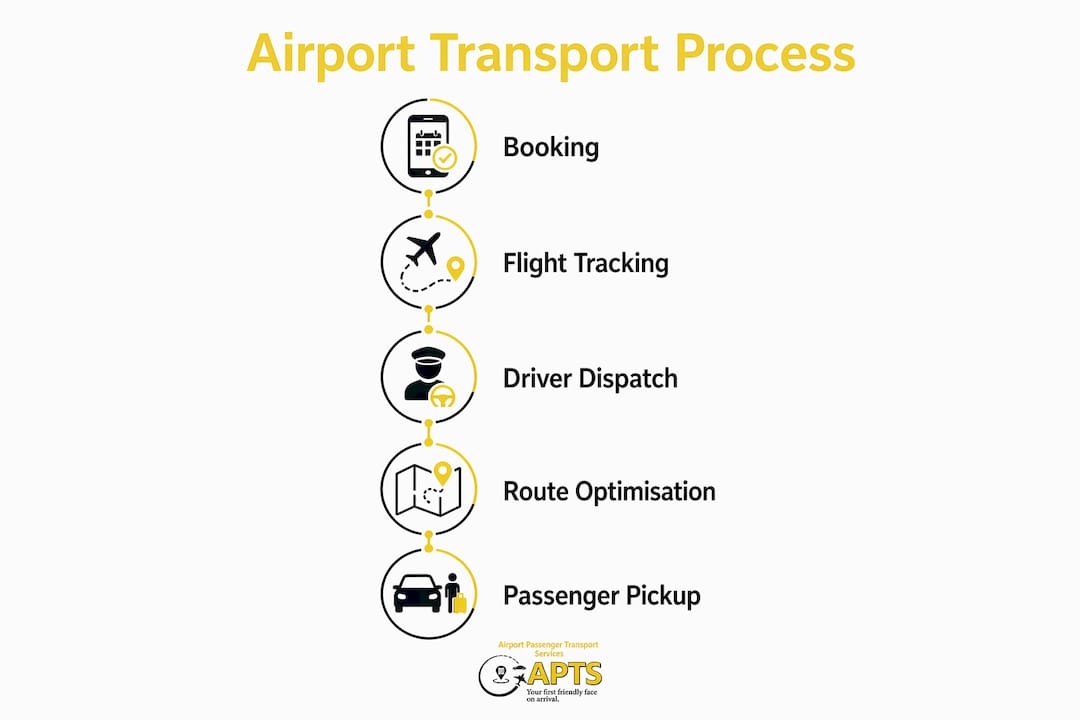
Technology-driven transport programmes reduce airport vehicle trips by up to 1.5 million annually through optimised routing and centralised operations. That reduction has a direct environmental benefit, cutting emissions around terminals where air quality is already a concern.
Meet and assist integration
Some providers integrate directly with airport concierge services. A meet and assist service places a representative inside the terminal who greets you at arrivals, helps with luggage, and escorts you to the vehicle. This eliminates the need to navigate an unfamiliar airport, find the correct exit, or locate your driver in a crowded pick-up zone.
Pro Tip: If you are travelling through an unfamiliar airport with heavy luggage, a meet and assist upgrade is worth the additional cost. It removes the most stressful part of the arrival process entirely.
Why is the role of airport transport providers critical for business travellers?
For business travellers, the importance of airport transport extends beyond personal convenience. Duty-of-care responsibilities require employers to provide safe transport arrangements, track travel spend, and maintain consistent standards through managed airport transfers. A missed pickup or an unnetted driver is not just an inconvenience. It is a compliance failure.
The key reasons business travellers rely on professional providers:
- Safety and accountability. Managed transfers use vetted, licensed drivers with documented records. This satisfies duty-of-care requirements that ad-hoc taxis cannot.
- Expense tracking. Booking transfers through standalone services creates documentation gaps and audit challenges. Managed platforms produce clear records for expense reconciliation.
- Punctuality. A missed connection caused by unreliable ground transport can cost far more than the price difference between a professional transfer and a cheaper alternative. Hidden costs of unreliable transport routinely exceed the incremental cost of professional pre-booked services.
- Consistent standards. Business travellers moving between cities need the same service quality at each location. Managed providers deliver that consistency.
Leisure travellers benefit equally, though for different reasons. Families travelling with children and multiple bags need a vehicle that accommodates everyone without a surcharge. Groups benefit from fixed pricing that does not multiply unpredictably. Travellers on early morning or late night flights need a driver who is confirmed and waiting, not one they are hoping to find at the kerb.
The benefits of pre-arranged airport transport are most apparent when the alternative fails. A rideshare surge at midnight, a taxi queue at 5am, or a bus that does not run on bank holidays are all situations a pre-booked transfer eliminates entirely.
Key takeaways
Professional airport transport providers deliver reliability through fixed pricing, live flight tracking, and duty-of-care standards that no ad-hoc transport mode can consistently match.
| Point | Details |
|---|---|
| Fixed pricing protects you | Pre-booked transfers use all-inclusive rates, removing surge pricing risk entirely. |
| Flight tracking is non-negotiable | Providers that track actual landing times prevent missed pickups after delays. |
| 60-minute wait is the standard | Reputable providers include a free 60-minute wait post-landing to cover customs and baggage. |
| Duty of care applies to business travel | Managed transfers satisfy employer obligations for safety, tracking, and compliance. |
| Reliability outweighs cost savings | Hidden costs from unreliable transport consistently exceed the price of professional services. |
Declan’s view: reliability is the product, not the vehicle
After years of observing how travellers approach airport transport, the pattern is consistent. Most people focus on the price at the point of booking and ignore every other variable. Then they experience a surge charge, a no-show driver, or a 40-minute wait at arrivals, and the calculation changes entirely.
The shift happening across the industry is real. Travellers are increasingly choosing pre-booked professional services not because they are cheaper, but because the cost of getting it wrong is too high. A missed business meeting, a delayed hotel check-in, or a family stranded at an airport at midnight are not abstract risks. They happen regularly to people who booked on price alone.
What I find most underappreciated is the logistics dimension. A good airport transfer provider operates with the same discipline as a freight logistics company. Timing, routing, contingency planning, and communication are all part of the service. When that infrastructure is in place, the transfer becomes invisible. You land, your driver is there, and you arrive at your destination on time. That is the standard worth paying for.
The providers worth choosing are those who track your actual flight, confirm your booking in advance, and have a clear process for delays. Everything else is secondary.
— Declan
Apts airport transfers: professional service for every journey
Apts provides taxi, executive taxi, and chauffeur services to and from airports throughout Ireland and Spain. Every booking includes fixed pricing with no hidden charges, drivers who monitor live flight data, and vehicles suited to solo travellers, families, and business passengers alike.
Whether you need a private airport transfer for a business trip or a family-friendly taxi service for a group holiday, Apts covers the full range of passenger needs. Bookings are confirmed in advance, pricing is transparent, and drivers are vetted professionals. For a full overview of airports served, visit the airports covered by taxi service guide and book with confidence.
FAQ
What is the role of an airport transport provider?
An airport transport provider coordinates pre-booked, punctual ground transfers between airports and passenger destinations. Core responsibilities include real-time flight tracking, fixed pricing, luggage assistance, and direct routing.
How does flight tracking improve airport transfers?
Providers that monitor actual landing times, rather than scheduled arrivals, adjust driver dispatch dynamically. This prevents missed pickups caused by delays and removes extra waiting charges for passengers clearing customs.
What is the standard waiting time for airport transfers?
Reputable providers include a 60-minute complimentary waiting period after actual flight landing. This covers the time needed for passport control, customs, and baggage collection.
Why do business travellers use managed airport transfers?
Duty-of-care obligations require employers to arrange safe, documented transport for staff. Managed transfers provide vetted drivers, expense records, and consistent service standards that ad-hoc taxis cannot reliably deliver.
Are pre-booked transfers more expensive than rideshares?
Pre-booked transfers use fixed pricing, while rideshare fares fluctuate with demand. During peak travel periods, surge pricing on rideshare apps frequently exceeds the cost of a pre-booked professional transfer.
Recommended
- List of airport ground transport: your 2026 guide
- Why airport transfer matters for stress-free travel
- Chauffeur service for airports: what to expect
- Luggage policies for airport taxis: your clear guide
Article checked by Declan Rodden.