

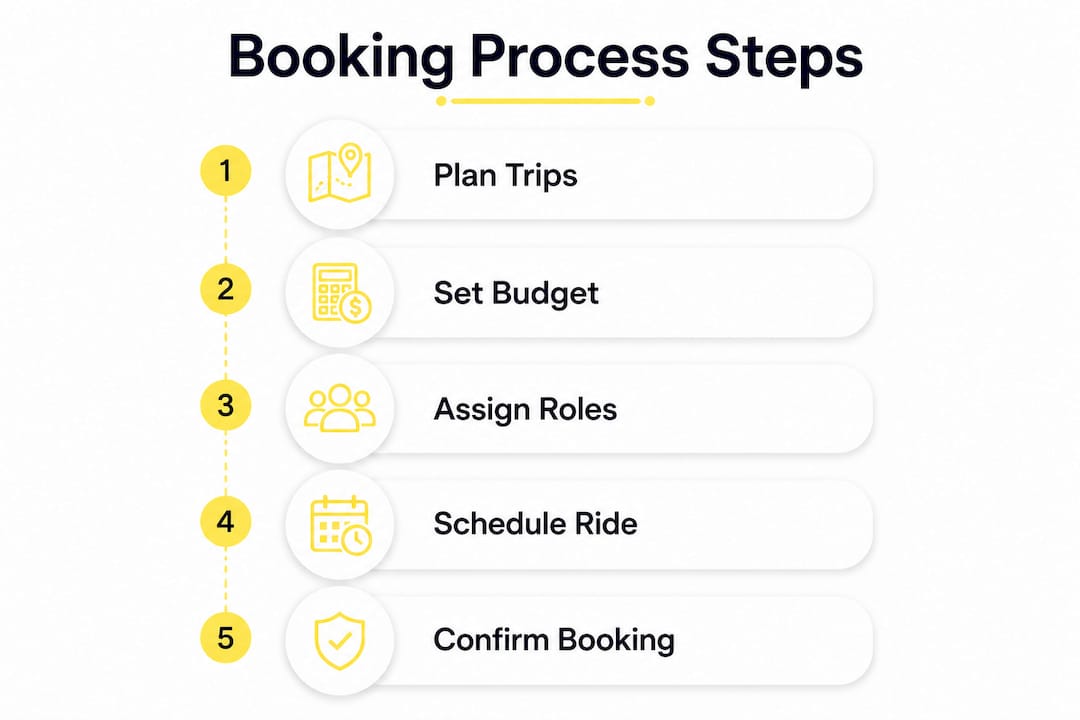
Corporate taxi booking is the organised system businesses use to pre-schedule rides, enforce budget controls, and assign user permissions so that every work trip is cost-controlled, traceable, and compliant. Unlike hailing a cab on the street, this is a structured process built around scheduled bookings, role-based access, and transparent billing. Travel managers who treat it as a repeatable framework rather than a series of one-off arrangements reduce administrative burden significantly. This guide covers the full corporate taxi reservation process, from approval workflows and spending limits to the technology features that make the whole system work.
What is the corporate taxi booking process?
Corporate taxi booking is a formalised workflow that replaces ad-hoc taxi use with planned, policy-driven transport. Where a personal taxi booking might involve opening an app and requesting the nearest available car, a corporate booking follows defined rules: the trip type is categorised, the fare is estimated before confirmation, and the record feeds directly into expense reporting.
The most common trip types in a corporate programme are:
- Airport transfers for executives and client-facing staff travelling on business
- Client meeting transfers where punctuality and vehicle presentation matter
- Commuter runs for employees travelling between offices or to off-site locations
- Out-of-hours travel requiring manager approval due to higher fare risk
Scheduled bookings reduce stress and surge pricing risks, giving administrators clear visibility of transport demand before the day begins. That visibility is what separates a managed programme from a collection of individual receipts.
Modern corporate taxi platforms support this process through booking portals, automated fare estimates, and real-time ride tracking for both employees and administrators. The data trail each booking creates is as valuable as the ride itself. It feeds monthly reports, flags policy breaches, and supports finance reconciliation without manual chasing.

Pro Tip: Set up trip categories before your first booking goes live. Categorising rides by type, such as airport, client, or internal, makes reporting far cleaner and gives managers the context they need to approve or query a fare.
How do roles and permissions shape booking policies?
Role-based access is the structural backbone of any well-run corporate taxi programme. Assigning permissions by role improves security and reduces booking errors by ensuring each person can only do what their position requires.
A typical permission structure looks like this:
- Office administrators hold the broadest access. They configure the booking system, manage user profiles, set budget rules, and view all trip data across the organisation.
- Department managers can book rides for their teams, approve or reject requests that exceed thresholds, and view cost reports for their cost centre.
- Employees book within pre-set policy limits. They see fare estimates, receive driver details, and track their own rides. They cannot edit budget rules or view other employees’ trips.
- Finance teams access billing summaries and monthly invoices without needing to interact with the booking interface directly.
The risk in getting this wrong cuts both ways. Overly broad access creates budget exposure. Overly restrictive access causes employees to bypass corporate systems entirely, booking personal rides and submitting reimbursement claims that are harder to control. The best practice is auto-approval for routine, low-cost trips and manual review only for exceptions.
Pro Tip: Review role assignments every quarter. Staff changes, promotions, and departmental restructures frequently leave outdated permissions in place, which creates both security gaps and budget risk.
What budget controls are standard in corporate taxi booking?
Financial controls embedded in the booking flow are what give travel managers genuine oversight rather than retrospective damage limitation. Corporate travel systems commonly set monthly spending limits, automatic ride approvals under defined thresholds, and manager reviews for out-of-hours or higher fare rides.
The table below shows how different control types apply across common trip scenarios:
| Control Type | Routine Airport Transfer | Out-of-Hours Client Run | Executive VIP Trip |
|---|---|---|---|
| Spending cap | Monthly employee limit applies | Manager approval required | Separate executive budget pool |
| Approval workflow | Auto-approved under threshold | Manual review triggered | Pre-authorised by travel manager |
| Fare estimate shown | Yes, before confirmation | Yes, with override option | Yes, with premium vehicle note |
| Invoice detail | Full breakdown per trip | Full breakdown per trip | Full breakdown per trip |
Corporate accounts centralise billing, eliminate individual reimbursements, and enable volume-based pricing for meaningful savings. That shift from per-employee expense claims to a single monthly invoice with line-item detail is one of the clearest financial wins a travel manager can deliver.
Detailed receipts with pickup and drop-off locations, fare breakdowns, tax, tolls, and booking references reduce finance follow-ups and speed up reconciliation. A well-structured trip record removes the back-and-forth between employees and accounts teams that consumes hours each month.
What technology features improve the booking experience?
The quality of the technology platform determines how much of the corporate taxi booking process runs automatically and how much falls back on manual effort. Modern corporate taxi platforms offer real-time tracking, transparent pricing, and detailed invoicing compatible with accounting software.
Key features to look for when evaluating a platform:
- Live vehicle tracking so employees know exactly when their driver will arrive and administrators can monitor active trips
- Fare estimates before confirmation so there are no billing surprises and employees can flag unusual pricing before committing
- Mobile app booking that allows new users to book a ride in under a minute, with driver and vehicle details displayed upfront
- Integrated monthly invoicing that exports directly to accounting tools, removing manual data entry from the finance workflow
- User profile management that mirrors the company hierarchy, so permissions and budget rules apply automatically when a new employee is added
- Vetted driver credentials and ride history logs that support duty-of-care obligations for travelling employees
Simple taxi booking apps allow new users to book rides in under a minute, showing driver and vehicle details upfront. That ease of use matters particularly for occasional travellers who do not use the system daily and need confidence from the first interaction.
For executives requiring a higher standard of vehicle and service, executive taxi options sit within the same booking framework but draw from a premium fleet. The booking process is identical; the vehicle and service level are elevated.
How to implement corporate taxi booking for your business
Setting up a corporate taxi programme correctly from the start saves significant rework later. Successful corporate taxi programmes standardise travel processes and tailor booking rules to different rider groups, such as executives, commuters, and client-facing employees.
Follow these steps to build a programme that holds up under daily use:
- Define your trip categories. Decide upfront which trip types the programme covers: airport transfers, client meetings, commuter routes, and out-of-hours travel. Each category should carry its own approval rule and budget threshold.
- Segment employees by role and travel need. Executives travelling with clients have different requirements from office staff making occasional trips. Apply distinct booking rules per group to reduce friction and improve compliance.
- Set budget rules and approval workflows. Establish monthly spending caps per employee or department. Configure auto-approval for trips under a defined fare threshold and manual review for anything above it.
- Select a provider with the right credentials. Before signing with any taxi provider, verify their licence status and obtain their certificate of insurance. Verified licences and insurance are non-negotiable requirements for legal operation and risk management.
- Train users before go-live. Run a short briefing for each user group covering how to book, what the approval process looks like, and how to handle exceptions such as delayed meetings or last-minute changes.
- Monitor and adjust. Review monthly reports for policy breaches, unused approvals, and cost trends. Adjust thresholds and rules as travel patterns evolve.
For a detailed walkthrough of the business trip taxi process, including common workflows and scheduling best practices, that resource covers the operational side in full.
Key takeaways
A well-structured corporate taxi booking programme reduces costs, improves compliance, and removes the administrative burden of individual expense claims through role-based access, embedded budget controls, and centralised billing.
| Point | Details |
|---|---|
| Define trip categories early | Categorise rides by type before launch to make reporting accurate and approvals consistent. |
| Role-based access is non-negotiable | Assign booking, approval, and billing rights by role to reduce errors and protect budgets. |
| Auto-approval reduces circumvention | Set auto-approval for routine low-cost trips and manual review only for exceptions. |
| Centralised billing saves time | A single monthly invoice with line-item detail replaces individual reimbursement claims. |
| Verify provider credentials | Confirm licence status and insurance before signing with any taxi provider. |
Why most corporate travel programmes get booking wrong
Most corporate travel programmes I have seen fail not because of bad intentions but because of bad process design. The booking system gets set up once, permissions are assigned loosely, and approval workflows are either too tight or non-existent. Within three months, employees are booking personal rides and submitting receipts because the corporate system is too slow or too complicated.
The uncomfortable truth is that approval bottlenecks are the single biggest cause of non-compliance. When an employee needs a ride in 20 minutes and the approval chain takes 40, they will find another way. The fix is not to remove controls. It is to apply them intelligently. Auto-approve anything routine and under threshold. Reserve manual review for the trips that genuinely warrant scrutiny.
The other mistake I see regularly is treating the booking platform as a pure cost tool rather than a service tool. Employees who travel frequently for client meetings or airport runs are representing the business. A reliable, professional vehicle with a vetted driver is not a luxury. It is a basic standard of care. When you schedule a taxi pick-up in advance through a managed programme, you remove the last-minute stress that undermines a traveller’s focus before an important meeting.
Build the programme around the traveller’s experience first. The budget controls and compliance benefits follow naturally from a system people actually use.
— Declan
How Apts supports corporate taxi booking in ireland and spain
Apts provides professional ground transport for corporate clients travelling to and from airports across Ireland and Spain. Whether your team needs a standard airport transfer or a premium executive vehicle for a client arrival, Apts operates a vetted fleet with transparent pricing and reliable scheduling.
Corporate accounts with Apts include centralised billing, detailed trip records, and access to executive taxi services for high-priority travel. The booking process is straightforward, and every ride is tracked from confirmation to drop-off. For companies managing frequent airport transfers, Apts covers a wide range of airports across Ireland and Spain, giving travel managers a single reliable provider for cross-border business transport. Contact Apts to discuss a corporate account tailored to your team’s travel requirements.
FAQ
What is corporate taxi booking?
Corporate taxi booking is a structured system for managing business travel through pre-scheduled rides, role-based permissions, and centralised billing. It replaces ad-hoc taxi use with a policy-driven process that supports budget control and compliance.
How does the corporate taxi reservation process differ from personal booking?
Personal taxi bookings are one-off transactions with no budget oversight or reporting. Corporate taxi reservations follow defined approval workflows, spending thresholds, and generate detailed invoices that feed directly into expense management.
What approval workflow works best for corporate taxi programmes?
Auto-approval for routine, low-cost trips combined with manual manager review for out-of-hours or higher-fare rides is the recommended approach. This balance maintains compliance without creating bottlenecks that push employees off-system.
What technology features should a corporate taxi booking platform include?
The core features are live vehicle tracking, fare estimates before confirmation, mobile app booking, integrated monthly invoicing, and user profile management aligned with company roles and budget rules.
How do corporate accounts reduce taxi costs for businesses?
Corporate accounts centralise billing and eliminate individual reimbursements, enabling volume-based pricing and reducing the administrative cost of processing separate expense claims each month.
Recommended
- Business trip taxi process: a complete guide for travellers
- Examples of executive taxi services explained
- Airport taxi pricing explained: a traveller’s guide
- How to schedule a taxi pick up: a traveller’s guide
Article checked by Declan Rodden.