

An airport shuttle is a shared or dedicated vehicle service that transfers passengers between an airport and specific destinations such as hotels, city centres, or car parks, typically operating on fixed or flexible routes. The term covers a broad range of services, from scheduled stop-based buses to door-to-door minivan transfers, and understanding the distinction matters when planning any trip. Grand Canyon National Park operates free seasonal shuttle buses running every 15 to 30 minutes across multiple routes, illustrating how the scheduled model works at scale. Newark Liberty International Airport deploys shuttle buses as AirTrain replacements on weekdays between 5 a.m. and 3 p.m. during ongoing construction. Knowing which type of airport shuttle applies to your journey determines your cost, comfort, and arrival time.
What is an airport shuttle bus and how does it operate?
An airport shuttle bus is a vehicle service, ranging from a compact minivan to a full-size coach, that moves passengers along a defined corridor between an airport and surrounding destinations. The operational model varies significantly depending on whether the service runs fixed routes with scheduled stops or adapts its routing based on passenger demand. Both models serve the same core purpose: reliable, repeatable airport access without the cost of a private hire.
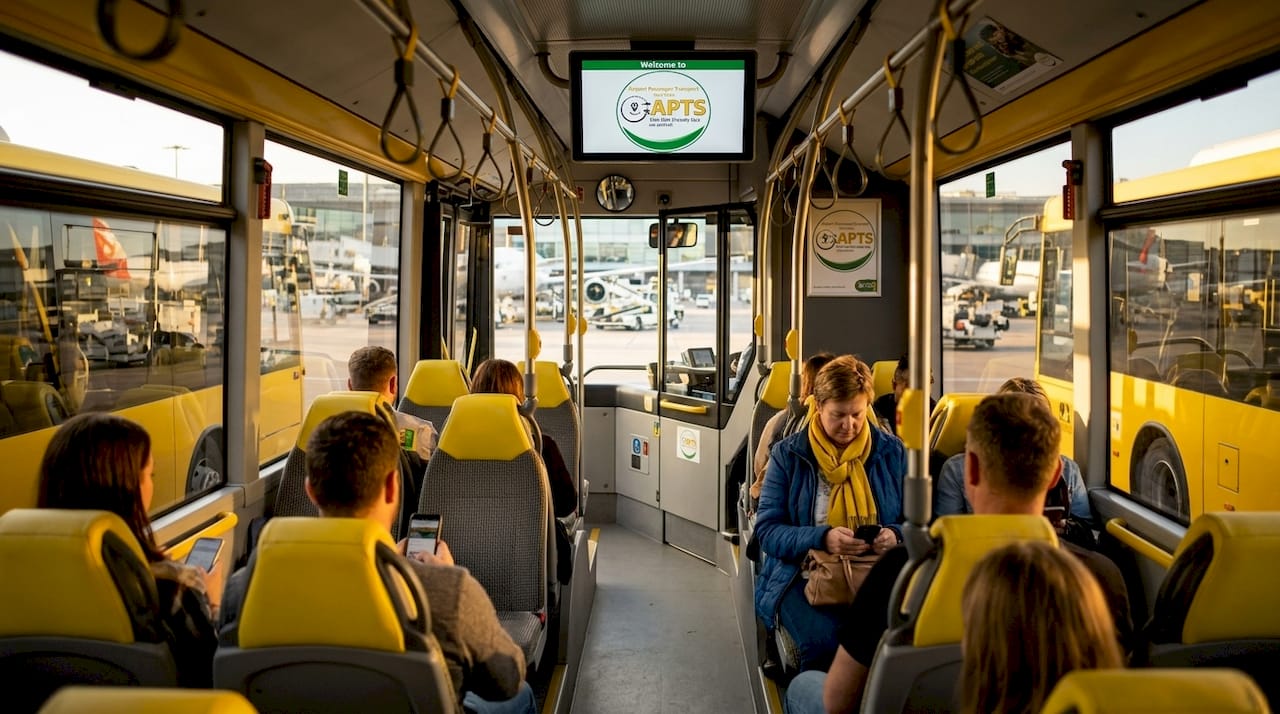
Fixed-route shuttles follow a predetermined timetable and stop at designated points, such as hotel zones, car park terminals, or rail stations. Demand-responsive shuttles collect passengers from multiple pickup points and drop them at individual addresses, which adds flexibility but also adds time to the overall journey. The choice between the two depends entirely on your priority: predictability or convenience.
Key operational features of airport shuttle services include:
- Vehicle types: Shuttle vans seat 8 to 14 passengers and offer good manoeuvrability in tight airport drop-off zones. Full shuttle buses carry larger groups and are common on hotel corridor routes.
- Luggage accommodation: Most shuttles provide dedicated luggage compartments or underfloor storage, making them practical for travellers with checked baggage.
- Accessibility: Many modern shuttle vehicles include step-free entry and wheelchair space, complying with accessibility standards across Ireland and the EU.
- Scheduling frequency: Services at busy airports typically run every 15 to 30 minutes during peak hours, with reduced frequency overnight or in off-peak seasons.
- Seasonal variation: Some routes, particularly those serving tourist destinations, operate only during peak travel months.
Pro Tip: Always check the shuttle operator’s timetable directly rather than relying on third-party aggregators. Schedules change seasonally, and real-time updates are often posted only on the operator’s own website or airport notice boards.
What are the advantages and disadvantages of airport shuttles?
Shared shuttle rides lower the average cost per passenger compared to taxis or private transfers, making them the most economical airport transfer option for solo travellers or small groups on a budget. However, cost savings come at the expense of direct routing, and the total journey time is often longer than a private hire.
Advantages worth considering:
- Cost: Shared shuttles distribute the fare across multiple passengers, reducing individual spend considerably.
- Environmental impact: Many operators now run alternative-fuel vehicles, lowering the carbon footprint per passenger compared to individual taxis.
- Accessibility: Step-free vehicles and luggage assistance make shuttles a practical choice for passengers with mobility requirements.
- No parking costs: Shuttles remove the need to leave a vehicle at the airport, which at Dublin Airport can represent a significant saving over multi-day trips.
Limitations to factor in:
- Inflexible routing: Fixed-stop services require passengers to walk between the shuttle stop and their final destination, which is inconvenient with heavy luggage.
- Wait times: Boarding delays during peak periods are common, particularly when passenger volume exceeds vehicle capacity.
- Shared space: Travelling alongside strangers with varying luggage volumes reduces comfort, particularly on longer transfers.
- Dependency on other passengers: Door-to-door shared shuttles make multiple stops before reaching your destination, adding unpredictable time to the journey.
Shuttles are practical connectors within an airport transit system, not premium travel experiences. Setting realistic expectations before you travel is the single most effective way to avoid frustration on arrival.
The right choice depends on your priorities. For budget-conscious solo travellers with light luggage and flexible timing, a shuttle is a sound option. For business travellers, families, or anyone with a tight connection, the limitations outweigh the savings.
How do airport shuttles compare with taxis and private transfers?
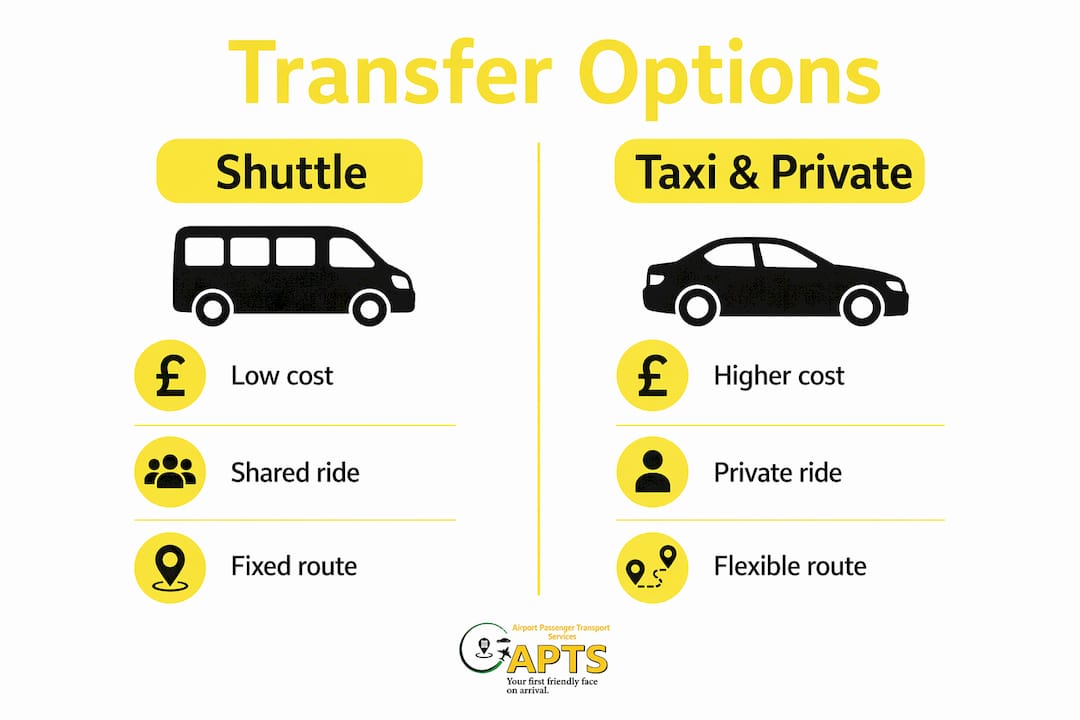
Airport transfer options fall into three broad categories: shared shuttles, standard taxis, and private chauffeur or executive taxi services. Each serves a different type of traveller, and the differences go well beyond price.
| Transfer type | Cost | Privacy | Flexibility | Best suited for |
|---|---|---|---|---|
| Shared shuttle | Lowest | None | Low | Budget solo travellers |
| Standard taxi | Mid-range | Full | High | Small groups, flexible timing |
| Private chauffeur | Premium | Full | Highest | Business, VIP, time-sensitive |
Shared shuttles follow fixed or semi-fixed routes and vary considerably in stop patterns and passenger loading order. A taxi collects you directly from the terminal and delivers you to a single address without intermediate stops. A private chauffeur service adds meet-and-greet, flight monitoring, and vehicle selection to that direct transfer model.
For a detailed breakdown of costs and practical trade-offs, the taxi vs shuttle comparison from Apts covers the key decision points clearly. The short version: if you are travelling with colleagues, carrying equipment, or working to a schedule, a private transfer almost always recovers its premium through time saved and stress avoided.
Booking methods also differ. Shuttles are often purchased on arrival or through airport kiosks, with no guaranteed seat. Taxis and private transfers can be pre-booked with confirmed pickup times, which matters significantly when catching an early morning flight from Dublin or Cork.
Pro Tip: When comparing prices, include the full cost of the journey. A shuttle that costs €15 per person but adds 45 minutes to your transfer is not cheaper than a €35 taxi if your time has any value.
How to plan, book, and budget for airport shuttle transfers
Effective planning for an airport shuttle transfer starts with understanding the schedule structure at your specific airport. Peak-time boarding delays are a consistent feature of shared shuttle services, and failing to account for them is the most common cause of missed connections.
Follow these steps to book and budget accurately:
- Identify the shuttle operator. Most major airports publish a list of approved shuttle operators on their official website. Dublin Airport, for example, lists authorised ground transport providers in the arrivals information section.
- Check the timetable and route map. Confirm that the shuttle serves your specific hotel zone or destination. Not all services cover every part of a city.
- Compare pricing structures. Shuttle fares are typically flat-rate per person. Confirm whether the quoted price includes luggage, and whether there are surcharges for early morning or late-night travel.
- Book in advance where possible. Pre-booking secures your seat and provides a confirmation reference, which is particularly useful if the shuttle operates at capacity during peak season.
- Allow buffer time. Add at least 20 minutes to the shuttle’s stated journey time during peak periods. Seasonal and daily schedule variations mean published times are estimates, not guarantees.
- Check accessibility requirements. If you require a wheelchair-accessible vehicle or extra luggage space, confirm availability directly with the operator before booking.
For a full walkthrough of the airport to hotel transfer process, including what to expect on arrival and how to locate your vehicle, Apts provides a practical step-by-step resource. Scheduling guidance for stress-free transfers is also covered in detail at Apts transfer scheduling advice.
Pro Tip: Screenshot or print your booking confirmation and the operator’s contact number before you travel. Airport Wi-Fi is unreliable, and having offline access to your transfer details removes one variable from an already busy arrival.
Key takeaways
Airport shuttles are the most cost-effective transfer option for budget travellers, but private transfers deliver superior reliability, comfort, and time efficiency for business and time-sensitive journeys.
| Point | Details |
|---|---|
| Shuttle definition | An airport shuttle transfers passengers between airports and hotels, city centres, or car parks on fixed or flexible routes. |
| Two core models | Fixed-route scheduled shuttles and door-to-door demand-responsive services operate differently and suit different traveller needs. |
| Cost vs convenience | Shared shuttles reduce cost but add journey time through multiple stops and potential boarding delays. |
| Private transfer advantage | Taxis and chauffeur services offer direct routing, confirmed bookings, and no shared space, making them better for business travel. |
| Advance planning | Pre-booking, checking real-time schedules, and allowing buffer time are the three most effective ways to avoid transfer delays. |
Why I think most travellers misread the shuttle option
After years of working in ground transport across Ireland and Spain, the pattern I see most often is travellers choosing a shuttle based on the headline price and then being surprised by the reality of the journey. The shuttle is not the problem. The mismatch between expectation and experience is.
A shared shuttle from Dublin Airport to a city centre hotel sounds straightforward. In practice, you may wait 20 minutes for the vehicle to fill, make four stops before yours, and arrive 55 minutes after leaving the terminal. That is not a failure of the service. That is exactly how the service is designed to work. The issue is that most travellers do not read the small print.
Where I think shuttles genuinely earn their place is in specific, well-defined scenarios: airport car park connections, inter-terminal transfers, and short fixed-route hops where the stop is directly at your destination. In those cases, the scheduled model works well and the price advantage is real.
For everything else, particularly business travel, early morning departures, or journeys with luggage and time pressure, a licensed private transfer is the more rational choice. The advantages of private taxi transfers are not about luxury for its own sake. They are about removing the variables that shuttles, by design, cannot control. A professional chauffeur monitors your flight, meets you at arrivals, and takes you directly to your destination. No stops, no waiting, no uncertainty.
The travellers I see most satisfied with their transfers are the ones who chose the right service for their actual situation, not the cheapest option available.
— Declan
Plan your airport transfer with Apts
Apts provides professional airport transfer services across Ireland and Spain, covering Dublin Airport, Cork Airport, Shannon Airport, and key Spanish destinations. Whether you need a standard taxi, an executive vehicle, or a minibus for a group, every booking is confirmed in advance with a professional, licensed driver.
Apts operates with full licensing, flight monitoring, and meet-and-greet service as standard. There are no shared vehicles, no intermediate stops, and no uncertainty about your pickup time. For travellers who want the reliability of a private transfer without the complexity of arranging it on arrival, book your airport transfer directly through the Apts website. Groups and corporate accounts are also catered for, with flexible vehicle options and straightforward online scheduling.
FAQ
What is the difference between a shuttle bus and a taxi?
A shuttle bus carries multiple passengers along a fixed or semi-fixed route with scheduled stops, while a taxi provides a direct, private transfer from one point to another. Taxis are faster for door-to-door journeys but cost more per person than a shared shuttle.
How does an airport shuttle work in practice?
Passengers board at a designated terminal pickup point, the vehicle follows its route making stops at hotels or city locations, and passengers disembark at their stop. Door-to-door shuttles collect from multiple addresses and drop each passenger individually, which adds time to the overall journey.
Are airport shuttles accessible for passengers with mobility needs?
Many modern airport shuttle vehicles include step-free entry and wheelchair space, but availability varies by operator. Always confirm accessibility requirements directly with the shuttle provider before booking.
When should I choose a private transfer over a shuttle?
A private transfer is the better choice for business travel, early morning or late-night flights, journeys with significant luggage, or any situation where arrival time is fixed. Shuttles suit budget-conscious travellers with flexible schedules and light luggage.
How far in advance should I book an airport shuttle?
Booking at least 24 to 48 hours in advance is advisable for pre-booked shuttle services, particularly during peak travel seasons. Walk-up availability exists at many airports, but it does not guarantee a seat on the next departure.
Recommended
- How to get airport pickup: a clear 2026 guide
- Sustainable airport transfers: your 2026 green travel guide
- Airport taxi vs shuttle: best choice for cost and convenience
Article checked by Declan Rodden.