

Executive travel services are high-touch, human-led management solutions for senior leaders that protect time, preserve continuity, and keep duty of care obligations firmly in place. Where standard corporate travel programmes prioritise volume and cost control, executive services prioritise the leader’s cognitive energy and schedule integrity above all else. The distinction matters because a single disrupted itinerary for a C-suite executive can cost far more in lost meetings, delayed decisions, and reputational harm than a full year of concierge fees.
What executives gain immediately:
- Reclaimed time: logistics are handled proactively, before the traveller is aware of a problem
- Continuity: a dedicated point of contact manages disruptions, rebooking, and itinerary changes in real time
- 24/7 support: on-call concierge cover means no disruption goes unmanaged, regardless of time zone
Table of Contents
- How executive travel services differ from standard corporate travel
- What you actually receive from an executive travel service
- Business benefits and the measurable impact on productivity
- Why chauffeur services are central to executive travel outcomes
- When to use executive travel services: common triggers and use cases
- How executive travel providers operate and how to work with them effectively
- Pricing models, cost drivers, and how to calculate ROI
- Duty of care, risk management, and UK practicalities
- What to expect from UK executive travel providers: an operational checklist
- Key takeaways
- The trade-off that most procurement teams get wrong
- Apts: professional ground transport for executive travellers
- Useful sources and further reading
How executive travel services differ from standard corporate travel
The clearest way to understand the role of executive travel services is to compare them with the transactional model most organisations already use.
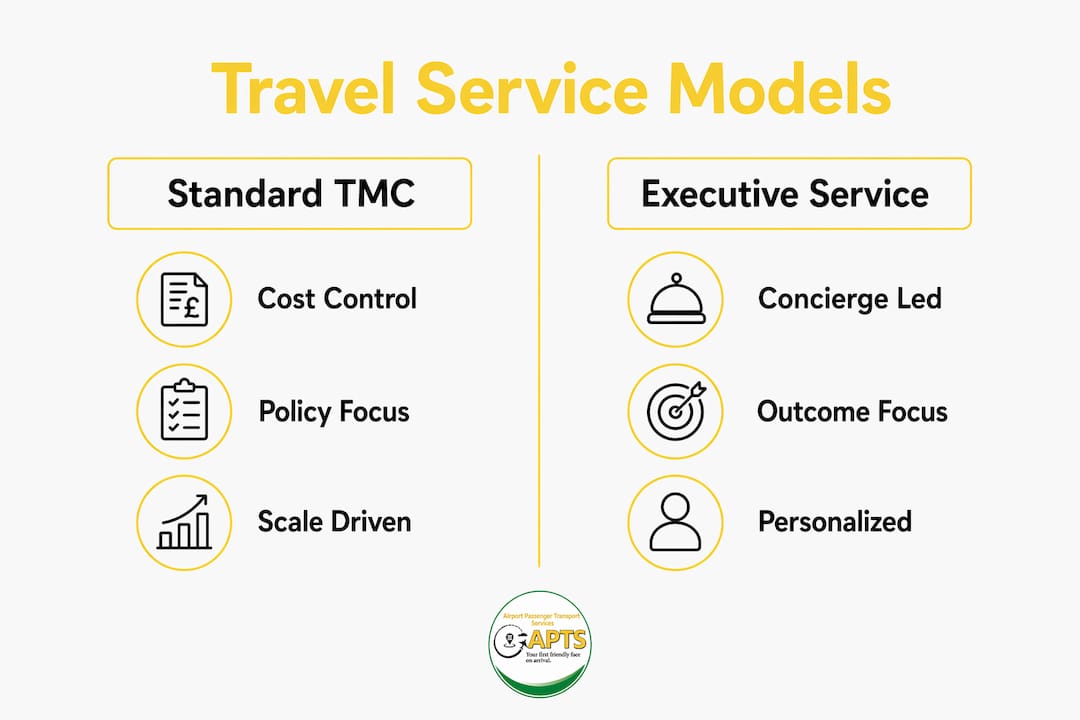
Standard corporate travel management, typically delivered through a Travel Management Company (TMC), is built for scale. It relies on online booking tools (OBTs), call-centre support, and policy compliance as the primary measures of success. The experience is largely self-service, and the traveller is expected to manage their own disruptions within a defined policy framework.
Executive travel services operate on an entirely different premise. The concierge-led model focuses on outcome and experience rather than booking transactions. A dedicated account manager holds the traveller’s full profile, monitors itineraries proactively, and acts before a problem becomes the executive’s problem.
| Dimension | Standard TMC model | Executive travel service |
|---|---|---|
| Primary focus | Cost control and policy compliance | Time protection and continuity |
| Support model | Call centre or self-service OBT | Named account manager, 24/7 concierge |
| Disruption handling | Reactive, traveller-initiated | Proactive, provider-initiated |
| Itinerary design | Template-driven | Bespoke, preference-led |
| Ground transport | Standard booking | Coordinated chauffeur and premium fleet |
| Privacy and data | Shared TMC systems | Restricted, executive-only profiles |
The practical difference shows up at the airport gate. A standard TMC user learns about a cancelled flight from a departure board. An executive travel client receives an alternative routing, a confirmed seat, and a revised ground transfer before they have left the lounge.
What you actually receive from an executive travel service
The service is not a single product. It is a set of coordinated components, each with a defined operating standard.
- Dedicated account manager: one named contact who holds the executive’s full profile and acts as the single point of escalation. Response times for urgent requests are typically measured in minutes, not hours.
- 24/7 concierge and monitoring: proactive itinerary audits and real-time flight monitoring, with rebooking initiated before the traveller is aware of a disruption.
- Bespoke itinerary design: routing, hotel selection, and ground transport coordinated around the executive’s schedule and preferences, not a policy template.
- Proactive disruption management: alternative options are sourced and confirmed at the first sign of a delay, cancellation, or schedule change.
- Loyalty optimisation: points, upgrades, and status benefits are tracked and applied automatically across airlines and hotel programmes.
- Secure information handling: executive profiles, travel plans, and personal data are held under restricted access, separate from the broader corporate travel system.
- Chauffeur and ground transport coordination: transfers are booked, monitored, and adjusted in line with live flight data, with meet-and-greet services at arrival.
Pro Tip: Treat executive preferences as permanent operating standards, not one-off requests. Capture seating preferences, loyalty numbers, dietary requirements, and car preferences in the profile from day one, and instruct the provider to apply them automatically. This removes repeated admin and eliminates friction on every subsequent trip.
Business benefits and the measurable impact on productivity
The primary role of an executive travel service is to act as a specialised operational partner that protects a leader’s time as a finite, high-cost resource. Every feature maps to a measurable business outcome.
- Reclaimed executive time: proactive disruption handling and pre-built itineraries remove the logistics burden from the executive’s day entirely.
- Maintained meeting schedules: faster rebooking and alternative routing mean fewer missed appointments and less downstream rescheduling.
- Reduced risk exposure: 24/7 monitoring and on-ground vendor relationships reduce the probability and impact of travel incidents.
- Faster recovery from disruption: when delays do occur, the provider acts immediately, compressing recovery time from hours to minutes.
- Client impression and reputation: arriving on time, composed, and prepared signals professionalism to clients and counterparts.
- Executive wellbeing: removing logistical stress preserves cognitive energy for the strategic work that actually requires the executive’s attention.
Research by the Global Business Travel Association and ASTA found that US firms with strategically well-governed travel programmes outperform peers in revenue, with increasing managed travel spending positively associated with revenue growth. While that data covers the US market, the directional finding is consistent with what UK travel managers observe: disciplined, well-managed travel investment generates returns well beyond the cost of the programme itself.
The cost of a single missed connection for a senior executive can exceed a full year of concierge fees when measured in lost meetings, delay costs, and reputational harm. That is the financial case for executive travel services in a single sentence.
Why chauffeur services are central to executive travel outcomes
Ground transport is where executive travel either delivers or fails. A perfectly planned flight itinerary unravels quickly if the transfer is late, the vehicle is unsuitable, or the driver has no awareness of the executive’s schedule.
Professional chauffeur services address each of these risks directly:
- Meet-and-greet at arrivals: the driver is present at the terminal, name board visible, before the executive clears customs. No waiting, no searching.
- Flight monitoring: the chauffeur provider tracks the flight in real time and adjusts pick-up timing automatically for early arrivals or delays.
- Buffer time management: experienced providers build appropriate buffer times into the transfer schedule, accounting for terminal walking distances, baggage collection, and congestion.
- Local knowledge: professional drivers know the fastest routes, congestion patterns, and alternative approaches to major airports and city-centre venues.
- VIP handling: discretion, luggage assistance, and a quiet, prepared vehicle are standard expectations, not optional extras.
Fleet selection matters too. An executive saloon suits a single traveller or a pair. An MPV accommodates a small leadership team with luggage. A minibus serves a larger delegation travelling together. Understanding which vehicle fits the trip is part of the coordination role, not an afterthought. For a detailed breakdown of vehicle types and capacities, the airport executive fleet guide covers the practical planning considerations.
The integration between ground transport and the wider itinerary is what separates executive-grade chauffeur services from standard taxi bookings. When a flight is delayed by 40 minutes, the chauffeur provider should already know, the driver should already be adjusted, and the executive should receive a single message confirming the revised plan.

When to use executive travel services: common triggers and use cases
Not every business trip justifies the investment. The decision to use executive travel services should be driven by the strategic value of the journey and the cost of getting it wrong.
Typical scenarios where executive services are the right choice:
- Multi-city roadshows where schedule precision across several locations is non-negotiable
- C-suite international negotiation trips where the executive’s preparation and composure on arrival directly affect the outcome
- VIP client visits and high-visibility speaking engagements where the organisation’s reputation is on display
- High-risk destinations where security monitoring, vetted ground transport, and emergency protocols are required
- Last-minute itinerary changes that require immediate rebooking and ground transport adjustment
- Frequent travellers making three or more trips per month, where accumulated disruption risk is high
Decision checklist for travel managers:
- Is the executive travelling more than twice per month?
- Does the trip involve a high-stakes meeting, negotiation, or public appearance?
- Would a missed connection or delayed arrival have a material business consequence?
- Is the destination high-risk or logistically complex?
- Is the executive expected to be productive during transit?
If three or more of these apply, escalating from standard TMC support to an executive service for that trip is justified. For choosing the right transport for specific business journeys, practical guidance is available to help travel managers make the right call.

How executive travel providers operate and how to work with them effectively
Understanding the delivery model helps travel managers integrate executive services into existing corporate travel policy without creating parallel, ungoverned processes.
Common delivery models:
- Fixed-fee retainer: a monthly fee covering a defined level of service for a named executive or small group. Predictable cost, clear scope.
- Per-executive subscription: individual pricing per traveller, scaled to trip frequency and service level.
- Blended TMC plus concierge add-on: the organisation’s existing TMC handles standard bookings; the executive service layer handles senior leaders only.
- Bespoke operations retainer: a fully tailored arrangement for heavy users, often including dedicated operations staff, SOPs, and done-for-you systems for executives making three or more trips per month.
Onboarding and governance process:
- Build a detailed profile for each covered executive: loyalty numbers, seating preferences, dietary requirements, preferred airlines, hotel brands, and ground transport preferences.
- Define escalation paths: who contacts whom, in what order, and within what timeframe when a disruption occurs.
- Agree SLAs in writing: response time for urgent requests, rebooking turnaround, and ground transport adjustment windows.
- Integrate with corporate policy: confirm which booking categories sit within the executive service and which remain in the standard OBT.
- Set a review cadence: monthly or quarterly reporting on trip performance, disruption incidents, and cost against benchmark.
Pro Tip: Combine executive services with your existing corporate travel policy by defining a clear tier structure. Specify which roles or trip types qualify for executive service, and document this in the travel policy itself. This gives finance visibility, removes ambiguity for travellers, and prevents the executive service from becoming an ungoverned parallel programme.
Pricing models, cost drivers, and how to calculate ROI
Executive travel services are priced differently from standard TMC arrangements, and understanding the cost structure is the first step to building a credible business case.
Common pricing models:
- Fixed monthly retainer: covers a defined number of executives and a set service scope. Predictable and easy to budget.
- Per-person subscription: priced per covered traveller, often tiered by trip frequency.
- Transaction fees: a per-booking fee on top of the underlying travel cost, common in blended TMC models.
- Hybrid model: a base retainer plus transaction fees for trips above a defined threshold.
- Bespoke retainer: fully customised for high-frequency travellers, often including dedicated staffing and proprietary systems.
Key cost drivers:
- Trip complexity and multi-city routing
- Frequency of travel and on-call cover requirements
- Ground transport choices and fleet level
- Security and risk management requirements
- Level of 24/7 cover and response SLA
A simple ROI framework:
Take the executive’s fully loaded hourly cost (salary, benefits, and overhead). Estimate the hours recovered per month through proactive disruption handling, pre-built itineraries, and eliminated logistics admin. Multiply by twelve. Compare that figure against the annual service cost. Concierge programmes can return measurable savings by optimising bookings, loyalty benefits, and reducing lost executive time, with some clients reporting significant annual savings from consolidated concierge support.
Pro Tip: When negotiating with providers, ask for a 90-day pilot with defined performance metrics before committing to a full retainer. This gives you real data on disruption frequency, time recovered, and service responsiveness, which makes the renewal conversation with finance straightforward.
Duty of care, risk management, and UK practicalities
Duty of care is a legal and ethical obligation for UK employers. Organisations must take reasonable steps to protect employees travelling on company business, and senior executives, who often travel to complex or high-risk destinations, represent a concentrated risk.
Executive travel services support duty of care through several mechanisms:
- 24/7 monitoring: continuous itinerary oversight means the provider knows where the executive is at all times and can act immediately if a situation changes.
- Proactive risk alerts: travel risk intelligence is monitored and communicated to the traveller and the travel manager before and during the trip.
- Vetted ground transport: chauffeur providers used by executive services should hold appropriate licensing, insurance, and background-checked drivers.
- Secure data handling: executive travel data, including itineraries, hotel locations, and personal details, must be held under restricted access and in compliance with UK GDPR.
- Emergency escalation protocols: clear, tested processes for medical emergencies, security incidents, and natural disruptions.
Contract checkpoints for travel managers:
- Written SLA for emergency response (target: under 15 minutes for urgent incidents)
- Confirmation of UK GDPR compliance and data retention policy
- Evidence of ground transport provider licensing and insurance
- Named escalation contacts available outside business hours
- Documented process for traveller location tracking and emergency communication
Duty of care is not satisfied by policy alone. A travel policy that requires executives to book within an OBT but provides no proactive monitoring, no 24/7 support, and no vetted ground transport leaves the organisation exposed. The standard is reasonable steps, actively taken, not a document filed and forgotten. Travel managers should confirm specific obligations with their legal or corporate risk team, as requirements vary by organisation, destination, and traveller role.
This article provides general guidance only. Organisations should confirm their specific duty of care obligations with qualified legal or corporate risk advisers.
What to expect from UK executive travel providers: an operational checklist
Use this checklist when evaluating providers or setting internal standards for executive travel provision in the UK market.
- 24/7 availability with a defined response SLA. Confirm the provider offers genuine round-the-clock human support, not an out-of-hours voicemail. Ask for the guaranteed response time for urgent requests.
- UK airport coverage and meet-and-greet services. The provider should cover all major UK airports (Heathrow, Gatwick, Manchester, Edinburgh, Birmingham) with confirmed meet-and-greet capability at each.
- Verified chauffeur standards. Drivers should hold Private Hire Vehicle (PHV) licences issued by the relevant local licensing authority, with documented background checks and professional conduct standards.
- Data privacy and restricted information sharing. Executive itineraries and personal data must be held separately from general corporate travel data, with access limited to named personnel.
- Insurance and liability terms. Confirm the provider’s public liability and professional indemnity cover, and verify that ground transport partners carry appropriate passenger liability insurance.
- Local emergency contacts. The provider should have named, reachable contacts in the UK who can act on the ground, not just a central overseas call centre.
- Transfer SLAs for airport collections. Ask for the standard buffer time built into airport collections and the process for adjusting pick-up times when flights are delayed or early.
- Congestion and access charge awareness. UK providers should be familiar with London’s Congestion Charge, Ultra Low Emission Zone (ULEZ) requirements, and airport access road restrictions, and factor these into routing and cost estimates.
Sample procurement questions:
- What is your guaranteed response time for an urgent rebooking outside business hours?
- How do you monitor live flight data and communicate changes to the driver and the traveller?
- Which UK airports do you cover with direct meet-and-greet capability?
- How is executive travel data stored, and who has access to it?
Pro Tip: Test the provider’s SLAs before signing a contract. Submit a staged trial request outside business hours and measure the actual response time against the promised SLA. A provider that performs well in a test will perform well in a genuine emergency.
Key takeaways
Executive travel services protect senior leaders’ time, continuity, and safety by operating as a proactive logistics partner rather than a transactional booking service. Travel managers who embed these services into a clearly defined tier structure, with written SLAs and regular performance reviews, will see the strongest return.
| Point | Details |
|---|---|
| Core role | Executive travel services protect time and continuity through proactive, human-led management, not reactive booking. |
| Business case | Research links strategic travel management to measurable revenue outperformance; disruption costs often exceed annual service fees. |
| Duty of care | 24/7 monitoring, vetted ground transport, and clear escalation protocols are the practical minimum for UK compliance. |
| Pricing and ROI | Calculate ROI by comparing recovered executive hours against service cost; a 90-day pilot generates the data needed to justify full commitment. |
| Apts for ground transport | Apts provides professional executive taxi and chauffeur transfers to and from airports across Ireland and Spain, with a fleet suited to individual executives and small leadership teams. |
The trade-off that most procurement teams get wrong
The most common mistake in executive travel procurement is treating the service as a premium version of standard booking rather than as a distinct operational function. When organisations approach it that way, they tend to evaluate providers on price per transaction rather than on the value of time protected and disruptions avoided.
The cost-versus-continuity trade-off is real, but it resolves quickly once you put numbers to it. A senior executive earning a competitive UK salary represents a significant hourly cost to the organisation. Every hour spent managing a disrupted itinerary, waiting for a delayed transfer, or rescheduling a missed meeting is an hour of that cost with no return. The executive travel service fee, spread across a year of trips, rarely approaches the value of even a handful of recovered hours.
Where executive services deliver the most concentrated value is in high-frequency travellers and high-stakes trips. A CEO making three international trips per month, or a CFO travelling to a critical negotiation, is exactly the use case the service is designed for. Applying it uniformly to all senior staff, regardless of travel frequency or trip importance, dilutes the ROI and creates governance complexity.
The practical recommendation: run a 90-day pilot for your top three to five most frequent executive travellers. Measure disruption incidents, time recovered, and on-time meeting attendance before and after. The data will make the business case for you, and it will also tell you precisely which travellers and trip types justify the investment going forward.
Apts: professional ground transport for executive travellers
Ground transport is the first and last impression of any executive trip. Apts provides professional executive taxi and chauffeur transfer services to and from airports across Ireland and Spain, with a fleet that covers individual executives, small leadership teams, and VIP delegations. Every booking includes flight monitoring, meet-and-greet at arrivals, and a professional driver who understands the standards that executive travellers expect.
For travel managers coordinating airport transfers as part of a wider executive travel programme, Apts offers corporate account arrangements that simplify booking, consolidate billing, and keep executive preferences on file for every trip. The fleet ranges from executive saloons to MPVs and minibuses, matched to the size and nature of each journey.
To arrange a transfer or discuss a corporate account, visit apts.ie and make an enquiry today.
Useful sources and further reading
The following sources are recommended for travel managers and senior business professionals seeking deeper guidance on executive travel management, duty of care, and procurement standards.
- Global Business Travel Association and ASTA ROI Study: landmark US benchmarking analysis on the revenue impact of strategic travel management. Useful for building a financial business case, with directional findings applicable to UK procurement conversations.
- Deloitte corporate travel study: industry analysis on how leading organisations balance cost pressures with strategic travel investment. Relevant for procurement framing and supplier evaluation criteria.
- Safe Harbors: business travel concierge services guide: detailed practitioner guide on concierge service components, 24/7 support standards, and ROI examples. Useful for defining SLAs and evaluating provider capability.
- Inspired Corporate Travel: executive support for C-suite leaders: focused resource on the operational role of executive travel services and the shift from transactional to proactive support models.
- Ciré Travel: what busy leaders need from their agency: practical guidance on preference capture, profile management, and embedding executive standards into travel operations.
- Executive Travel Systems: overview of done-for-you retainer models and operational systems for high-frequency executive travellers. Relevant for organisations evaluating bespoke retainer arrangements.
- Apts: advantages of chauffeur services: practical guide to chauffeur service standards and the operational value of professional ground transport for executive travellers.
- Apts: airport executive fleet types: planning guide for fleet selection and vehicle capacity, useful for travel managers coordinating group or multi-executive transfers.
For binding duty of care obligations, data protection requirements, and corporate risk management standards, consult your organisation’s legal team or a qualified corporate risk adviser. Regulatory requirements vary by organisation, destination, and traveller role.
Recommended
- Examples of executive taxi services explained
- Airport executive fleet types: your 2026 planning guide
- Corporate taxi booking explained for travel managers
- Role of airport transport provider: what travellers need to know
Article checked by Declan Rodden.