

Airport executive fleet types are defined by passenger capacity and luxury tier, ranging from executive sedans for solo travellers to full-size SUVs and large passenger vans for corporate groups. Understanding these categories is the foundation of effective corporate travel planning. The wrong vehicle choice wastes budget, creates logistical friction, and reflects poorly on the organisation. This guide covers every major category of executive airport transportation, from the characteristics of each vehicle class to the operational protocols that separate a professional service from an ordinary taxi.
What are the main airport executive fleet types?
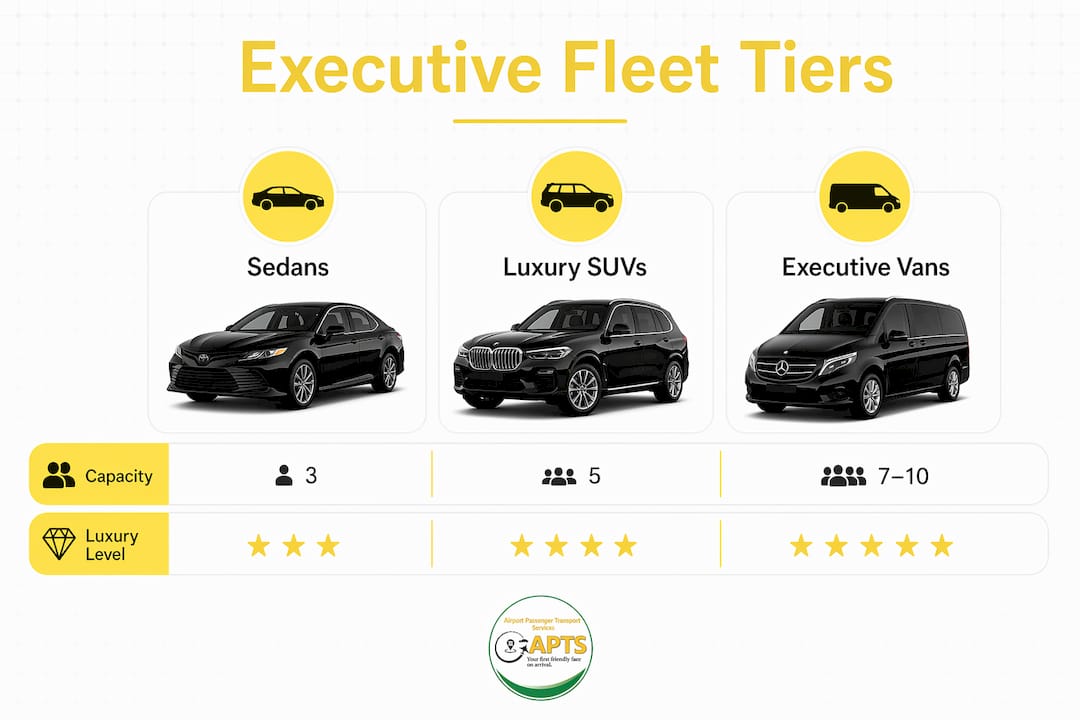
The standard executive fleet is structured by passenger capacity: sedans carry 1–3 passengers, luxury SUVs carry up to 6, and Mercedes-Benz Sprinter vans accommodate 9–14 passengers. Motor coaches extend capacity further for large delegations. That tiered structure means every business travel scenario has a corresponding vehicle class, and selecting the wrong tier creates avoidable problems. A solo executive in a 14-seat van signals poor planning. A group of eight in a sedan simply does not work.
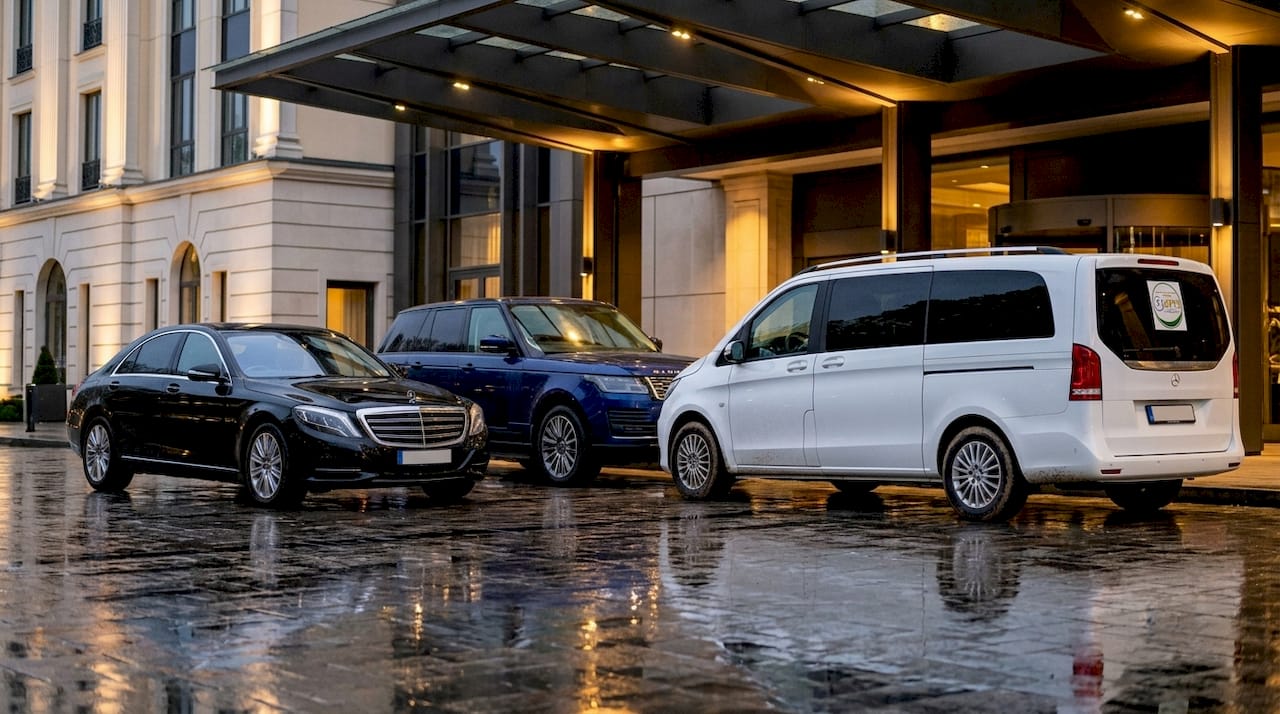
Corporate travel planners who understand these tiers make faster, more confident decisions. They also avoid the common mistake of defaulting to sedans for every booking, regardless of group size or luggage volume.
Executive sedans: the case for solo and small-group transfers
Executive sedans are the most widely recognised vehicle in luxury airport vehicle types, and for good reason. They carry 1–3 passengers with a standard luggage allowance, and their compact footprint makes them ideal for quick, discreet transfers between an airport and a hotel or office.
The defining advantage of a luxury full-size sedan is privacy. A solo executive can take calls, review documents, or simply decompress without distraction. The cabin is quiet, the ride is smooth, and the vehicle itself communicates a level of professionalism that a standard taxi does not.
Key advantages of executive sedans for airport transfers:
- Discretion: Low-profile vehicles attract minimal attention, which suits executives travelling with sensitive commercial information.
- Speed: Smaller vehicles navigate airport pick-up zones and city traffic more efficiently than larger alternatives.
- Comfort for one or two: The rear cabin is designed for passenger comfort, not maximum occupancy.
- Luggage capacity: A full-size luxury sedan typically accommodates two large suitcases and carry-on luggage without difficulty.
Pro Tip: Book a sedan for solo or two-person transfers whenever the itinerary involves a tight connection or a time-sensitive meeting. The smaller vehicle moves faster through congested airport zones.
Sedans remain the status symbol of choice in executive transport, though their practical limitations become apparent the moment a third passenger or significant luggage volume enters the equation.
Luxury SUVs in executive fleets: capacity meets practicality
Luxury SUVs have become the preferred vehicle for many corporate travel programmes, and the reason is straightforward. They carry up to 6 passengers with ample luggage space, making them the most versatile option in the executive fleet. A sedan cannot match that capacity. A van is unnecessary for a group of four.
Sophisticated corporate travel programmes prefer luxury SUVs because they balance practical passenger and luggage needs better than sedans. That preference reflects a broader shift in how companies think about executive transport. Status still matters, but operational efficiency matters more.
Common corporate scenarios where a luxury SUV is the right choice:
- Client hospitality: Collecting two or three clients from an airport with their luggage requires space that a sedan cannot reliably provide.
- Small team travel: A group of four executives travelling together fits comfortably, with room for briefcases and overnight bags.
- Airport pickups with mixed luggage: Business trips often involve a mix of carry-on and checked luggage. An SUV handles both without compromise.
- Extended transfers: Longer journeys between airports and conference venues benefit from the higher seating position and cabin space of an SUV.
Pro Tip: When booking for a group of three or more, always confirm luggage volume before selecting a sedan. A luxury SUV costs marginally more but eliminates the risk of a second vehicle being required at the last minute.
The cabin configuration of a luxury SUV also supports productivity. Rear passengers have genuine legroom, and the vehicle’s road presence communicates authority without ostentation. For luxury airport transfers involving clients or senior leadership, an SUV is rarely the wrong choice.
Executive vans: group transport without compromise
Executive vans occupy a distinct position in the types of airport fleets available to corporate travel planners. The Mercedes-Benz Sprinter is the benchmark vehicle in this category. Sprinter vans are reconfigured for executive use with captain’s chairs replacing standard bench seating, accommodating 10 passengers comfortably within a 12–15 seat shell.
That configuration matters. Captain’s chairs provide individual armrests, increased legroom, and a seating experience that is genuinely comfortable for journeys of 30 minutes or more. Standard minibus seating does not offer that level of comfort, which is why the distinction between a reconfigured executive van and a standard airport shuttle is significant.
| Vehicle type | Passenger capacity | Luggage capacity | Best use case |
|---|---|---|---|
| Executive sedan | 1–3 | 2 large cases | Solo or paired executive transfers |
| Luxury SUV | Up to 6 | 4–6 cases | Small teams and client hospitality |
| Executive van (Sprinter) | 9–14 | Large group luggage | Corporate team transfers and event shuttles |
| Motor coach | 20+ | Extensive | Large delegations and conference groups |
For group airport transfers, a single executive van is almost always more cost-efficient than two or three separate vehicles. Coordination is simpler, the group arrives together, and the per-head cost drops considerably. Corporate event planners frequently use Sprinter-class vehicles for VIP hospitality shuttles between airports, hotels, and conference venues.
Key operational considerations when choosing executive fleet vehicles
Vehicle type is only one part of the decision. The operational framework around the vehicle determines whether the transfer actually meets executive standards.
Reservation-based executive transport offers a predictable environment that supports productivity and privacy. That is the core distinction between a professional chauffeur service and an app-based rideshare. With a reservation, the chauffeur is confirmed, the vehicle is allocated, and the itinerary is fixed before the executive leaves the office.
Operational factors that define service quality:
- Flight tracking: Professional services monitor inbound flights in real time. If a flight is delayed, the chauffeur adjusts. The executive does not wait, and neither does the driver.
- Meet-and-greet protocols: Chauffeurs arrive ahead of schedule to meet passengers at the arrivals hall, not the kerb. That distinction matters for executives arriving after a long-haul flight.
- Centralised corporate accounts: Consolidated billing and a dedicated account manager simplify logistics across multi-city travel programmes. Finance teams get clean invoices. Travel planners get consistent service.
- Owned fleets versus affiliate networks: Trusted providers maintain a core owned fleet and supplement with hand-vetted affiliate networks. That structure ensures safety and service standards hold regardless of location.
Pro Tip: Always confirm whether your provider operates an owned fleet or relies on a broker pool. Owned fleets and vetted affiliates maintain consistent vehicle standards. Broker pools do not.
The advantages of a professional chauffeur service over ad hoc alternatives are most visible when something goes wrong. A delayed flight, a last-minute change of destination, or an additional passenger is handled without drama when the service operates on a reservation and account basis.
How to match fleet types to specific business travel scenarios
Selecting the right vehicle starts with three questions: how many passengers, how much luggage, and what is the nature of the trip? The answers point directly to the correct vehicle class.
Practical guidance for common scenarios:
- Solo executive, overnight bag only: Executive sedan. Fast, discreet, and appropriately sized.
- Two executives with checked luggage: Executive sedan or compact SUV, depending on luggage volume. Confirm bag count before booking.
- Team of four with presentation equipment: Luxury SUV. The additional boot space handles equipment cases without requiring a separate vehicle.
- Group of eight to ten for a conference: Executive van. One vehicle, one arrival, one invoice.
- Large delegation of 20 or more: Motor coach or multiple executive vans, coordinated through a centralised account.
Cost-efficiency and status are not always in conflict. A luxury SUV costs more than a sedan but less than two sedans. An executive van costs more than an SUV but far less than three separate vehicles. The right vehicle for the group size is almost always the most cost-efficient option.
For corporate airport transfers involving repeat bookings across multiple cities, a centralised account with a single provider removes the administrative burden of sourcing vehicles market by market. Apts operates this model for corporate clients travelling to and from airports in Ireland and Spain, providing consistent vehicle standards and consolidated billing across all bookings.
Pro Tip: Build a simple internal matrix for your travel programme: group size, luggage volume, and journey type. Map each combination to a vehicle class. That matrix eliminates ad hoc decisions and reduces booking errors.
For business travel taxi options that span multiple vehicle classes, a provider with a full fleet range is more reliable than one that specialises in a single vehicle type.
Key takeaways
Selecting the right airport executive fleet type requires matching vehicle capacity to group size, luggage volume, and the nature of the trip.
| Point | Details |
|---|---|
| Fleet tiers by capacity | Sedans serve 1–3 passengers; SUVs up to 6; Sprinter vans 9–14; coaches handle larger groups. |
| SUVs lead on versatility | Luxury SUVs balance passenger and luggage capacity better than sedans for most corporate scenarios. |
| Operational protocols matter | Flight tracking and meet-and-greet services define professional executive transport. |
| Reservation over rideshare | Reservation-based services provide accountability, privacy, and a predictable workflow. |
| Centralised accounts save time | A single corporate account with consolidated billing reduces administrative complexity across locations. |
Declan’s view: what the vehicle class debate misses
The conversation about executive fleet types tends to focus on the vehicle itself. Sedan versus SUV. Sprinter versus coach. Those distinctions matter, but they are secondary to the operational framework around the vehicle.
I have seen well-resourced corporate travel programmes book the right vehicle and still deliver a poor experience because the service had no flight tracking, no meet-and-greet protocol, and no account management. The executive landed, waited 20 minutes at the kerb, and called the office to complain. The vehicle was a luxury SUV. The service was not.
The shift toward SUVs is real and sensible. Sedans carry symbolic weight, but an SUV handles the practical realities of business travel more reliably. Two passengers with checked luggage, a laptop bag, and a presentation case fit in an SUV without a second thought. In a sedan, that same group is negotiating boot space at the kerb.
What I find underappreciated is the value of vetted affiliate networks for extended coverage. A provider with a strong owned fleet in one city but no vetted partners in another is a liability for multi-city programmes. The best corporate travel arrangements use providers who can confirm vehicle standards across every location on the itinerary, not just the home market.
The VIP airport transfer experience is defined by what happens before the passenger lands, not just the vehicle waiting at arrivals.
— Declan
Planning your next executive airport transfer with Apts
Choosing the right vehicle class is straightforward once you understand the capacity tiers and operational standards that define professional executive airport transportation. Apts provides executive taxi and chauffeur services to and from airports across Ireland and Spain, covering the full range of vehicle types discussed in this guide.
Whether you are booking a solo executive sedan or coordinating a group transfer for a corporate delegation, Apts offers consistent vehicle standards, professional chauffeurs, and centralised account management for repeat corporate clients. The taxi service selection guide on the Apts website covers vehicle options, service features, and practical advice for corporate travel planners making regular airport bookings. For a full overview of executive taxi services and the vehicle types available, the Apts website provides clear guidance for every business travel scenario.
FAQ
What vehicles are included in an executive airport fleet?
The standard executive fleet includes luxury sedans for 1–3 passengers, SUVs for up to 6, and Mercedes-Benz Sprinter vans for 9–14 passengers. Motor coaches serve larger delegations.
Why do corporate travel programmes prefer luxury SUVs?
Luxury SUVs balance passenger capacity and luggage space more effectively than sedans. They suit small teams and client hospitality scenarios where a sedan would be undersized.
What is the difference between an executive van and a standard minibus?
An executive van such as a reconfigured Sprinter uses captain’s chairs instead of bench seating, providing individual armrests and increased legroom for a genuinely comfortable group transfer.
How does flight tracking improve executive airport transfers?
Professional chauffeur services monitor inbound flights in real time and adjust arrival times accordingly. That means the chauffeur is waiting when the executive lands, regardless of delays.
What is a centralised corporate account for airport transport?
A centralised corporate account consolidates all bookings and billing under a single account manager, simplifying logistics and maintaining consistent service standards across multiple cities and trips.
Recommended
- How to plan holiday airport travel: your 2026 guide
- Best transport options to airports: your 2026 guide
- Choosing business travel transport: your 2026 guide
- List of airport ground transport: your 2026 guide
Article checked by Declan Rodden.