

A transfer service is a pre-arranged, door-to-door transport option booked in advance to move travellers between airports and their final destinations, with fixed pricing and a confirmed professional driver. Unlike hailing a cab at the kerb, a pre-booked transfer removes all uncertainty before you leave home. The global market for pre-booked airport transfers was valued at over $8 billion in 2023, reflecting how strongly travellers now prefer planned, predictable ground transport. Whether you are flying into Dublin Airport for a business meeting or arriving in Málaga for a family holiday, understanding what a transfer service is helps you choose the right option every time.
What is a transfer service and what types are available?
A transfer service is defined as pre-arranged ground transport that takes you directly from one point to another, most commonly between an airport and a hotel, home, or office. The industry term most widely used is “airport transfer,” though the same structure applies to port transfers, hotel-to-hotel journeys, and corporate ground transport. Transfer services fall into five categories: private transfers, shared shuttles, taxis and ride-hailing, hotel shuttles, and public transit. Each differs significantly in cost, comfort, and convenience.

Here is a clear comparison to help you understand the differences at a glance:
| Transfer type | Best for | Pricing | Comfort level |
|---|---|---|---|
| Private transfer | Solo travellers, families, executives | Fixed, pre-agreed | High |
| Shared shuttle | Budget-conscious travellers | Lower, shared cost | Moderate |
| Chauffeur service | Business and VIP travellers | Fixed, premium | Very high |
| Hotel shuttle | Guests of specific hotels | Often complimentary | Moderate |
| Public transit | Cost-first travellers | Lowest | Low |
The key distinctions worth knowing:
- Private transfers give you exclusive use of the vehicle. The driver goes directly to your destination with no stops.
- Shared shuttles are cost-effective but involve multiple passengers and fixed stops. They take longer.
- Chauffeur services are pre-booked with licensed professional drivers and fixed prices. The term “chauffeur service” denotes a pre-booked, fixed-price structure with licensed drivers, not simply a luxury ride.
- Hotel shuttles run on fixed schedules and serve only guests of that property.
- Taxis and ride-hailing apps are on-demand and not technically “transfer services” by the strict industry definition, because they lack pre-arrangement and fixed pricing.
Understanding these distinctions saves you from booking the wrong service for your needs.
How does a transfer service work: booking, pricing, and logistics
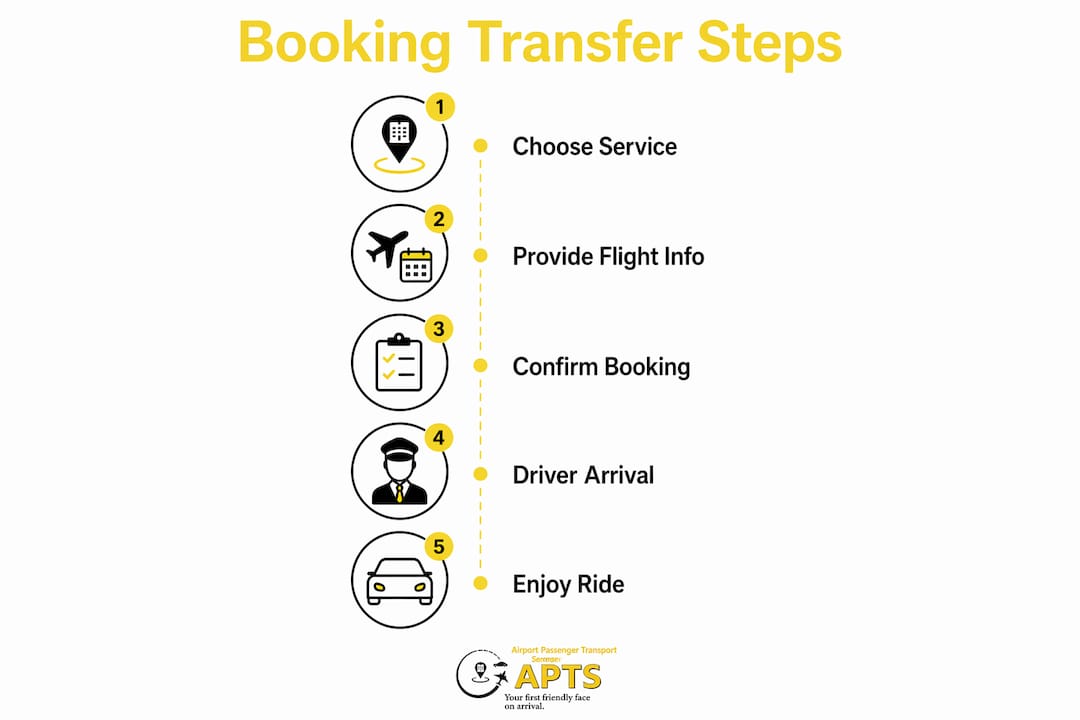
A transfer service works through advance booking, confirmed pricing, and a driver assigned to your journey before you travel. The process is straightforward once you know the steps.
- Book in advance. You provide your flight number, pickup location, destination, and passenger count. The operator confirms your vehicle and driver details.
- Receive fixed pricing. Unlike taxis, pre-booked transfers offer fixed prices with no surge pricing. You know the exact cost before you travel.
- Driver monitors your flight. Quality transfer operators use flight tracking to adjust pickup times automatically if your flight is delayed. Flight tracking adjusts pickup times without you needing to call or rebook.
- Meet and greet at arrivals. Your driver waits in the arrivals hall, typically holding a name board. This is standard for private and chauffeur services.
- Door-to-door delivery. The driver assists with luggage and takes you directly to your destination. No stops, no detours.
Pro Tip: Book your transfer at the same time as your flight. Vehicle availability at popular airports like Dublin, Málaga, and Alicante fills quickly during peak travel periods.
Pricing models vary by service tier. Private and chauffeur transfers use fixed quotes. Shared shuttles charge per seat. Hotel shuttles are usually included in the room rate. The absence of surge pricing is one of the most practical advantages of booking a transfer service over a ride-hailing app, particularly for early morning or late-night flights when demand pricing spikes.
What are the benefits of using transfer services?
Transfer services deliver four core advantages over alternatives: predictable cost, direct routing, professional drivers, and luggage assistance. Each of these matters more than travellers typically expect until they experience the alternative.
- No surge pricing. Ride-hailing apps like Uber apply dynamic pricing during peak hours. A pre-booked transfer locks in your fare regardless of demand.
- Direct routing. Private transfers go straight to your destination. Shared shuttles and public transit add time through stops and connections.
- Professional, licensed drivers. Transfer operators use vetted, licensed drivers. This matters for safety and reliability, particularly in unfamiliar cities.
- Luggage assistance. Drivers help load and unload bags. This is especially valuable for families, elderly travellers, and those with heavy equipment.
- Stress-free arrivals. Transfer services reduce travel stress by handling last-mile logistics reliably, so you arrive composed rather than frantic.
The convenience factor in transfer choices consistently outweighs simple fare comparison for business travellers. A shared shuttle that saves €10 but adds 45 minutes to your journey is rarely the better choice when you have a meeting to reach.
Transfer services also suit travellers who are unfamiliar with local transport networks. Arriving at an airport in a city you do not know, late at night, with luggage, is not the moment to figure out bus routes. A confirmed driver waiting for you removes that problem entirely.
Choosing the right transfer service for your travel needs
The right transfer service depends on four factors: your budget, group size, luggage volume, and how much your time is worth. There is no single correct answer, but there are clear patterns.
Pro Tip: “Airport transfer” refers to the service structure, not the vehicle class. Premium vehicles require explicit selection during booking. Do not assume a standard transfer includes an executive car.
Consider these scenarios:
- Solo business traveller on a tight schedule. Choose a private transfer or chauffeur service. Fixed pricing and direct routing protect your schedule.
- Family of four with large luggage. A private transfer with a people carrier or estate vehicle is the practical choice. Shared shuttles rarely accommodate large bags comfortably.
- Budget-conscious leisure traveller with flexible timing. A shared shuttle or public transit works well if you have time and light luggage.
- VIP or corporate client. An executive chauffeur service with meet and greet is the appropriate choice. First impressions matter.
- Group travel for events or conferences. A minibus private transfer keeps the group together and on schedule.
When comparing taxi versus shuttle options, the decision usually comes down to time versus cost. Shuttles save money. Private transfers save time. For most business travellers, time is the scarcer resource.
One commonly overlooked factor is flight tracking. Not all transfer operators offer it. Those that do adjust your pickup automatically if your flight lands early or late. This single feature eliminates the most common source of transfer anxiety: the fear that your driver will not wait.
Key takeaways
A transfer service is the most reliable ground transport option for travellers who prioritise fixed pricing, direct routing, and professional drivers over cost alone.
| Point | Details |
|---|---|
| Definition is clear | A transfer service is pre-arranged, fixed-price, door-to-door transport between airports and destinations. |
| Five main types exist | Private, shared shuttle, chauffeur, hotel shuttle, and public transit each suit different needs and budgets. |
| Booking in advance is essential | Pre-booking secures your vehicle, fixes your price, and enables flight tracking for delay management. |
| Vehicle class requires explicit choice | Booking an airport transfer does not automatically include a premium vehicle. Select your class at booking. |
| Convenience outweighs fare for most | Time savings and predictability make transfer services the stronger choice for business and family travellers. |
Why I always pre-book a transfer, and what most travellers get wrong
After years of travelling through airports across Ireland, Spain, and beyond, the single biggest mistake I see travellers make is treating ground transport as an afterthought. They spend hours comparing flights and hotels, then leave the last mile to chance.
The second mistake is assuming that “airport transfer” means a luxury vehicle will arrive. It does not. The term describes the booking structure, not the vehicle. I have spoken with travellers who were genuinely surprised to find a standard saloon waiting when they expected an executive car. The fix is simple: specify your vehicle class at the time of booking.
Flight tracking is the feature most travellers do not know to ask for. When your inbound flight is delayed by an hour, a transfer operator with flight tracking adjusts automatically. One without it may leave before you land. Always confirm whether your operator monitors flights before you confirm the booking.
My honest view is that shared shuttles are oversold as a budget option. The fare saving is real, but the time cost is often not. If you are travelling with luggage, arriving tired, or heading to a meeting, the extra stops and schedule inflexibility of a shuttle rarely justify the saving. A private transfer is not a luxury. For most journeys, it is simply the sensible choice.
— Declan
Apts: professional airport transfers across Ireland and Spain
Apts provides private taxi, executive taxi, and chauffeur services to and from airports throughout Ireland and Spain. Every booking includes a fixed price confirmed before you travel, a professional licensed driver, and meet and greet at arrivals.
Whether you need a taxi service for a business trip or a chauffeur service for your airport arrival, Apts covers the full range of transfer options. Families, executives, and solo travellers all benefit from fixed pricing with no surprises on the day. Use the taxi service selection guide to identify the right vehicle and service level for your next journey. Apts serves Dublin Airport and airports across Spain, including Málaga and Alicante.
FAQ
What is the transfer service meaning in travel?
A transfer service is a pre-arranged, door-to-door transport booking between an airport and a destination, with a confirmed driver and fixed price agreed before travel.
Is a transfer service the same as a taxi?
A transfer service differs from a taxi because it is pre-booked, fixed-price, and confirmed in advance. Taxis are on-demand with variable fares and no guaranteed vehicle.
Is transfer service necessary for airport travel?
A transfer service is not mandatory, but it eliminates surge pricing, removes uncertainty, and provides a confirmed driver. It is the most reliable option for business travellers, families, and those arriving in unfamiliar cities.
How does a transfer service handle flight delays?
Quality transfer operators use flight tracking to adjust pickup times automatically when flights are delayed, so your driver waits without you needing to contact them.
What are the main types of transfer services available?
The five main types of transfer services are private transfers, shared shuttles, chauffeur services, hotel shuttles, and public transit, each differing in cost, comfort, and convenience.
Recommended
- What is a seamless airport transfer? Your 2026 guide
- What is an airport shuttle? Your 2026 transfer guide
- What is a VIP airport transfer? Your 2026 guide
- Sustainable airport transfers: your 2026 green travel guide
Article checked by Declan Rodden.