

Taking a taxi at a Spanish airport is the fastest, most direct way to reach your destination after landing. Official taxis operate 24/7 at regulated ranks directly outside arrivals halls at all major Spanish airports, including Madrid-Barajas (MAD), Barcelona-El Prat (BCN), Málaga (AGP), and Palma de Mallorca (PMI). Fares run on metered pricing with regulated surcharges, giving you full transparency before you arrive at your destination. This guide covers every stage of the process, from locating the official rank to paying your driver, so you can travel with confidence from the moment you land.
How to find official taxi ranks at Spanish airports
The official taxi rank is always located directly outside the arrivals hall at every major Spanish terminal. Follow the signs marked “Taxi” as you exit customs. The signage is clear, consistent, and present at MAD, BCN, AGP, and PMI without exception.
Official taxis in Spain are easy to identify by their city-specific colours and a roof-mounted sign displaying the word “Taxi.” Barcelona taxis are black and yellow, while Madrid taxis are white. Knowing this before you land removes any doubt at the kerb.
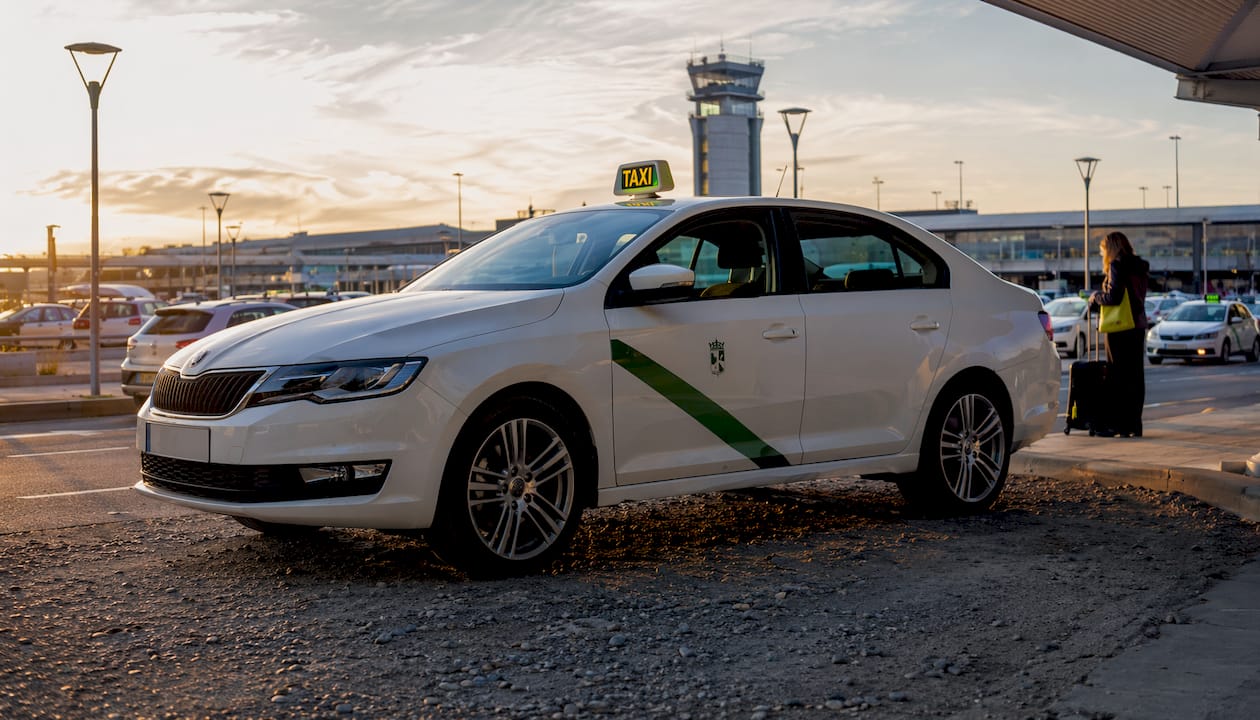
Every licensed taxi must display a visible taximeter and an official licence number on the door or dashboard. These are legal requirements under Spanish transport regulations, not optional extras. If either is absent, the vehicle is not a licensed taxi.
Key identifiers of a legitimate Spanish airport taxi:
- City-specific body colour (black and yellow in Barcelona, white in Madrid)
- Illuminated roof sign reading “Taxi”
- Visible taximeter on the dashboard
- Official licence number displayed on the door
- Driver identification card visible inside the vehicle
Pro Tip: Photograph the licence plate and driver ID card on your phone before the journey begins. This takes ten seconds and gives you a clear record if any dispute arises.
Never accept a ride from anyone approaching you inside the terminal or immediately outside the doors. Unofficial taxi offers inside or just outside terminals are almost always unlicensed and carry both safety and pricing risks. Official queues operate on a strict first-come, first-served basis with licensed, metered vehicles only.
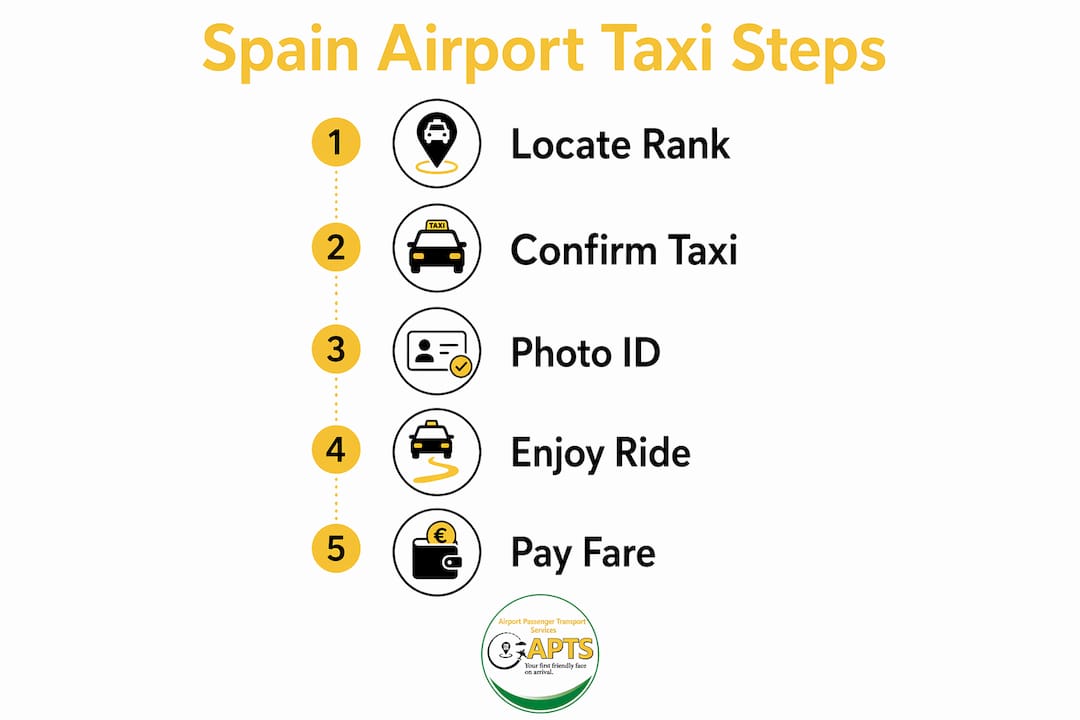
Step-by-step process for getting a taxi from a Spanish airport
The spain airport taxi steps follow a consistent process across all major hubs. Knowing each stage in advance removes uncertainty and speeds up your departure from the terminal.
- Exit through arrivals. Walk from your gate through passport control and baggage reclaim to the arrivals exit. Follow the green “Taxi” signs throughout.
- Locate the official rank. The rank is directly outside the arrivals hall, clearly marked and staffed at busy airports. Join the queue at the back.
- Board the first available taxi. Take the taxi at the front of the queue. Do not negotiate with drivers or accept offers from vehicles not in the official line.
- Confirm the meter is running. Before the car moves, check that the taximeter is switched on and displaying a fare. If it is not, ask the driver to activate it before you proceed.
- Share your destination. Hand the driver your destination address written clearly on paper or displayed on your phone. A written address removes language confusion and ensures you arrive at the correct location.
- Confirm payment method. Ask whether the driver accepts card before the journey starts. Contactless and chip-and-pin cards are generally accepted in official taxis, but carrying cash as a backup is sensible.
- Pay and collect your receipt. At your destination, pay the metered fare plus any applicable surcharge. Request a printed receipt, which drivers are obliged to provide on request.
Pre-booking your airport transfer
Pre-booking a taxi or private transfer before you land gives you a fixed price and a meet-and-greet service at arrivals. Pre-booked transfers allow you to select your vehicle type, luggage capacity, and payment method in advance. Providers typically monitor your flight for delays, so your driver adjusts arrival time automatically.
Official taxi apps including Free Now and PideTaxi offer digital booking, real-time tracking, and cashless payment while retaining regulated fare pricing. Both apps are widely used in Barcelona and Madrid. They are particularly useful for late-night arrivals when queues at the rank may be longer.
Pro Tip: If you are travelling with a group of two to four people, a pre-booked minivan transfer can reduce the per-person cost significantly while keeping door-to-door convenience. Read more about group airport transfers to understand your options before booking.
What do Spanish airport taxi fares cost?
Spanish airport taxi fares are regulated by local transport authorities and calculated by taximeter. A standard ride from a major airport to the city centre costs between €25 and €35, including typical airport surcharges. That figure covers most journeys from BCN or MAD to central districts.
Barcelona-El Prat applies a €4.60 airport surcharge on top of the metered fare, with minimum fares starting around €21. This surcharge is legal, standard, and applied by all licensed taxis at the airport. Madrid operates differently: taxis charge a fixed flat fare for all destinations inside the M-30 ring road, removing meter uncertainty entirely.
| Route | Fare type | Approximate cost |
|---|---|---|
| Barcelona-El Prat to city centre | Metered + airport surcharge | €25–€35 |
| Madrid-Barajas to inside M-30 | Fixed flat fare | Set rate, confirmed before boarding |
| Málaga Airport to city centre | Metered | €15–€25 (shorter distance) |
| Palma de Mallorca to Palma centre | Metered | €20–€30 |
Night-time surcharges apply between 10PM and 6AM at most Spanish airports, adding a percentage to the metered fare. Weekend and public holiday surcharges also apply in many cities. These additions are legal and displayed on the taximeter tariff card inside the vehicle.
Taxi pricing regulations in Spain mandate full transparency. If the driver cannot explain the fare components, that is a warning sign.
Pro Tip: Carry €20–€30 in small notes and coins. Some drivers carry limited change, and paying a €35 fare with a €50 note can cause unnecessary delays at your destination.
Common pitfalls and how to stay safe
The most common mistake travellers make is accepting a taxi offer from someone who approaches them inside the terminal. Official transport authorities are clear: licensed taxis do not solicit passengers. Any driver who approaches you is almost certainly unlicensed.
“If a taxi driver attempts to negotiate a flat fee instead of using the taximeter, or claims the meter is broken, the passenger should refuse the ride immediately and take the next vehicle from the official queue. Meter use is mandatory under Spanish law, and a non-functioning meter is grounds to exit the vehicle without payment.”
Safety checklist for Spanish airport taxi use:
- Join the official rank queue only. Never accept offers from individuals inside or outside the terminal.
- Verify the taximeter is active before the car moves.
- Check the licence number on the door matches the driver ID card inside.
- Have your destination address written clearly on your phone or on paper.
- Confirm card payment acceptance before departure if you do not have cash.
- Share your ride details with a contact before you depart.
- For groups, a shared licensed taxi is both cost-effective and safe. Group taxi sharing reduces the per-person fare while maintaining door-to-door service.
Language barriers are manageable with minimal preparation. Most drivers understand basic English, but a clearly written destination address removes all ambiguity. Save your hotel address in Spanish on your phone before you board your flight.
Key takeaways
Official Spanish airport taxis are the safest, most direct transfer option available 24/7 at regulated ranks, with metered fares, city-specific identification, and legal protections that unlicensed vehicles cannot offer.
| Point | Details |
|---|---|
| Locate the official rank | Follow “Taxi” signs directly outside arrivals halls at MAD, BCN, AGP, and PMI. |
| Identify licensed taxis | Look for city-specific colours, a roof sign, a visible meter, and a door licence number. |
| Confirm the meter before moving | Ask the driver to activate the taximeter before the journey begins. |
| Know your fare range | Expect €25–€35 from major airports to city centres, including airport surcharges. |
| Prepare your destination address | Write or display your destination in Spanish to avoid miscommunication with drivers. |
What I have learned from using Spain’s airport taxi system
Having travelled through Barcelona, Madrid, and Málaga airports on numerous occasions, the one thing that consistently stands out is how straightforward the official system is when you trust it. The rank is always there. The queue moves. The meter runs. The problems only arise when travellers deviate from the official process.
The advice to pre-book is sound, particularly for late-night arrivals or when travelling with significant luggage. A meet-and-greet service removes the need to navigate an unfamiliar terminal after a long flight. That said, the official rank at any major Spanish airport is genuinely reliable. You do not need to pre-book to have a safe, fairly priced journey.
The one preparation I consider non-negotiable is having your destination address ready in Spanish before you land. Not because drivers are unhelpful, but because a clear address removes any possibility of misunderstanding. It also speeds up the journey, which benefits everyone.
Carrying a small amount of cash remains sensible despite the growth of card payments. Not every driver carries sufficient change, and a contactless terminal can occasionally be out of service. €30 in notes covers most city-centre journeys and removes any friction at the end of the ride.
The taxi apps are genuinely useful for regular travellers. Free Now and PideTaxi both provide upfront fare estimates and cashless payment while using fully regulated taxis. For anyone who finds the rank queue uncertain, an app booking is a practical and equally safe alternative.
— Declan
Planning your next airport transfer with confidence
Knowing the process before you land makes every arrival calmer and more efficient. Apts provides professional taxi and executive taxi services to and from airports across Spain and Ireland, with 24/7 availability and pre-booking options that include meet-and-greet and fixed pricing.

Whether you are travelling for business or leisure, Apts offers a taxi service selection guide to help you choose the right vehicle and service level for your trip. For travellers who want to understand the full range of airport ground transport options available across Spain, Apts has detailed guidance to support every stage of your planning. Book in advance, arrive prepared, and travel with confidence.
FAQ
Where is the taxi rank at Spanish airports?
The official taxi rank is located directly outside the arrivals hall at all major Spanish airports, including Madrid-Barajas, Barcelona-El Prat, Málaga, and Palma de Mallorca. Follow the “Taxi” signs from the arrivals exit.
How much does a taxi from a Spanish airport cost?
A standard taxi from a major Spanish airport to the city centre costs between €25 and €35, including airport surcharges. Madrid operates a fixed flat fare for destinations inside the M-30 ring road.
Are taxis at Spanish airports safe to use?
Licensed Spanish airport taxis are regulated by local transport authorities, with mandatory meter use, visible licence numbers, and city-specific colour codes. Always join the official rank queue and never accept offers from individuals inside the terminal.
Can I pay by card in a Spanish airport taxi?
Contactless and chip-and-pin cards are generally accepted in official Spanish taxis, but you should confirm with the driver before the journey begins. Carrying €20–€30 in cash as a backup is advisable.
Is it better to pre-book or queue at the rank?
Both options are reliable. Pre-booking offers fixed pricing, meet-and-greet service, and flight monitoring, making it particularly useful for late-night arrivals or group travel. The official rank is consistently available and equally safe for straightforward journeys.
Recommended
- Your guide to reliable airport taxi services abroad
- Airport Taxi Explained: What to Expect in Ireland, UK, and Spain
- Your essential UK airport taxi guide: easy, reliable rides
- Airport taxi safety guide for smart travellers
Article checked by Declan Rodden.