

The most significant shift in 2026 airport transfer trends is the convergence of electric vehicle fleets, AI-powered booking platforms, and fixed pricing models that together are redefining how travellers move between terminals and their destinations. The pre-book airport transfer market reached USD 11.67 billion in 2026 and is forecast to grow to USD 20.62 billion by 2030 at a compound annual growth rate of 15.3%. For travellers and industry professionals alike, understanding these shifts is no longer optional. It is the difference between a transfer that works and one that does not.
Table of Contents
- What are the key 2026 airport transfer trends shaping UK ground transport?
- How is traveller behaviour reshaping demand for airport transfers?
- How are electric vehicles and AI booking tools changing airport transfers?
- What does market growth tell us about pricing and booking preferences?
- What should travellers know when booking airport transfers in 2026?
- Why are demand-responsive transport and sustainability shaping the future of airport transfers?
- How have post-pandemic health and safety protocols influenced airport transfer services?
- Key takeaways
- Apts: professional airport transfer services for discerning travellers
What are the key 2026 airport transfer trends shaping UK ground transport?
The UK ground transport market is moving on several fronts simultaneously. Here are the defining trends:
- Electric and hybrid vehicle fleets are becoming the default rather than the exception, with providers increasingly deploying low-emission vehicles across their transfer operations.
- AI-powered booking platforms now offer real-time pricing, integrated flight tracking, and personalised vehicle recommendations, raising the baseline expectation for every booking experience.
- Fixed, all-inclusive pricing has replaced the taxi meter model for pre-booked transfers. Travellers receive a confirmed total upfront, with no surprise surcharges on arrival.
- Digital payments and contactless transactions are now standard. App-based driver tracking, in-app communication, and one-tap payment are baseline expectations in 2026, not premium add-ons.
- Blended booking models are emerging, where the line between on-demand ride-hailing and pre-booked transfers is blurring. Platforms increasingly offer both instant and pre-scheduled options within a single interface.
- Demand-Responsive Transport (DRT) is replacing fixed-route shuttle loops at airports, matching vehicle supply to real-time passenger demand and reducing both fuel waste and waiting times.
- Sustainability is now a competitive driver. Travellers actively favour providers with clear environmental commitments, and airport operators are responding with preferential access policies for zero-emission vehicles.
These trends do not operate in isolation. They are reinforcing one another, and the travellers who understand the full picture will book smarter and travel with greater confidence.
How is traveller behaviour reshaping demand for airport transfers?
Traveller priorities have shifted materially since the pandemic, and those shifts are now fully embedded in how people plan and book ground transport.
The preference for fewer, longer trips is one of the clearest behavioural changes. Rather than multiple short breaks, travellers are consolidating their travel into extended trips, which places greater emphasis on reliability and comfort at each stage, including the transfer. A missed or delayed pickup at the start of a long journey carries a disproportionate cost.
Convenience and reliability now rank above price for a growing segment of travellers. The ACI World ASQ Global Traveller Survey, drawing on insights from 4,125 travellers across 30 countries, found that the 2026 travel experience is defined by a shift from transactional interactions to human-centred experiences that balance technological efficiency with empathetic service. That expectation extends directly to ground transport.
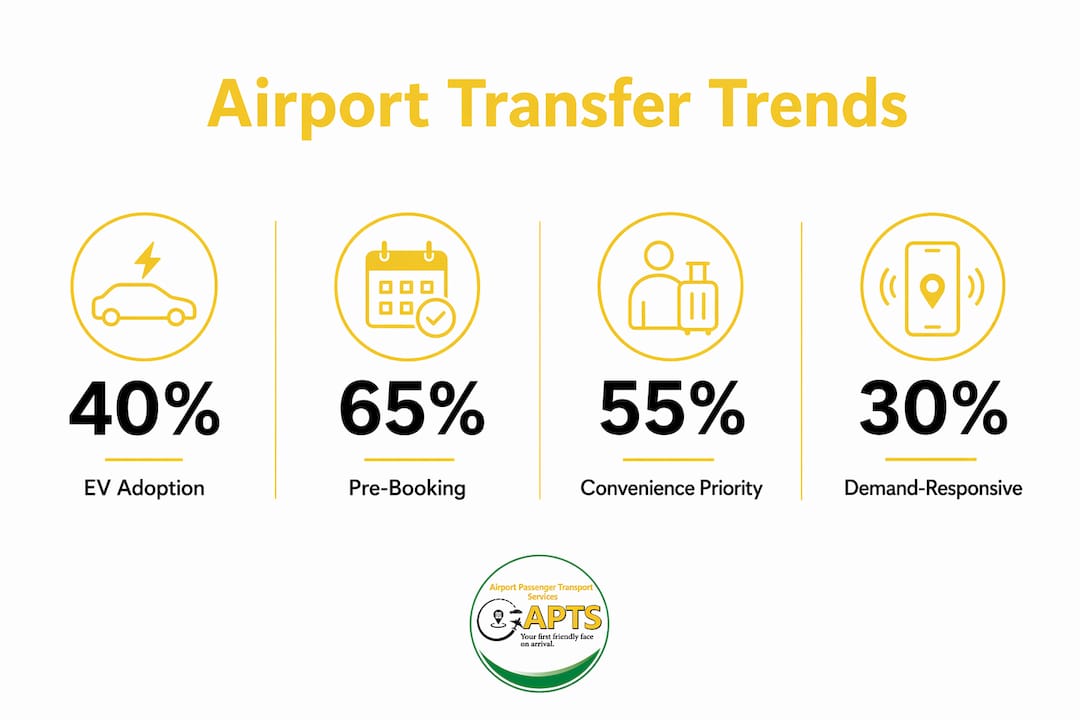
Environmental awareness is also influencing transfer choices in a concrete way. Travellers are not simply accepting greener options when offered. Many are actively seeking providers who can demonstrate genuine sustainability commitments, not just marketing language. This is explored further in the DRT and sustainability section below.
Multimodal itineraries are becoming more common, with travellers combining pre-booked private transfers with rail or metro connections depending on the leg of the journey. For airport ground transport providers, this means travellers arrive with more specific requirements and less tolerance for vague or flexible arrangements.
How are electric vehicles and AI booking tools changing airport transfers?
Technology is the engine behind most of the 2026 airport transfer trends, and two developments stand out above the rest.

Electric and hybrid vehicle adoption is accelerating across transfer fleets. Vehicles such as the Tesla Model Y, Mercedes EQS, and BYD range are increasingly visible in professional transfer operations. For travellers, this means quieter, smoother rides with a lower environmental footprint. The practical caveat is that fleet composition varies by provider, and a guaranteed fully electric vehicle is not always available unless specified at the point of booking.
AI-driven booking platforms have moved from a competitive advantage to an industry standard. These platforms optimise reservations in real time, provide personalised vehicle recommendations, and integrate directly with flight data to adjust pickup times automatically when flights are delayed. The result is a booking experience that requires far less manual coordination from the traveller. For a deeper look at how sustainable vehicle adoption is playing out across transfer fleets, the environmental implications are worth examining separately.
Beyond vehicles and booking, two further technological shifts are worth noting:
- Autonomous vehicle pilots on airport routes are advancing. Driverless airport transfers are likely within 2–3 years in select markets, with major international airports partnering with autonomous shuttle operators to move from pilot stage to commercial deployment.
- Biometric verification and digital identity are gaining traction. Willingness to use biometric solutions among travellers climbed to 72% in 2025 from 57% in 2021, signalling strong appetite for frictionless, pre-verified travel experiences that will extend to ground transport check-in and verification processes.
What does market growth tell us about pricing and booking preferences?
The numbers behind the pre-book airport transfer market tell a clear story about where traveller preferences are heading.
The global pre-book transfer market is growing at 15.3% per year, driven by rising air travel volumes, growing demand for stress-free experiences, and the expansion of premium and customised transfer services. The broader airport ground transportation market, which includes taxis, shuttles, ride-hailing, and public transit, is valued at $52.3 billion in 2026 and is projected to reach $94.7 billion by 2034.
| Market segment | 2026 value | Projected value | Growth rate |
|---|---|---|---|
| Pre-book airport transfers | USD 11.67 billion | USD 20.62 billion (2030) | 15.3% CAGR |
| Airport ground transportation (global) | USD 52.3 billion | USD 94.7 billion (2034) | 15.3% CAGR |
Key figure: The pre-book airport transfer market is growing at more than twice the rate of the broader ground transportation market, reflecting a decisive shift towards planned, reliable, and premium transfer services.
Pricing transparency is central to this growth. Fixed pricing and all-inclusive quotes are now the norm for pre-booked transfers. Travellers receive a confirmed total before they book, covering all fees and waiting time within agreed parameters. The taxi meter model, with its potential for surge charges and unpredictable totals, is losing ground to this approach. For business travellers and VIP passengers in particular, the ability to confirm a transfer cost at the point of booking is a practical necessity, not a luxury.
What should travellers know when booking airport transfers in 2026?
Practical knowledge makes the difference between a smooth transfer and a frustrating one. These are the most important considerations for travellers booking in 2026.
- Pre-book 24–72 hours in advance. Booking ahead secures preferred vehicle types and avoids surge pricing during peak periods. For major events, holidays, or early morning departures, booking further in advance is advisable.
- Clarify vehicle type at booking. Not all providers labelled as eco-friendly guarantee a fully electric vehicle. If a zero-emission transfer matters to you, confirm the specific vehicle type before completing the booking rather than assuming it from the provider’s marketing.
- Signal readiness only after collecting luggage. Coordinating pickup after bags are collected, rather than on landing, avoids missed collections and unnecessary waiting fees. Driver tracking apps often notify arrivals based on proximity, so the sequence matters.
- Consider shared transfers for cost efficiency. Group and shared transfer options offer meaningful savings for solo travellers or small groups with flexible timing. The trade-off is additional stops and a longer overall journey time.
- Understand regulatory and health protocol requirements. UK airports continue to refine their ground transport access policies, including designated pickup zones, curb access fees for ride-hailing vehicles, and vehicle emission standards for commercial operators. Checking the specific airport’s current ground transport rules before travel avoids last-minute complications.
- Use app-based tracking as standard. Real-time driver tracking and in-app communication are baseline features in 2026. If a provider does not offer these, that is a meaningful gap in service quality. For stress-free airport pickups, app communication with your driver before arrival is one of the most effective tools available.
Pro Tip: When booking a pre-scheduled transfer, send your flight number at the time of booking. AI-integrated platforms will automatically adjust your pickup time if your flight is delayed, removing the need for manual coordination on the day.
Why are demand-responsive transport and sustainability shaping the future of airport transfers?
Demand-Responsive Transport is one of the most consequential developments in airport ground access, yet it remains underappreciated by most travellers. Understanding it helps explain why the airport shuttle experience is improving at a pace that fixed-route systems never could have achieved.

Traditional fixed-route shuttle loops run on a schedule regardless of actual passenger numbers. The result is predictable: empty buses at 2 AM and overcrowded vehicles during the 6 AM rush. DRT platforms solve this by dynamically matching vehicle supply with real-time passenger demand, dispatching vehicles only when and where they are needed. The efficiency gains are direct: reduced fuel consumption, shorter waiting times, and better vehicle utilisation across the operation.
For travellers, DRT manifests as a noticeably better experience. Through a dedicated app or QR code at a shuttle stop, passengers can access live vehicle locations, real-time ETAs, capacity information for the next vehicle, and one-click booking for express services. The guesswork is removed entirely. Airport operators adopting DRT are also meeting their own sustainability targets more effectively, since demand-responsive modes reduce fuel waste compared to fixed-route loops running at low occupancy.
Sustainability is now a mainstream competitive factor rather than a niche consideration. Travellers favour providers with genuine environmental commitments, and airports are responding with preferential access policies and charging infrastructure investment for zero-emission fleets. The providers who will lead the market through 2026 and beyond are those who can demonstrate both operational efficiency and a credible path to lower emissions.
Pro Tip: When evaluating transfer providers, ask specifically whether their fleet includes hybrid or fully electric vehicles and whether those vehicles are guaranteed for your booking. A provider who can confirm vehicle type at booking is demonstrating a level of operational transparency that reflects genuine sustainability commitment, not just marketing.
How have post-pandemic health and safety protocols influenced airport transfer services?
The pandemic permanently altered the standards travellers expect from ground transport operators, and those changes have not receded. They have been absorbed into the baseline.
Contactless payment and digital-only receipts are now universal expectations. Travellers who experienced the shift away from cash transactions during the pandemic have not reverted, and providers who cannot accommodate contactless payment are at a structural disadvantage. The same applies to vehicle hygiene standards. Regular sanitisation protocols, introduced as an emergency measure, are now treated as a minimum standard of professional operation.
Physical distancing considerations have also influenced vehicle capacity policies. Many professional transfer operators have maintained reduced passenger limits in standard vehicles, particularly for shared transfers, as a quality and comfort measure rather than a regulatory one. The effect is a higher standard of personal space per passenger compared to pre-pandemic norms.
Health and safety awareness has also accelerated the adoption of digital communication over in-person interaction. Travellers now expect to manage their entire transfer experience through an app, from booking confirmation to driver communication to payment, without needing to handle physical documents or engage in extended face-to-face exchanges. This expectation has become a design requirement for any transfer platform operating at a professional level in 2026.
Key takeaways
The pre-book airport transfer market is growing annually at a notable rate, driven by traveller demand for reliability, price transparency, and low-emission vehicle options.
| Point | Details |
|---|---|
| Market growth is accelerating | The pre-book transfer market reached USD 11.67 billion in 2026 and is forecast to reach USD 20.62 billion by 2030. |
| Fixed pricing is now standard | All-inclusive, upfront quotes have replaced taxi meters as the norm for professional pre-booked transfers. |
| Pre-book 24–72 hours ahead | Booking in advance secures vehicle availability and avoids surge pricing, especially during peak travel periods. |
| EV availability varies by provider | Hybrid and fully electric vehicles are increasingly common, but a guaranteed EV requires explicit confirmation at booking. |
| Apts for professional transfers | Apts offers professional taxi, executive taxi, and chauffeur services to and from airports across Ireland and Spain. |
Apts: professional airport transfer services for discerning travellers
For travellers who have read this far, the picture is clear. The best airport transfers in 2026 are pre-booked, transparently priced, and delivered by professional operators who can confirm vehicle type, communicate in real time, and meet you precisely when and where you need them.
Apts provides professional taxi, executive taxi, and chauffeur services to and from airports across Ireland and Spain. Every booking comes with a fixed, all-inclusive price confirmed upfront, professional meet-and-greet service, and direct communication with your driver. Whether you are travelling for business or leisure, Apts offers the reliability and executive comfort that the 2026 traveller expects. For those planning travel through Irish or Spanish airports, explore the full range of chauffeur service advantages or use Apts’s taxi service selection guide to find the right vehicle for your journey. Book your transfer directly at apts.ie and travel with confidence from the moment you land.
Recommended
- Taxi vs ride-hailing for airports: your 2026 guide
- Tips for stress-free airport transfers in 2026
- List of airport ground transport: your 2026 guide
- Best transport options to airports: your 2026 guide
Article checked by Declan Rodden.