

Executive transfer is defined as the planned movement of a senior leader into a new organisational role to maintain continuity, strengthen performance, and align leadership with evolving business goals. The role of executive transfer extends far beyond a simple personnel change. Successful transitions lead to a 90% higher likelihood of meeting three-year performance goals and 13% lower attrition risk. That data alone makes executive transfer one of the highest-leverage decisions a board or HR team can make. When managed well, it shapes culture, preserves institutional knowledge, and protects team performance across the organisation.
What are the common challenges in the executive transfer process?
The executive transfer process fails more often than most organisations admit. Over 40% of newly hired or transferred executives fail within the first 18 months, with cultural misfit, unclear expectations, and weak onboarding cited as the primary causes. That failure rate carries a steep cost.
Failed transitions do not just affect the departing or arriving leader. Failed transitions cause 20% lower engagement and 15% lower team performance across the affected unit. High performers, who have options, begin looking elsewhere when leadership instability sets in.
The most common challenges include:
- Cultural misfit. A new executive may have the right technical credentials but fail to read the unwritten rules of the organisation. Every company has embedded cultural scripts, and ignoring them triggers rejection from within.
- Weak onboarding. A single orientation day is not an integration plan. Without structured support across weeks and months, executives default to the habits of their previous role.
- Unclear expectations. When performance targets are not defined early, executives spend their first months guessing priorities rather than delivering results.
- Loss of momentum. If the outgoing leader departs before knowledge transfer is complete, teams lose direction and projects stall.
- Voluntary turnover. High performers who were loyal to the previous leader often reassess their commitment during a leadership change.
Pro Tip: A structured 6–12 month integration plan reduces executive failure risk significantly. Build it before the new leader arrives, not after.
How does structured onboarding and executive coaching improve transfer outcomes?
Structured onboarding is not a welcome event. It is a planned programme that runs for months, covering relationship building, cultural immersion, and performance alignment. The distinction matters because organisations that treat onboarding as a single event consistently see higher failure rates.

Executive transition coaching accelerates leader effectiveness during onboarding by improving decision-making and cultural adaptation. This is different from standard leadership coaching. Transition coaching focuses specifically on the identity shift a leader undergoes when moving between organisational systems.
The most effective onboarding frameworks follow a clear sequence:
- Pre-arrival briefing. The incoming executive receives a cultural briefing, stakeholder map, and priority overview before their first day.
- 30-day listening phase. The leader observes, asks questions, and builds relationships without making major decisions. Trust is the goal, not productivity.
- 60-day alignment review. Expectations are clarified with the board or direct line manager. Early assumptions are tested against reality.
- 90-day credibility milestone. The executive delivers one visible win that signals competence and earns team confidence.
- 6-month coaching review. A transition coach assesses cultural integration, leadership blind spots, and stakeholder relationships.
- 12-month performance evaluation. Formal review against the agreed goals set at the start of the transition.
Pairing new executives with transition coaches doubles success likelihood compared to onboarding alone. That is not a marginal improvement. It is the difference between a leader who thrives and one who quietly fails.
Pro Tip: Transition coaching addresses cultural alignment and systemic integration, not just role performance. Choose a coach with experience in organisational systems, not just individual leadership development.
What practical strategies should organisations implement for successful executive transfers?
The best practices for executive transfer begin months before the new leader arrives. Planning transfers 3–6 months before departure maintains momentum and prevents strategic stalling. Late starts leave interim leaders unprepared and teams without direction.
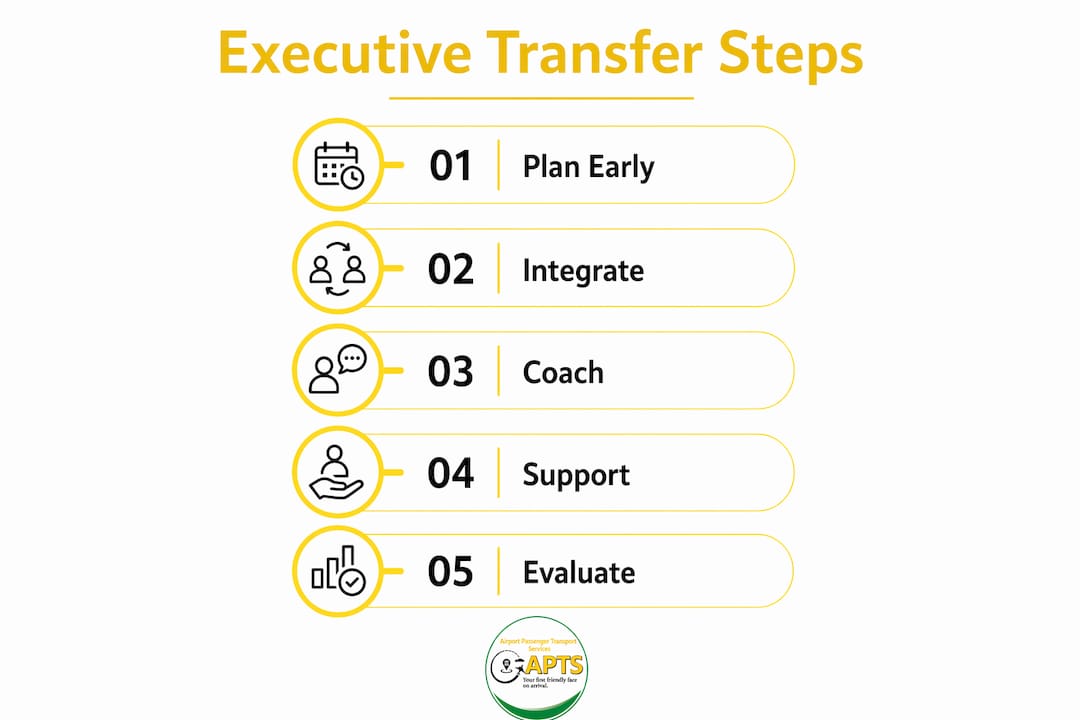
Succession planning should run continuously, not reactively. Quarterly reviews of leadership readiness, role profiles, and pipeline candidates mean that when a transfer becomes necessary, the organisation is ready to act rather than scramble.
Key strategies that reduce risk and improve outcomes:
- Appoint interim leadership early. A credible interim leader maintains team stability and preserves client relationships while the permanent appointment is confirmed.
- Define 30/60/90-day milestones. Relationship-building milestones at each stage prevent drift and reduce the political risks that derail new leaders.
- Run structured listening tours. The incoming executive meets key stakeholders across functions, not just their direct reports. This builds credibility and surfaces hidden priorities.
- Clarify cultural expectations explicitly. Do not assume the new leader will absorb culture by proximity. Name the values, behaviours, and norms that define success in the organisation.
- Protect the first 90 days. The first 90 days should prioritise trust and credibility over immediate productivity gains.
| Strategy | Timing | Primary benefit |
|---|---|---|
| Succession planning reviews | Quarterly, ongoing | Readiness for unplanned changes |
| Interim leadership appointment | At announcement | Team stability and continuity |
| Pre-arrival cultural briefing | 4–6 weeks before start | Faster cultural orientation |
| 30/60/90-day milestone reviews | First 3 months | Expectation alignment |
| Transition coaching programme | Months 1–12 | Reduced failure risk |
What are the specific considerations for international executive transfers?
International executive transfers carry a layer of complexity that domestic moves do not. Legal compliance, tax obligations, family relocation, and cultural adaptation all require coordination. Managing these separately creates gaps. An integrated approach coordinating legal, tax, and relocation services is more effective than managing vendors independently.
Visa requirements alone can derail a transfer if not addressed early. The US L-1A intracompany transfer visa, for example, requires 1 continuous year of managerial or executive employment abroad before an application is valid. Processing timelines range from 2–9 months, with premium processing reducing the response time to 15 business days at an additional cost of $2,965. A single break in continuous employment can invalidate the application entirely.
Family relocation is consistently underestimated as a risk factor. Family stress is a primary cause of international executive transfer failures. Executives who are managing an anxious family alongside a demanding new role rarely perform at their best.
Pro Tip: Arrange a “look and see” trip for the executive and their family before the move is confirmed. Visiting schools, neighbourhoods, and commute routes reduces anxiety and increases commitment to the relocation.
The table below outlines the key risk areas and mitigation approaches for international transfers:
| Risk area | Consequence if ignored | Mitigation approach |
|---|---|---|
| Visa compliance timing | Application invalidation | Begin legal review 6+ months early |
| Tax and double taxation | Financial penalties | Engage specialist tax advisers pre-move |
| Family relocation stress | Executive underperformance | Arrange preliminary visit and family support |
| Cultural adaptation | Leadership rejection | Provide cross-cultural coaching |
| Labour law compliance | Regulatory penalties | Use integrated mobility provider |
How to measure the impact and benefits of successful executive transfers?
Measuring the impact of executive transfer requires tracking indicators across multiple timeframes. Short-term metrics collected in the first 90 days focus on relationship quality and team stability. Longer-term indicators, gathered at 180 days and beyond, reflect genuine performance and cultural integration.
The most reliable indicators of a successful transfer include:
| Metric | What it measures |
|---|---|
| Three-year performance goal attainment | Long-term strategic delivery |
| Team engagement scores | Cultural integration and morale |
| Attrition rate in the leader’s unit | Stability and confidence in leadership |
| Stakeholder satisfaction feedback | Relationship quality across functions |
| High-performer retention | Trust in the new leader’s direction |
Organisations that invest in structured executive transfer processes report measurable returns. The benefits of executive transfers include smoother strategic execution, stronger talent retention, and higher team performance across the affected unit. These outcomes compound over time. A leader who integrates well in year one builds the team capability that delivers results in years two and three.
Tracking these metrics also creates accountability. When HR teams and boards can see integration progress in real time, they can intervene early if a transfer is showing warning signs, rather than waiting for a visible failure.
Key takeaways
Effective executive transfers require structured integration, early planning, and ongoing coaching to deliver measurable gains in performance and retention.
| Point | Details |
|---|---|
| Plan transfers 3–6 months early | Late starts cause strategic stalling and leave interim leaders unprepared. |
| Use a 6–12 month integration plan | Structured onboarding reduces the 40% executive failure rate within 18 months. |
| Pair executives with transition coaches | Coaching doubles success likelihood compared to onboarding alone. |
| Coordinate international transfers as one process | Integrating legal, tax, and relocation services prevents compliance failures. |
| Measure impact beyond 180 days | Long-term metrics reveal true cultural integration and performance gains. |
What I have learned from watching executive transfers succeed and fail
The most common mistake I see is organisations treating an executive transfer as a logistics exercise. They arrange the contract, set a start date, and assume the leader will find their feet. They rarely do, at least not quickly enough to avoid damage.
The research on cultural scripts and organisational ancestry resonates with what I have observed in practice. Every organisation has an invisible operating system built from its history, its founders, its past crises, and its unspoken norms. A new executive who ignores that system, even unintentionally, gets rejected. Not through overt conflict, but through quiet withdrawal of trust from the people who matter most.
The leaders who succeed are the ones who listen before they act. They spend their first weeks asking questions rather than announcing changes. They build relationships with people two levels below them, not just their direct reports. They treat cultural integration as a professional discipline, not a soft afterthought.
The trend I find most encouraging in 2026 is the growing use of systemic transition coaching, which addresses psychological identity shifts alongside practical role demands. This is the right direction. Technical competence gets a leader through the door. Cultural intelligence and psychological adaptability determine whether they stay.
My advice to any organisation planning a senior leadership change is simple. Start earlier than you think you need to. Invest in coaching. Measure integration, not just performance. And protect the first 90 days from the pressure to produce immediate results.
— Declan
Apts: professional transport for executives on the move
Executive transfers involve more than organisational planning. They involve real journeys, tight schedules, and first impressions that matter. Apts provides professional executive taxi and chauffeur services to and from airports across Ireland and Spain, giving business professionals the reliable, comfortable transport their role demands.

Whether an executive is arriving for their first day in a new city or travelling between corporate sites, Apts delivers punctual, discreet, and professional ground transport. Premium vehicles, experienced drivers, and a meet-and-greet service mean executives arrive composed and ready. For organisations managing complex transfer logistics, Apts offers executive taxi services tailored to corporate clients. Explore the full range of business travel transport options and book with confidence.
FAQ
What is the role of executive transfer in organisations?
Executive transfer is the planned movement of a senior leader into a new role to maintain leadership continuity, align strategy, and protect team performance. Successful transfers lead to a 90% higher likelihood of meeting three-year performance goals.
Why do so many executive transfers fail?
Over 40% of executive transfers fail within the first 18 months due to cultural misfit, unclear expectations, and inadequate onboarding. A structured 6–12 month integration plan significantly reduces this risk.
How long should executive transfer planning take?
Planning should begin 3–6 months before the transfer date. Starting late causes strategic stalling and leaves interim leadership unprepared to maintain team stability.
What makes international executive transfers more complex?
International transfers require coordinating visa compliance, tax obligations, and family relocation simultaneously. Managing these as separate workstreams increases the risk of regulatory failures and executive underperformance.
How does executive coaching improve transfer outcomes?
Pairing a new executive with a transition coach doubles the likelihood of a successful transfer compared to onboarding alone. Transition coaching focuses on cultural adaptation and systemic integration, not just role performance.
Recommended
- Corporate Airport Transfers Ireland | Dublin Business Transport
- Corporate taxi booking explained for travel managers
- Why airport transfer matters for stress-free travel
- Tips for stress-free airport transfers in 2026
Article checked by Declan Rodden.