

An airport meet point is the official, designated landside location within an airport where arriving passengers and their pick-up parties can reunite safely and efficiently. These areas sit beyond security and immigration, typically in arrivals halls or terminal lobbies, making them accessible to both passengers and non-travelling visitors. Unlike curbside pick-up zones or airside gates, a meet point is a fixed, publicly accessible spot intended purely for on-foot meetings. Airports such as Heathrow Terminal 5 and San Francisco International Airport (SFO) have formalised these locations with clear signage and terminal-specific instructions. Understanding how they work saves time, avoids fines, and removes the stress from every airport pick-up.
What is an airport meet point and where are they located?
An airport meet point is an official landside area placed in the arrivals hall or terminal lobby, designed for on-foot meetings between passengers and those collecting them. The location is always beyond immigration and baggage claim, meaning anyone can access it without a boarding pass or security clearance. This is what separates a meet point from an airside gate or a curbside drop-off zone.

Most airports position meet points near high-visibility landmarks. Common anchor points include information desks, coffee outlets, currency exchange counters, and prominent digital display boards. These landmarks serve a practical purpose: they are easy to describe over the phone and hard to miss in a busy terminal.
Signage varies by airport, but standardised pictograms are widely used. The most common is the two-people-meeting icon, a simple graphic that signals the designated rendezvous area. At larger airports such as Heathrow T5, two distinct meet points exist within the same terminal. At SFO, instructions are terminal-specific, so the correct meet point at the International Terminal differs from those at Terminals 2 or 3.
The table below shows common meet point locations at major international airports.
| Airport | Terminal | Common meet point location |
|---|---|---|
| Heathrow (LHR) | T5 | Two designated points in arrivals hall |
| San Francisco (SFO) | International | Terminal-specific, near baggage claim exits |
| Dublin (DUB) | T1 & T2 | Arrivals concourse, near information desks |
| Dublin (DUB) | T2 | Near Costa Coffee, ground floor arrivals |
Key factors that affect where you should stand:
- Floor level: Many terminals have multi-level arrivals. Confirm whether the meet point is on the ground floor or a mezzanine level.
- Door number: Terminal buildings have multiple numbered exits. Door 4 and Door 6 can be a significant walk apart.
- Landmark proximity: Agreeing on a specific café or desk removes ambiguity entirely.
Pro Tip: Before travel, visit the airport’s official website and screenshot the arrivals hall map. Share it with your pick-up party so both sides are looking at the same reference point.
What airport pick-up rules affect meet point usage?
Airport pick-up rules directly shape how meet points are used. The core rule at most major airports is active loading: a vehicle cannot remain stationary at a terminal forecourt unless a passenger is physically present and actively boarding. Drivers who arrive early and wait at the kerb risk fines or forced removal by airport staff.
Heathrow enforces a 10-minute maximum stay on terminal forecourts, with a £7 penalty for violations. This rule makes curbside waiting impractical for most pick-ups, particularly on international flights where passengers can take considerably longer to clear immigration. The practical result is that drivers must either park and walk to the meet point, or use a designated waiting area.
SFO addresses this with cell phone waiting lots, which offer up to 60 minutes of free parking. Drivers wait there until the passenger confirms they are at the meet point, then drive to the terminal for active loading. This system protects drivers from fines and keeps forecourts clear.
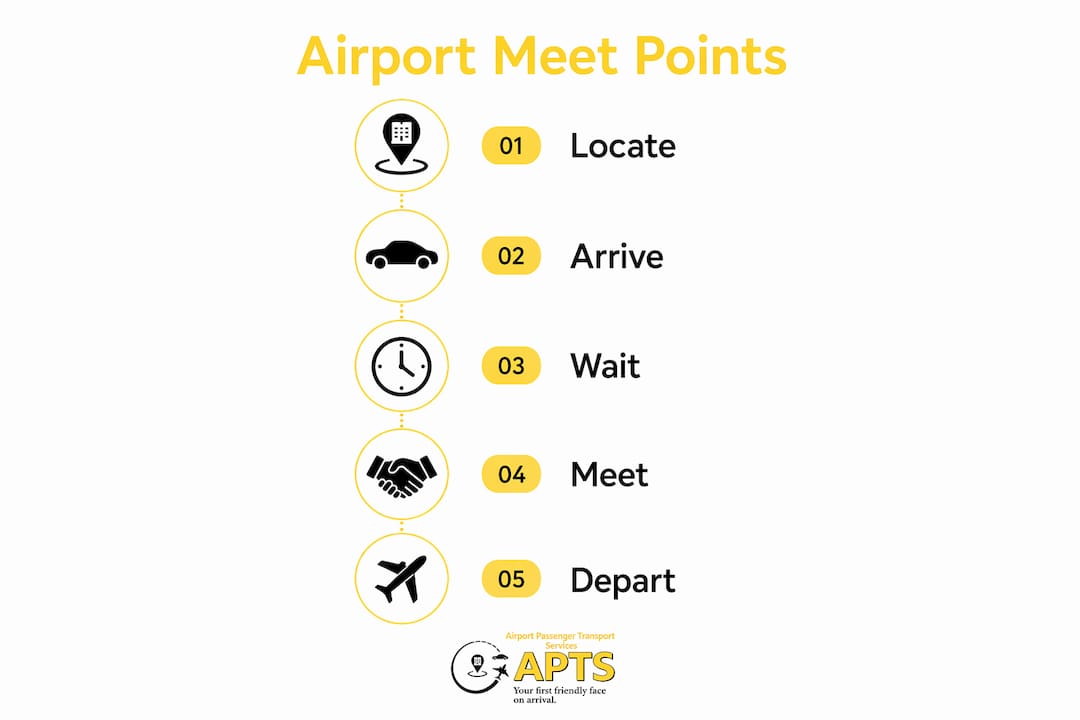
The steps below outline the correct process for a smooth pick-up.
- Confirm the meet point in advance. Agree on the exact location, door number, and landmark before the flight lands.
- Track the flight. Use the airport’s arrivals board or a flight-tracking service to monitor landing time.
- Wait in the designated area. Use a cell phone waiting lot or short-stay car park rather than the terminal forecourt.
- Receive confirmation from the passenger. Wait until the passenger messages to confirm they are at the meet point.
- Drive to the terminal for active loading. Pull up only when the passenger is physically present and ready to board.
- Complete the pick-up promptly. Load luggage and depart without delay to avoid forecourt penalties.
Pro Tip: Allow a minimum of 20 minutes after landing before expecting a passenger at the meet point. On busy international routes, immigration and baggage delays can extend this to 60 minutes or more.
What do airport terms like door, zone, and bay actually mean?
Airport pick-up terminology causes more confusion than almost any other aspect of travel logistics. Three terms appear repeatedly in airport instructions, and mixing them up leads directly to missed connections.
A door is a numbered entrance or exit on the terminal building itself. Doors are fixed points on the building’s exterior and are the most precise reference for on-foot meetings. When a driver says “meet me at Door 5,” they mean a specific opening in the terminal wall, not a general area.
A zone is a lettered or colour-coded section of the pick-up area outside the terminal. Zones are used primarily by rideshare services and taxis to organise vehicle queuing. Zone A and Zone B may be separated by a considerable distance, particularly at large terminals.
A bay is a single numbered vehicle slot within a zone. It is the most granular reference point for vehicle pick-ups. Telling a passenger “Zone C, Bay 12” gives them a precise location to walk to.
Tips for using these terms correctly:
- Always confirm which of the three terms your driver or pick-up party is using before you land.
- Do not assume “Zone B” and “Door B” refer to the same location. They rarely do.
- At Dublin Airport, arrivals exits are numbered clearly on the building. Agreeing on a door number is the most reliable method.
- When using a professional transfer service, the driver will typically specify all three: door, zone, and bay.
Pro Tip: When coordinating with a driver, ask them to confirm the door number, zone letter, and bay number in a single message. This three-part confirmation prevents miscommunication and removes any ambiguity before you step off the plane.
For a broader look at airport meet and assist services, including how professional drivers manage these logistics on your behalf, Apts provides a detailed guide.
How to plan and confirm an airport meet point effectively
Effective planning starts well before the flight lands. Confirming the exact rendezvous spot including door numbers, bay letters, and nearby landmarks before arrival reduces stress and prevents fines and wasted time. A vague plan such as “meet in arrivals” is not sufficient at a multi-terminal airport.
Landing time and arrival at the meet point are not the same event. Expect 20–60 minutes between touchdown and the passenger reaching the meet point, depending on immigration queues, baggage carousel wait times, and the distance from the gate to the arrivals hall. Failing to account for this gap causes drivers to arrive too early and passengers to feel rushed.
Follow these steps to plan a reliable airport rendezvous.
- Identify the correct terminal. Confirm which terminal the flight arrives into. At multi-terminal airports, this is non-negotiable.
- Locate the official meet point. Check the airport’s website for the designated meeting area within that terminal.
- Agree on a specific landmark. Choose a named café, information desk, or numbered door as the primary reference.
- Set a realistic meeting time. Add at least 30 minutes to the scheduled landing time as the earliest expected meet time.
- Agree on a fallback location. If the primary meet point is crowded or unclear, identify a secondary landmark in advance.
- Reconfirm on the day. Send a message when the flight lands and again when the passenger clears baggage claim.
For passengers using a professional transfer service, the airport pick-up process is typically managed end-to-end. The driver monitors the flight, adjusts for delays, and confirms the meet point directly with the passenger.
Meet and greet services add a further layer of assistance. Basic meet-and-guide services direct passengers through the terminal, while premium concierge options include baggage assistance, fast-track immigration, and onward transfer coordination. Understanding which level of service you have booked sets the right expectations before you land.
Pro Tip: Save the airport’s arrivals hall map as a contact note in your phone alongside the driver’s number. If your phone battery is low, you can still describe your exact location without needing data.
For guidance on luxury airport arrivals and pick-up etiquette, particularly for executive and VIP travellers, the principles of clear communication and precise location-sharing apply universally.
Key takeaways
An airport meet point is a fixed, landside location in the arrivals hall where passengers and pick-up parties meet on foot, bypassing curbside restrictions and vehicle waiting rules entirely.
| Point | Details |
|---|---|
| Definition of a meet point | A designated landside area in arrivals, accessible without a boarding pass, for on-foot meetings. |
| Allow time after landing | Expect 20–60 minutes between touchdown and the passenger reaching the meet point. |
| Use precise terminology | Confirm door number, zone letter, and bay number to avoid miscommunication at pick-up. |
| Active loading rule | Vehicles must not wait at terminal forecourts; drivers should use waiting lots until passengers are ready. |
| Plan a fallback location | Agree on a secondary landmark in case the primary meet point is unclear or congested. |
Why I think most travellers underestimate the meet point
After years of working in airport ground transport, the single most common cause of a delayed pick-up is not traffic or a late flight. It is a vague meeting plan. Passengers say “arrivals” and drivers say “outside Terminal 2,” and neither party is wrong. They are just not talking about the same place.
The airports that handle this best, Dublin T2 in particular, make their meet points genuinely hard to miss. Clear signage, central placement, and a named landmark nearby mean that even a first-time visitor can find the spot without a data connection. The airports that handle it worst tend to be mid-sized facilities that have grown quickly and never formalised their meeting areas.
What most travellers overlook is the timing gap. Landing does not mean arrived. I have seen drivers wait 45 minutes at a meet point because they assumed the passenger would appear within 10 minutes of the scheduled landing. On a busy transatlantic route, that assumption is almost always wrong. Build the gap into your plan and communicate it clearly.
The other thing I would encourage every traveller to do is use the official meet point rather than improvising. The two-people-meeting icon exists for a reason. It is placed where foot traffic flows naturally from baggage claim, where there is space to stand without blocking exits, and where drivers can find you without needing to enter a restricted area. Trust the system. It works when you use it correctly.
— Declan
How Apts supports confident airport pick-ups
Apts specialises in professional airport transfers across Ireland and Spain, with a service built around the kind of precise coordination that meet points require.

Every Apts booking includes flight monitoring, direct communication with your driver, and confirmation of the exact meet point before you land. Whether you are travelling for business, with family, or require accessible airport transport, Apts manages the logistics so you do not have to. For travellers who want to arrive without uncertainty, the taxi service selection guide covers everything you need to choose the right service for your journey. Professional coordination at the meet point is not a luxury. It is simply the right way to travel.
FAQ
What is an airport meet point?
An airport meet point is an official designated area in the arrivals hall or terminal lobby where passengers and their pick-up parties can meet on foot. It is always landside, beyond immigration and baggage claim, and accessible without a boarding pass.
Where do I find the meet point at my airport?
Check the airport’s official website under arrivals or ground transport. Most airports publish a terminal map showing the exact location, often marked with a two-people-meeting pictogram.
How long should I wait before going to the meet point?
Allow 20–60 minutes after the scheduled landing time before heading to the meet point. Immigration queues and baggage claim can add significant time beyond the moment the aircraft touches down.
What is the difference between a meet point and a pick-up zone?
A meet point is an on-foot rendezvous area inside the terminal for passengers and greeters. A pick-up zone is a vehicle area outside the terminal where active loading takes place. The two serve different purposes and are rarely in the same location.
Can a driver wait at the terminal for me?
Most major airports, including Heathrow, prohibit extended waiting at terminal forecourts. Drivers should use a cell phone waiting lot or short-stay car park and drive to the terminal only once the passenger confirms they are at the meet point.
Recommended
- Airport meet and assist explained: a clear guide
- How to get airport pickup: a clear 2026 guide
- What is meet and greet? Airport assistance explained simply
Article checked by Declan Rodden.