

Corporate transfer booking is the process of arranging professional ground transport tailored to business travel needs, ensuring punctuality, comfort, and a consistent standard of service. For executives and travel managers, this is not a minor administrative task. A poorly managed transfer can delay a board meeting, undermine a client’s first impression, or leave a senior colleague stranded at an unfamiliar airport. This corporate transfer booking guide covers everything you need to get it right: optimal booking windows, essential trip details, vehicle selection, and a step-by-step booking process built for professional travel in 2026.
What is a corporate transfer booking guide and why does it matter?
Corporate transfer booking is defined as the advance arrangement of dedicated, professional ground transport for business purposes. It differs from consumer ride-hailing in three critical ways: fixed pricing, pre-confirmed vehicles, and a provider who monitors your journey from the moment you book.
The stakes are higher than most executives realise. Pre-trip logistics significantly impact the success of corporate transfers beyond simple car booking. A delayed pickup at Dublin Airport does not just cost time. It signals disorganisation to clients and colleagues alike.
Effective executive travel arrangements also carry a reputational dimension. The vehicle that collects a visiting client communicates your company’s standards before a single word is spoken. Getting the booking right is, therefore, a business decision as much as a logistical one.

When should you book a corporate transfer?
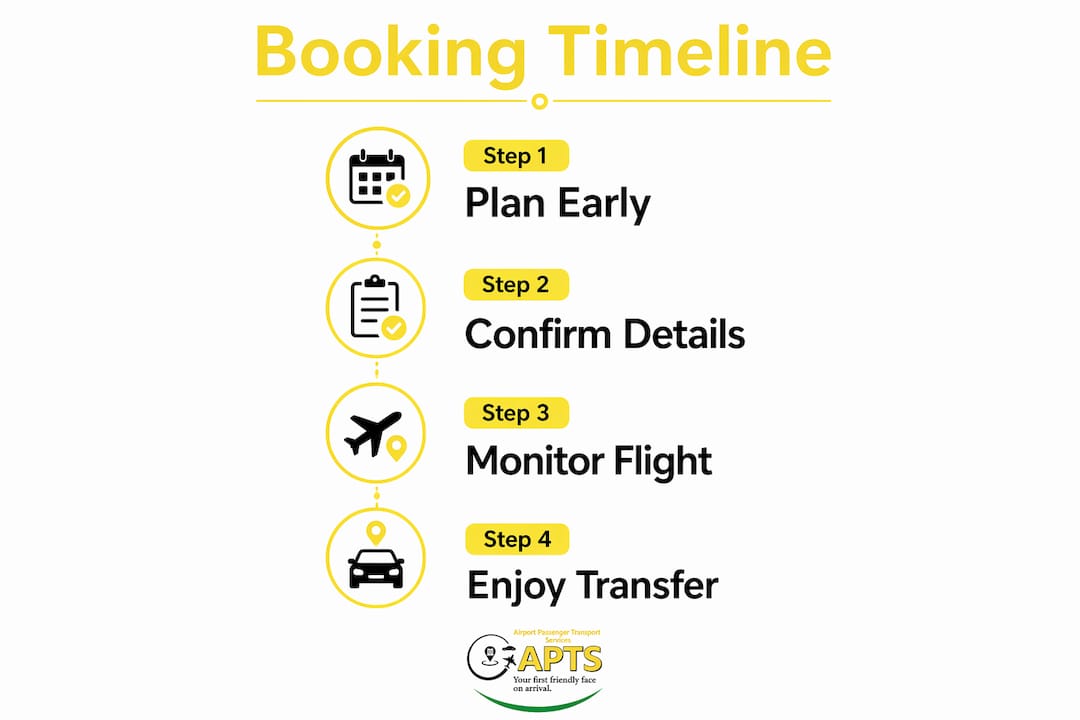
Booking timelines strongly influence price premiums and vehicle availability, making early planning essential for high-demand dates, conventions, and VIP trips. The recommended lead times vary considerably by trip type.
| Transfer scenario | Recommended booking window | Risk of booking late |
|---|---|---|
| Single executive airport transfer | 2–5 days in advance | Limited vehicle choice |
| Small group business travel | 5–10 days in advance | Coordination gaps |
| Corporate event or convention | 2–4 weeks in advance | Premium charges, unavailability |
| VIP or high-profile client transfer | 1–2 weeks in advance | Reputational risk |
Last-minute bookings often incur 20–30% premiums and risk vehicle unavailability. That cost is rarely justified when a booking takes fewer than ten minutes to complete in advance.
Pro Tip: For recurring routes, such as a weekly airport run for a senior executive, set up a standing booking with your provider. This locks in pricing, guarantees vehicle availability, and removes the task from your weekly to-do list entirely.
High-demand periods require particular attention. Conference season in cities like Dublin sees executive vehicle supply tighten sharply. Booking two to four weeks ahead for large events is not excessive caution. It is standard practice among experienced travel managers.
What information do you need to book a corporate transfer?
Most booking failures trace back to incomplete information at the point of reservation. Effective corporate transfers depend on transparent communication before and during travel. The more detail you provide upfront, the fewer problems arise on the day.
The following details are required for every booking:
- Flight number and terminal. This enables the provider to track your flight in real time and adjust pickup times for delays or early arrivals.
- Passenger count. Vehicle sizing depends on this. An incorrect count can result in a vehicle that cannot accommodate your group.
- Luggage volume. Specify the number of large cases, carry-on bags, and any oversized items such as golf bags or presentation equipment.
- Pickup and drop-off addresses. Full addresses, including building names and any access instructions for corporate premises.
- Passenger name and contact number. The driver needs a direct line to the lead passenger, not just the travel manager’s office number.
- Special requirements. Child seats, wheelchair-accessible vehicles, or specific meet-and-greet preferences should be noted at the time of booking.
Providing flight numbers enables proactive flight tracking, reducing delays and coordination issues. This single detail transforms a standard pickup into a monitored, adaptive service. Without it, your driver is working blind.
Early communication of special requirements leads to improved service quality and mitigates delays. A note about luggage or accessibility needs costs nothing to add. Failing to include it can cost a great deal more on the day.
How do you choose the right vehicle for a corporate transfer?
Vehicle selection is where many corporate travel programmes fall short. Choosing the wrong category creates discomfort, delays, or a poor impression. The right choice depends on passenger count, purpose, and the standard you wish to project.
| Vehicle category | Best suited for | Key features |
|---|---|---|
| Standard taxi | Solo traveller, short notice | Cost-effective, widely available |
| Executive taxi | Senior executive, client collection | Premium interior, professional driver |
| Chauffeur-driven saloon | VIP, board-level travel | Meet and greet, fixed pricing, Wi-Fi |
| Minibus or people carrier | Group transfers, team travel | Coordinated pickup, luggage capacity |
Premium transfer services deliver significant efficiency gains by allowing executives to focus on work while chauffeurs handle logistics and provide connectivity. That efficiency justifies the higher cost compared to standard transport, particularly for senior travellers whose time carries a measurable commercial value.
For client-facing journeys, an executive chauffeur service sets the correct tone from the outset. A professional chauffeur who greets your client by name, assists with luggage, and presents a clean, premium vehicle communicates attentiveness before the meeting begins. For a deeper look at how business and leisure chauffeur needs differ, the business vs holiday chauffeur guide covers the distinctions clearly.
Personalised transfers for premium clients also reduce the cognitive load on executives. When the vehicle, route, and timing are handled by a professional, the traveller arrives focused rather than frazzled.
How do you book a corporate transfer step by step?
A well-executed booking follows a clear sequence. Skipping steps is where errors enter the process.
-
Gather all trip details. Collect flight numbers, passenger names, luggage requirements, pickup addresses, and any special instructions before opening a booking form. Incomplete submissions cause delays and callbacks.
-
Select your provider and service level. Match the vehicle category to the trip purpose. A solo executive heading to a client pitch warrants a different choice than a team of six travelling to a conference venue.
-
Submit the booking with full details. Use a corporate booking platform where possible. These centralise billing, simplify invoicing, and give travel managers access to trip reports and multi-traveller booking functionality.
-
Confirm the booking in writing. A confirmation email or reference number is non-negotiable. It protects both parties and gives the passenger something to reference on the day.
-
Communicate any changes promptly. Flight rescheduled? Passenger count changed? Notify your provider as early as possible. Most reputable providers accommodate amendments without penalty when given adequate notice.
-
Brief the passenger. Share the driver’s name, vehicle registration, and contact number with the traveller before departure. This removes uncertainty and reduces the number of “where are you?” calls on the day.
-
Manage the pickup. Pre-booked private transfers with fixed pricing and flight tracking reduce uncertainty and enable reliable business travel. Instant booking confirmation and flexible amendments are hallmarks of strong corporate transfer providers.
Pro Tip: For group bookings involving staggered arrivals, appoint a single point of contact on the ground. Corporate airport transfers require managing vehicle sizing, coordination of staggered arrivals, and a clear point of contact. Without one, drivers and passengers lose time trying to locate each other.
Using corporate booking platforms centralises billing and improves accountability compared to ad hoc consumer apps. Travel managers gain detailed trip reports and multi-traveller booking functionality. That visibility is worth more than the marginal convenience of booking through a consumer app.
Key takeaways
Effective corporate transfer booking requires precise pre-trip data, appropriate lead times, and the right vehicle category matched to the purpose and passenger profile.
| Point | Details |
|---|---|
| Book well in advance | Single executive transfers need 2–5 days; large events need 2–4 weeks to avoid premiums. |
| Provide complete trip details | Flight numbers, passenger count, and luggage details prevent delays and vehicle mismatches. |
| Match vehicle to purpose | Executive taxis and chauffeur saloons suit client-facing trips; minibuses suit group travel. |
| Use a corporate platform | Centralised booking improves billing, accountability, and access to trip reports. |
| Communicate changes early | Prompt amendments avoid penalties and protect service quality on the day. |
Declan’s perspective: what most executives get wrong about corporate transfers
The most common mistake I see is treating a corporate transfer as an afterthought. Executives will spend hours preparing for a meeting and thirty seconds arranging how they get there. That imbalance creates entirely avoidable problems.
The second mistake is underestimating how much the transfer itself communicates. When a client steps into a clean, well-appointed vehicle with a professional driver who knows their name, that sets a tone. When they wait fifteen minutes on a kerb because the booking was incomplete, that sets a different one entirely.
My honest view is that the real value of a premium corporate transfer is not luxury. It is time and reliability. An executive who can review notes, take a call, or simply arrive composed has a measurable advantage over one who spent the journey managing a confused driver or a delayed pickup. The executive travel service model exists precisely because that advantage is real and repeatable.
Travel managers who implement a structured booking process, with standard lead times, a required information checklist, and a preferred provider, report far fewer day-of incidents than those who leave bookings to individual travellers. The process is simple. The discipline to follow it consistently is what separates well-run corporate travel programmes from chaotic ones.
— Declan
Corporate transfers made straightforward with Apts
Apts provides professional taxi, executive taxi, and chauffeur services to and from airports across Ireland and Spain, with a booking process built around the needs of corporate travellers and travel managers.
Whether you need a solo executive collected from Dublin Airport or a group transfer coordinated across multiple arrival times, Apts offers fixed pricing, real-time flight monitoring, and professional drivers who meet passengers by name. Corporate accounts give travel managers centralised billing and full trip visibility. For a clear starting point on choosing the right service for your next trip, the taxi service selection guide covers the key decisions in plain terms. You can also book directly for immediate confirmation.
FAQ
How far in advance should I book a corporate airport transfer?
Book single executive transfers at least 2–5 days ahead. For large events or conventions, allow 2–4 weeks to secure the right vehicle and avoid premium charges.
What details does a corporate transfer provider need at the time of booking?
Providers need the flight number, terminal, passenger count, luggage details, pickup and drop-off addresses, and any special requirements such as accessibility needs or meet-and-greet preferences.
Is a chauffeur service worth the cost for business travel?
Yes. Premium transfers allow executives to work, prepare, or rest during transit, which delivers a clear productivity benefit compared to standard transport options.
What happens if my flight is delayed?
Reputable providers monitor flights in real time using your flight number. They adjust pickup times automatically, so you are not charged for waiting time caused by airline delays.
Can travel managers book transfers for multiple travellers at once?
Yes. Corporate booking platforms support multi-traveller bookings, centralised invoicing, and trip reporting, which makes managing a team’s travel programme significantly more straightforward.
Recommended
- The role of executive transfer in corporate success
- Corporate taxi booking explained for travel managers
- What is a transfer service? Your 2026 travel guide
- Tips for stress-free airport transfers in 2026
Article checked by Declan Rodden.