

Airport transfers generate a measurable share of transport-related greenhouse gas emissions, and the gap between the cleanest and dirtiest options is wider than most travellers realise. Ground access to and from airports contributes approximately 8.17% of total transport-related CO₂ for outbound travellers, rising to over 13% in rural regions where distances are longer and public transport is sparse. The vehicle type, the number of passengers sharing it, and the distance covered are the three variables that determine whether your transfer is a minor footnote or a meaningful slice of your trip’s carbon total.
For policymakers and environmentally conscious travellers in the UK, 2026 brings both urgency and opportunity. New infrastructure investments, evolving regulations, and a growing body of research are reshaping what sustainable airport transport looks like in practice.
How airport transfers affect the environment: the core picture
Ground access is one of the most overlooked contributors to aviation’s total environmental footprint. Vehicles idling at kerbsides, private cars making empty return journeys, and diesel coaches queuing on congested approach roads all add pollutants to the air around airports, where communities already bear a disproportionate share of transport-related air quality impacts.
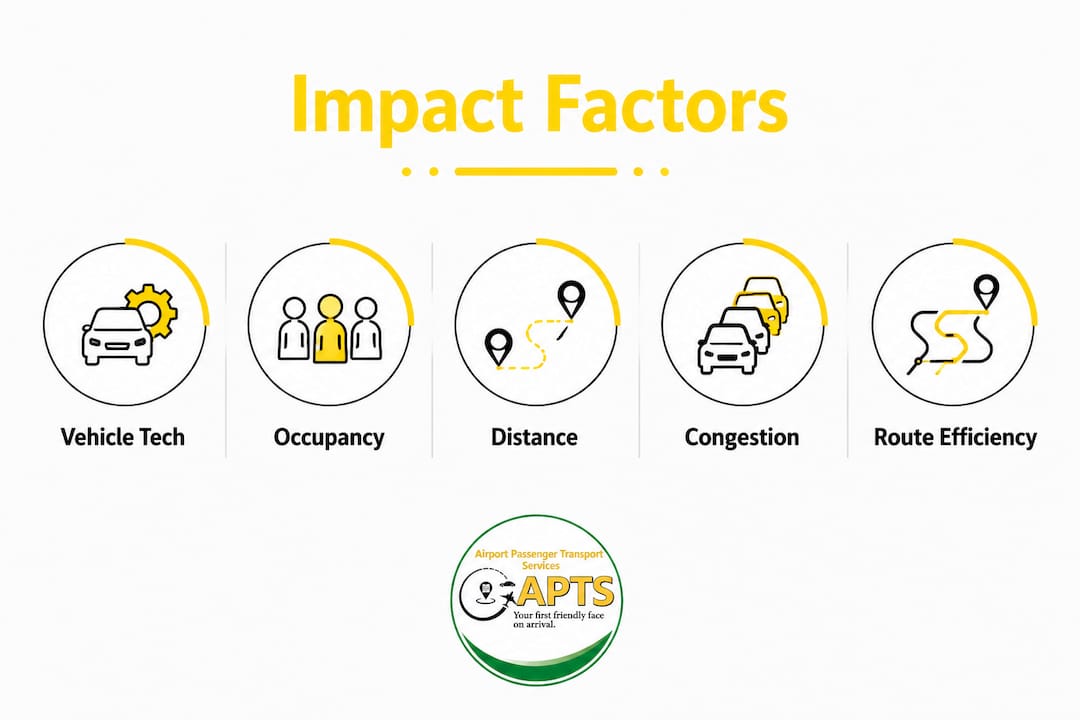
Key factors shaping the airport transfer environmental impact:
-
Vehicle type: Electric vehicles produce zero tailpipe emissions; modern diesel coaches meeting Euro 6 standards produce far less than older fleets, but still emit NOₓ and particulate matter.
-
Passenger occupancy: A single-occupancy taxi and a shared shuttle covering the same route produce vastly different per-passenger emissions. Shared shuttles can reduce per-passenger CO₂ by up to 80% compared with individual taxi journeys.
-
Trip distance: Urban airports with dense public transport links generate lower ground-access emissions per passenger than rural or regional airports where car travel dominates.
-
Congestion and idling: Stop-start traffic on airport approach roads increases fuel consumption and emissions well beyond what a free-flowing journey would produce.
-
Modal share: The proportion of passengers arriving by rail, bus, or shared shuttle versus private car is the single most powerful lever airports and policymakers can pull.
“Vehicle traffic and the emissions they generate are one of the largest contributing factors to environmental impacts around airports. Reducing the negative effects of surface movement at and around airports not only brings environmental benefits such as better local air quality and reduction in noise pollution; it also provides social and economic advantages, increasing an airport’s overall sustainability.” — ICAO, Sustainable Considerations for Airport Surface Access
The ICAO framing is deliberate: ground access is not a peripheral concern. At major UK airports, tens of millions of passenger journeys each year mean that even modest shifts in modal choice translate into material reductions in local air pollution and carbon output.
What factors determine how polluting your airport transfer is?
The environmental footprint of any airport transfer is not fixed. It shifts considerably depending on several interacting variables, and understanding them helps both travellers and planners make better decisions.
Vehicle technology and fuel type
Electric vehicles produce zero tailpipe emissions and, when charged from renewable sources, near-zero lifecycle emissions for the transfer itself. Electric and hybrid shuttles produce fewer emissions than traditional diesel vehicles, with hybrid buses offering significant fuel savings compared with conventional diesel equivalents. Diesel vehicles remain common across UK airport ground fleets, but Euro 6 compliant models produce substantially fewer pollutants than pre-2015 stock.

Occupancy and load factor
Occupancy is arguably the most powerful variable. A modern diesel shuttle carrying eight passengers produces roughly 19 grams of CO₂ per passenger per kilometre. The same vehicle carrying only one passenger produces eight times that figure per person. Private cars making solo journeys to airports, and then returning empty, carry the worst per-passenger emissions of any common transfer mode.
Distance and route efficiency
Research from Germany illustrates the distance effect clearly: ground access emissions range from 3.64% of a trip’s total CO₂ in urban Berlin, where rail is dominant, up to 13.09% in rural Bayern, where car travel is the default. UK regional airports serving areas with limited rail connectivity face a structurally similar challenge.
| Transfer mode | Approx. CO₂ per passenger per km | Occupancy assumption |
|---|---|---|
| Single-occupancy petrol car | High | 1 passenger |
| Single-occupancy diesel taxi | High | 1 passenger |
| Shared diesel shuttle (8 passengers) | Low | 8 passengers |
| Electric shuttle (renewable charge) | Near zero | 6–8 passengers |
| Rail or metro link | Very low | Multiple passengers |
Congestion and idling
Congestion on airport approach roads forces vehicles into stop-start driving patterns that increase fuel consumption and emissions beyond what a clear run would require. ICAO guidelines specifically recommend designing access roads and signage to reduce vehicle delays and idling at signals, noting that poor road layouts cause unnecessary emissions through driver stress and unfamiliarity with routing.
Air quality around airports
The impact of travel on air quality near airports is cumulative. NOₓ and particulate matter from road traffic combine with aircraft ground operations to create localised pollution hotspots. Communities living near major UK airports, particularly those under flight paths and adjacent to access roads, experience elevated exposure to these pollutants. Reducing the volume of private car journeys to airports directly improves local air quality, not just aggregate carbon figures.
Which sustainable transport options genuinely cut airport transfer emissions?
The most effective low-emission transfer options available in 2026 combine vehicle technology with smart operational practices. No single solution fits every airport or passenger, but the hierarchy is clear.
Sustainable airport transport modes, ranked by environmental benefit:
- Rail and metro links: The lowest-emission option for airports served by direct rail. Heathrow Express, the Elizabeth line, and Gatwick Express all offer sub-20g CO₂ per passenger per kilometre, far below any road-based alternative.
- Electric shared shuttles: Zero tailpipe emissions, quiet operation, and high occupancy make these the best road-based option. Their environmental advantage grows further when charged from renewable energy.
- Hybrid shared shuttles: A practical middle ground for routes where charging infrastructure is not yet in place. Fuel savings of 25–40% over diesel are achievable on typical airport shuttle duty cycles.
- Shared diesel shuttles (Euro 6): Still significantly better than single-occupancy travel on a per-passenger basis, particularly for routes without rail alternatives.
- Shared ride-hailing or taxi pooling: Consolidating passengers into shared bookings reduces per-person emissions compared with solo journeys, though the benefit depends on actual occupancy.
- Private electric vehicles: Zero tailpipe emissions, but the empty return journey problem remains. A private EV dropping one passenger still makes two trips for one person’s transfer.
- Private petrol or diesel vehicles: The least efficient option per passenger, particularly for solo travellers making round trips.
Pro Tip: When booking an airport transfer, ask the provider directly about their vehicle’s fuel type and Euro emission standard. A provider that cannot answer that question is unlikely to be operating a modern, low-emission fleet.
The airport shuttle carbon footprint advantage over individual taxis is well documented. One shuttle carrying six passengers produces roughly 80% less total emissions than six separate taxi journeys covering the same distance. That consolidation effect is the single most powerful tool available to travellers who want to reduce their transfer’s environmental impact without switching to rail.
For those planning group travel, sustainable group transport options follow the same logic: filling a vehicle efficiently is more effective than choosing a marginally cleaner vehicle type at low occupancy.
How UK transport policy and airport infrastructure support greener transfers
Policy and infrastructure are the structural enablers of modal shift. Without them, even the most environmentally motivated traveller faces a limited set of realistic choices.
UK regulatory and incentive frameworks
The UK government’s approach to reducing airport ground access emissions combines regulatory pressure with financial incentives. Clean Air Zones in cities like Birmingham and Bath penalise older, higher-emission vehicles entering designated areas, which affects taxi and private hire operators serving those cities’ airports. The Zero Emission Vehicle mandate requires manufacturers to increase the proportion of zero-emission cars and vans sold each year, gradually shifting the composition of private hire and taxi fleets.
Airport operators themselves face growing pressure under the Airport Carbon Accreditation programme, which requires participating airports to measure, manage, and reduce their carbon footprints, including scope 3 emissions from ground access. Accreditation at higher levels requires airports to actively engage with surface access emissions rather than treating them as outside their remit.
EV charging infrastructure at UK airports
- Heathrow Airport has committed to a zero-emission ground transport strategy, with EV charging points across its car parks and active engagement with taxi operators to accelerate fleet electrification.
- Gatwick Airport has installed rapid EV chargers in its short-stay car parks and operates an electric vehicle courtesy fleet for certain ground operations.
- Manchester Airport has expanded its EV charging provision as part of its broader sustainability programme, targeting a significant reduction in ground-level transport emissions.
- Edinburgh Airport has invested in charging infrastructure for both passenger vehicles and airside ground support equipment, reflecting Scotland’s ambitious net-zero targets.
The Brussels Airport Stargate project: a European benchmark
Brussels Airport’s Stargate project, supported by EU Horizon funding, demonstrates what coordinated airport sustainability investment looks like at scale. The project introduced multimodal journey planners that rank ground transport options by their CO₂ impact, giving passengers real-time information to make greener choices. That passenger-facing CO₂ ranking tool is the kind of transparency that UK airports have yet to adopt widely, but which policymakers are increasingly citing as a model.
Dublin Airport’s pantograph charging investment
While outside the UK, Dublin Airport’s infrastructure investment is directly relevant to the direction of travel for major airports. Dublin Airport invested substantially in Ireland’s first pantograph chargers for electric buses, supporting a zero-emission shuttle fleet with notable annual CO₂e reductions. Pantograph charging, which transfers power through an overhead contact system rather than a plug, enables rapid top-up charging between shuttle runs without taking vehicles out of service. This campus-wide electrification model, moving beyond isolated charging points to a fully integrated system, represents the infrastructure standard that major UK airports are now working towards.
ICAO’s integrated surface access planning
ICAO guidelines emphasise collaborative planning between airports and local transport authorities as the foundation of sustainable ground access. The guidance calls for environmental goals, including minimising vehicle wait times and encouraging public transport, to be explicit components of airport master plans rather than afterthoughts. Coordinating bus and rail schedules with flight arrivals, designing kerbside areas to minimise idling, and providing clear wayfinding to public transport options are all measures that reduce emissions without requiring passengers to make any active choice.
How your travel behaviour shapes the environmental impact of airport transfers
Individual choices aggregate into system-level outcomes. The modal share at any airport reflects millions of individual booking decisions, and shifting even a fraction of those decisions towards lower-emission options produces measurable results.
Key behavioural factors that increase transfer emissions:
- Single-occupancy travel: Travelling alone in a private car or taxi is the highest-emission choice for most airport journeys, particularly when the vehicle makes an empty return trip.
- Off-peak timing: Travelling during peak congestion periods increases fuel consumption and emissions for all road-based transfers, not just your own vehicle.
- Booking without checking vehicle type: Many passengers book the cheapest available option without asking whether the vehicle meets current emission standards.
- Avoiding public transport due to luggage concerns: Rail and bus options are often dismissed for journeys with heavy luggage, even when they are genuinely practical.
- Last-minute bookings: Spontaneous bookings tend to result in less efficient vehicle dispatch, with providers sending whatever is immediately available rather than consolidating passengers.
Passenger behavioural patterns such as single-occupancy travel and non-optimal route choice significantly increase airport transfer emissions. Promoting shared rides and public transport use materially reduces per-passenger emissions, but awareness campaigns alone rarely shift behaviour without accompanying incentives.
The most effective interventions combine information with financial signals. Congestion charges, parking levies, and preferential kerbside access for shared and zero-emission vehicles all change the relative cost of different transfer choices. Several UK airports already operate tiered drop-off charges that make private car use more expensive relative to shared options, nudging passengers towards coaches, buses, and shared taxis.
What travellers can do right now:
- Book a shared shuttle or coach service where one exists for your route.
- Choose rail where journey time is comparable to road-based alternatives.
- Ask your transfer provider about their vehicle’s emission standard before booking.
- Travel with companions where possible to share the per-passenger footprint of any road journey.
- Avoid booking transfers that require vehicles to make empty positioning runs to collect you.
The eco-conscious airport transfer choice is rarely the most inconvenient one. For most UK airport journeys, a shared shuttle or direct rail link is both lower-emission and comparable in cost to a private taxi, particularly when parking charges are factored in.
What does 2026 research tell us about the future of sustainable airport transfers?
The research picture in 2026 is more detailed and more actionable than it was even three years ago. Studies now quantify not just aggregate emissions but the specific levers that produce the greatest reductions.
Decarbonising airport ground access requires a coordinated approach that spans travel behaviour, transport infrastructure capacity, and incentives for low-emission vehicles. No single intervention is sufficient on its own. The research consistently shows that the highest-impact combination is modal shift to shared transport plus fleet electrification, with each reinforcing the other.
Key findings shaping UK airport transfer policy in 2026:
- Shared shuttles remain the most scalable near-term solution. The per-passenger emission reduction from consolidating passengers into shared vehicles is achievable with existing technology and does not require new infrastructure.
- Pantograph and ultrafast charging infrastructure is enabling high-frequency electric shuttle services. Dublin Airport’s €17 million investment demonstrates that campus-wide electrification is operationally viable at scale, with over 1,470 tonnes of CO₂e saved annually.
- Multimodal journey planners with CO₂ ranking are moving from pilot to mainstream. The Brussels Airport Stargate project showed that passengers respond to real-time environmental information when it is presented clearly alongside journey time and cost.
- Inter-modality is the next frontier. ICAO’s guidance identifies inter-modality, connecting electric autonomous shuttles with rail and real-time journey planners, as having the potential to optimise the sustainability of the entire mobility network around airports.
- UK policymakers are focusing on inter-modality strategies linking electric autonomous shuttles and real-time journey planners to shift passenger behaviour and reduce land transport emissions, according to current decarbonisation research.
The trajectory is clear. Ground access emissions that were once treated as an unavoidable consequence of airport operations are now a managed variable, with airports, operators, and policymakers all holding tools to reduce them. The gap between the most and least sustainable transfer options will narrow as electric fleets expand and public transport integration improves, but the choices travellers make today still matter considerably.
Private car vs shared transport: how do the emissions actually compare?
The emissions gap between a private car airport transfer and a shared shuttle is larger than most travellers expect, and it widens further when the full journey cycle is considered.
A private car dropping one passenger at a UK airport makes two trips: the outbound journey with the passenger and the return journey empty. That empty return leg effectively doubles the per-passenger carbon cost of the transfer. A shared shuttle, by contrast, consolidates multiple passengers into a single vehicle and typically operates on a fixed route with high average occupancy, spreading the vehicle’s total emissions across many passengers.
The arithmetic is straightforward. A modern diesel shuttle might produce 150 grams of CO₂ per kilometre. With eight passengers aboard, that is under 19 grams per person per kilometre. A single-occupancy taxi covering the same distance produces 150 grams per person per kilometre, nearly eight times more. When the taxi’s empty return journey is included, the gap widens further still.
Electric shuttles charged from renewable sources push the per-passenger figure close to zero for the operational phase of the journey. Private electric vehicles improve on petrol and diesel cars but do not eliminate the empty return journey problem, and their per-passenger efficiency remains far below that of a well-loaded shared vehicle.
The environmental case for shared transport is not marginal. It is the dominant factor in determining the ground access carbon footprint of any airport journey. For travellers who cannot use rail, choosing a shared shuttle over a private taxi is the single most effective action available to reduce their transfer’s environmental impact.
For those comparing taxi and ride-hailing options specifically, the environmental calculus depends heavily on whether the booking results in a shared or solo journey, and whether the vehicle dispatched meets current emission standards.
Which UK airports are leading on green transfer initiatives?
Several UK airports have moved beyond policy commitments to deliver measurable changes in their ground access emissions profiles.
Heathrow Airport
Heathrow is the UK’s busiest airport and, by volume, one of the largest contributors to ground access emissions. Its surface access strategy targets a reduction in the proportion of passengers arriving by private car, with investment in the Elizabeth line connection, coach network expansion, and EV charging infrastructure. The airport’s public transport mode share for passengers is among the highest of any major European hub, reflecting decades of rail investment. Heathrow’s taxi and private hire zone operates under emission standards requirements, with older, higher-emission vehicles progressively excluded.
Gatwick Airport
Gatwick has invested in rapid EV charging across its car parks and operates a zero-emission vehicle courtesy fleet for certain ground operations. Its direct rail link to London Victoria and Thameslink services to St Pancras and Farringdon give passengers genuine low-emission alternatives to road travel. The airport’s sustainability reporting includes ground access emissions as a tracked metric, reflecting the Airport Carbon Accreditation programme’s scope 3 requirements.
Manchester Airport
Manchester Airport Group has committed to net-zero operations and includes ground access in its emissions reduction strategy. The airport’s Metrolink tram connection, combined with coach services from across the North of England, provides a public transport network that competes with private car travel on journey time for many origin points. Investment in EV charging infrastructure supports both passenger vehicles and the taxi and private hire fleet serving the airport.
Edinburgh Airport
Edinburgh Airport operates under Scotland’s Climate Change Plan, which sets ambitious targets for transport decarbonisation. The airport has invested in EV charging infrastructure and works with transport partners to improve bus and coach connectivity from across central Scotland. Edinburgh’s relatively compact catchment area means that a higher proportion of passengers can realistically access the airport by public transport than at more dispersed regional airports.
Bristol Airport
Bristol Airport has faced scrutiny over its surface access emissions, partly because it lacks a direct rail connection. The airport has responded by expanding its coach network and investing in EV charging, while working with local authorities on longer-term rail connectivity proposals. Its sustainability reporting acknowledges ground access as a material emissions source and sets targets for modal shift away from private car travel.
The common thread across these case studies is that the airports making the most progress combine infrastructure investment with operational measures, such as emission standards for taxi fleets and preferential access for shared vehicles, and with passenger-facing information that makes the lower-emission choice the easier one.
Key takeaways
Switching from a single-occupancy private car to a shared shuttle or rail link is the most effective action any traveller can take to reduce the environmental impact of their airport transfer.
| Point | Details |
|---|---|
| Ground access emissions are material | Airport ground access accounts for approximately 8.17% of total transport-related CO₂ for outbound travellers, rising sharply in rural areas. |
| Shared shuttles cut per-passenger emissions dramatically | Shared shuttles can reduce per-passenger CO₂ by up to 80% compared with individual taxi journeys through passenger consolidation. |
| Electric fleets are the infrastructure priority | Dublin Airport’s €17 million pantograph charging investment saves over 1,470 tonnes of CO₂e annually, setting the standard for UK airports. |
| Policy and behaviour must work together | ICAO guidelines call for environmental goals to be explicit in airport master plans, not treated as optional additions. |
| Modal choice is the most powerful lever | Rail, shared shuttles, and high-occupancy vehicles consistently outperform private car transfers on every emissions metric. |
Planning a transfer that reflects your values?

Choosing the right transfer is not just about comfort and punctuality. For travellers who take their environmental responsibilities seriously, vehicle type, occupancy, and route efficiency all feed into the decision. Apts provides professional taxi, executive taxi, and chauffeur services to and from airports across Ireland and Spain, operating with modern, well-maintained vehicles and a commitment to professional standards.
If you are planning a transfer and want to understand your options, the taxi service selection guide covers the key considerations for choosing a reliable, professionally operated service. For those travelling on business, the business travel taxi guide addresses the specific requirements of corporate journeys, including vehicle standards and reliability.
Recommended
- Sustainable airport transfers: your 2026 green travel guide
- Best transport options to airports: your 2026 guide
- List of airport ground transport: your 2026 guide
- How to plan holiday airport travel: your 2026 guide
Article checked by Declan Rodden.